
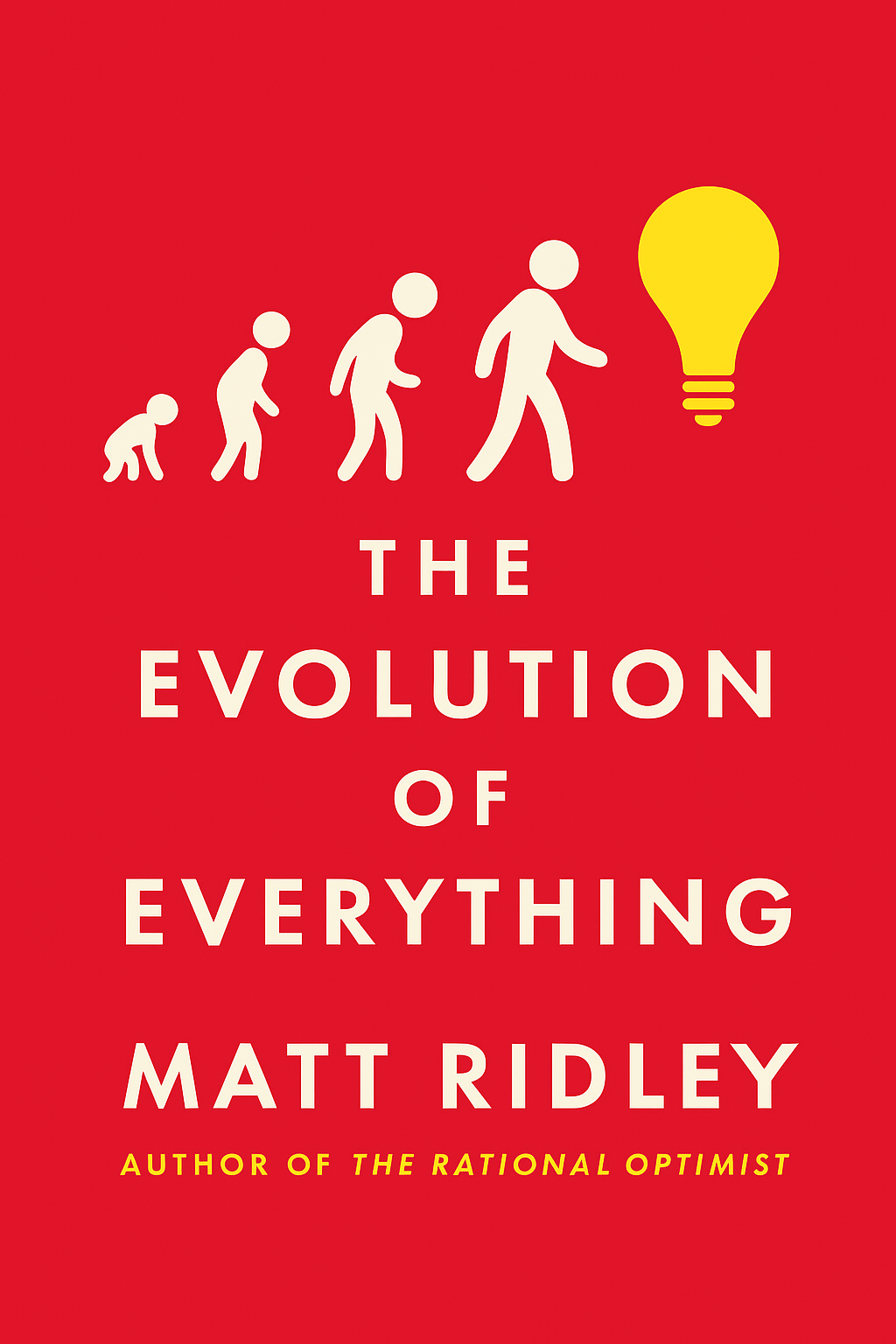
The Evolution of Everything
How New Ideas Emerge
Book Edition Details
Summary
Ideas don't always start at the top; sometimes, they bubble up from the depths of collective human endeavor. In "The Evolution of Everything," Matt Ridley challenges the notion that innovation and progress are the domains of the powerful few. Instead, Ridley paints a vivid tapestry where chaos breeds creativity and complexity arises from simplicity. Through fascinating stories from science, history, and culture, he dismantles the myth of the grand designer. Much like birds unwittingly sculpting perfect formations in the sky, societies, technologies, and even moralities emerge organically, guided by the invisible hand of evolution. Ridley's provocative narrative invites you to reconsider the forces that truly shape our world, revealing a universe propelled not by top-down dictates but by the myriad voices rising from below.
Introduction
Picture this: in ancient Rome, a poet named Lucretius penned verses that would challenge the very foundations of how we understand change and progress. He dared to suggest that everything in the universe, from the smallest atoms to the grandest civilizations, emerges not from divine design but from countless small interactions and natural processes. This radical idea would lie dormant for centuries, only to resurface and reshape our understanding of morality, economics, technology, and human society itself. This sweeping historical narrative reveals how the most profound transformations in human civilization have occurred not through grand plans or heroic interventions, but through the accumulated power of spontaneous, bottom-up processes. From the evolution of language and law to the emergence of markets and the internet, we discover that order and progress arise naturally when individuals are free to interact, experiment, and adapt. The exploration challenges our instinctive belief that complex systems require central control, showing instead how evolutionary principles operate across every domain of human experience. Whether you're a student of history, a business leader, or simply someone curious about how the world really works, this historical journey offers a fresh lens for understanding both past and present. It's particularly valuable for those who suspect that the conventional wisdom about progress and change might be missing something fundamental about the nature of human advancement and the eternal tension between designed control and emergent order.
Ancient Origins: From Lucretius to Enlightenment Foundations (Ancient-1800)
The intellectual revolution that would eventually transform Western civilization began in the most unlikely place: a Roman poet's meditation on the nature of reality. Lucretius, writing in the first century BC, proposed something scandalous for his time. In his masterwork "De Rerum Natura," he argued that everything in existence emerged from the random collision and combination of invisible particles, requiring no divine intervention or master plan. This was evolutionary thinking two millennia before Darwin, describing how nature experiments ceaselessly and those creatures that can adapt and reproduce will thrive while others perish. For centuries, this dangerous idea remained buried, suppressed by a Christian worldview that demanded purpose and design in all things. The Church recognized the threat these concepts posed to religious authority and systematically suppressed such thinking. Medieval scholars occasionally stumbled upon fragments of Lucretian thought, but it wasn't until 1417 that a papal secretary named Poggio Bracciolini discovered a complete manuscript in a German monastery. The rediscovery of this ancient text would prove to be one of history's most consequential moments, helping to spark the Renaissance as thinkers like Galileo and Newton began seeking natural rather than supernatural explanations for the world's complexity. The Renaissance thinkers who encountered Lucretius found themselves confronting a radically different way of understanding change and progress. Instead of seeing history as the unfolding of divine will or the implementation of human plans, they began to glimpse how complex order could emerge from simple rules and countless small interactions. This insight would eventually influence everyone from Newton to Adam Smith, though each would add their own crucial insights to the emerging picture. By the Enlightenment, these ideas had begun to coalesce into a new understanding of human society itself. David Hume challenged the argument from design in biology, while Adam Smith showed how moral sentiments could emerge from human interaction rather than divine command. Thinkers like Adam Ferguson recognized that our most cherished institutions, from language to law, were "the result of human action, but not of human design." This profound insight would set the stage for revolutionary new approaches to understanding morality, economics, and social organization, challenging the age-old assumption that order requires a central organizing intelligence.
Industrial Revolution and the Planning Paradox (1800-1950)
The nineteenth century witnessed an extraordinary paradox that would shape the modern world. Just as the principles of spontaneous order were demonstrating their power through the Industrial Revolution and expanding global trade, a counter-revolution of planning and control was gathering dangerous momentum. The very success of bottom-up processes seemed to inspire a misguided confidence that human intelligence could improve upon them through deliberate design and centralized management. This period saw the emergence of what we might call "creationist" thinking in human affairs. From Prussian educational systems designed to produce obedient soldiers to the rise of eugenics movements that sought to engineer human breeding, the nineteenth and early twentieth centuries became intoxicated with the possibilities of top-down control. Even Charles Darwin's insights about natural selection were twisted into prescriptive programs, as followers like Francis Galton argued that "what nature does blindly, slowly, and ruthlessly, man may do providently, quickly and kindly." This represented a fundamental misunderstanding of how evolutionary processes actually work. The consequences of this planning mentality proved catastrophic across multiple domains. The same intellectual framework that produced seemingly benign social reforms also gave birth to some of history's darkest chapters. The eugenics movement, embraced by progressives and conservatives alike, led directly to forced sterilizations, immigration restrictions, and ultimately to the Nazi genocide. Meanwhile, economic planning, whether socialist or fascist in orientation, consistently produced stagnation and suffering wherever it was implemented, from the Soviet Union's chronic shortages to China's Great Leap Forward famine. Perhaps most tragically, this era saw the systematic suppression of the very spontaneous processes that had created unprecedented prosperity and progress. Free trade gave way to protectionism, competitive markets to cartels and monopolies, and individual liberty to state control. By 1950, the world had witnessed two devastating wars, multiple economic collapses, and the rise of totalitarian regimes that claimed the power to remake human nature itself. The lesson was becoming clear: when human beings attempt to replace evolutionary processes with conscious design, the results are typically disastrous, yet this lesson would take decades more to fully sink in.
Digital Renaissance: Spontaneous Order Triumphant (1950-Present)
The second half of the twentieth century marked a remarkable renaissance of evolutionary thinking, though it took decades for the implications to become fully apparent. The development of computers and digital networks created new laboratories for observing how complex systems could emerge without central control, while advances in genetics and neuroscience revealed the spontaneous processes underlying life and consciousness themselves. The discovery of DNA's digital code showed how information could be stored, copied, and modified through purely natural processes, providing an even more powerful framework for understanding complexity without design. The internet stands as perhaps the most powerful demonstration of evolutionary principles in human history. Nobody planned this global network of networks; it emerged from countless individual decisions and innovations by researchers, entrepreneurs, and users around the world, creating a system more complex and capable than any centralized alternative could have achieved. From email to social media to the sharing economy, each new development arose through the same process of variation, selection, and adaptation that governs biological evolution, with ideas competing, surviving, and reproducing in ways their inventors never imagined. Simultaneously, the collapse of centrally planned economies provided a stark natural experiment in the superiority of spontaneous order over conscious design. The Soviet Union, despite its vast resources and intelligent planners, could not match the innovative power and adaptive capacity of market economies. China's transformation began only when it abandoned central planning in favor of allowing bottom-up entrepreneurship and experimentation. Countries that allowed markets to function, cities to grow organically, and institutions to adapt gradually consistently outperformed those that relied on central planning. Yet even as these lessons became undeniable, new forms of planning and control continued to emerge. Climate change policies, financial regulations, and educational reforms often reflected the same top-down mentality that had failed so spectacularly in previous eras. The challenge for the twenty-first century lies in learning to distinguish between those problems that require conscious intervention and those that are best solved through evolutionary processes. The digital revolution has given us powerful new tools for enabling spontaneous order, but only if we have the wisdom to create conditions that allow beneficial innovations to emerge and spread rather than trying to design perfect solutions in advance.
Summary
Throughout human history, a fundamental tension has shaped our civilizations: the eternal conflict between those who believe in conscious design and control, and those who trust in the power of spontaneous, evolutionary processes. Time and again, we see that the most beneficial and enduring changes in human society emerge not from grand plans or heroic leadership, but from the accumulated effects of countless individual choices and innovations. This pattern appears consistently across every domain, from the development of language and cities to the emergence of moral systems and technological breakthroughs. This historical perspective offers profound lessons for our contemporary challenges. Rather than seeking comprehensive solutions imposed from above, we should focus on creating conditions that allow beneficial innovations to emerge and spread naturally. This means protecting individual freedom, maintaining competitive markets, and resisting the persistent temptation to replace complex evolutionary processes with simplified bureaucratic systems. The most effective reforms are often those that remove obstacles to spontaneous cooperation rather than those that attempt to direct it through central planning. Perhaps most importantly, this long view of history suggests a fundamental humility about human knowledge and planning capacity. The complexity of modern society far exceeds any individual's or institution's ability to comprehend and control. Our role should be that of gardeners rather than engineers, creating fertile conditions for growth rather than attempting to construct predetermined outcomes. In an age of rapid technological change and global interconnection, this evolutionary approach may be not just preferable but essential for human flourishing. The future, like the past, will likely emerge through the spontaneous coordination of countless individuals pursuing their own goals, creating outcomes that no one could have planned but everyone can benefit from.
Related Books
Download PDF & EPUB
To save this Black List summary for later, download the free PDF and EPUB. You can print it out, or read offline at your convenience.
By Matt Ridley
