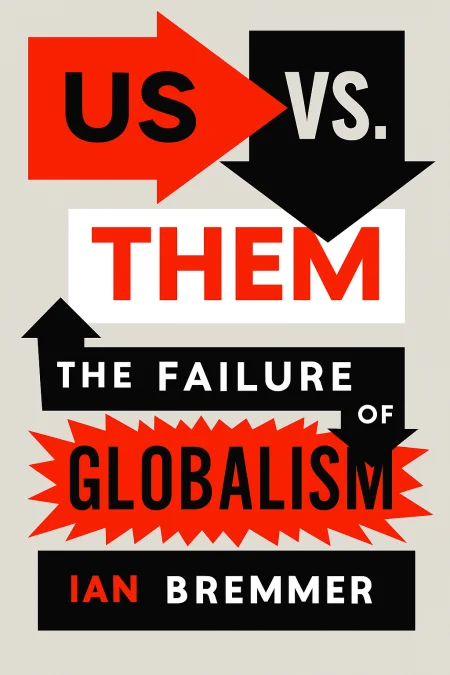
Us vs. Them
The Failure of Globalism
Book Edition Details
Summary
In a world teetering on the edge of ideological upheaval, Ian Bremmer's "Us vs. Them" dissects the seismic shifts shaking global politics. Once, globalization's siren call promised prosperity for all, but reality birthed a chasm between the haves and the have-nots. Across continents, disenfranchised voices rise, championing populist leaders who vow to dismantle the status quo. Bremmer expertly navigates this turbulent landscape, spotlighting the brewing storms in emerging nations where citizens, emboldened yet disillusioned, confront their governments. From Brazil’s civil unrest to China’s tightening grip on dissent, this provocative analysis unveils the undercurrents of fear and division. It’s a compelling wake-up call, urging us to grapple with the forces redrawing our world’s political map before the tide becomes irreversible.
Introduction
In the quiet streets of Chelsea, Massachusetts, a young boy gazed across at Boston's gleaming towers, wondering how someone like him could bridge that seemingly impossible gap. Years later, that same boy would find himself among the global elite, yet watching as the very system that lifted him began to crumble under the weight of its own contradictions. This is not merely a story about economics or politics, but about the fundamental tension between those who have benefited from our interconnected world and those who feel left behind by it. The promise of globalization was simple: open borders, free trade, and shared prosperity would lift all boats. Yet as we stand at this crossroads of history, we see walls rising instead of bridges, anger replacing hope, and societies fracturing along lines that seem to deepen with each passing year. From the Brexit vote to Trump's election, from protests in Brazil to unrest in Turkey, the same pattern emerges everywhere. People are choosing sides, and the center is not holding. This exploration reveals how technological change, economic disruption, and cultural anxiety have created a perfect storm that challenges the very foundations of democratic societies. It offers a roadmap for understanding why populist movements have gained such traction and what alternatives exist beyond building higher walls. For policymakers, business leaders, and engaged citizens seeking to understand our fractured moment, this analysis provides both sobering diagnosis and hope for renewal.
Winners and Losers: The Globalist Divide
The great promise of globalization rested on a simple belief that economic interdependence would create shared prosperity. As goods, services, capital, and people flowed more freely across borders, the theory suggested that everyone would eventually benefit. For decades, this seemed to hold true. Hundreds of millions were lifted from poverty in developing nations, while consumers in wealthy countries enjoyed access to cheaper goods and services. Yet this grand bargain contained the seeds of its own destruction. While globalization created unprecedented wealth, it distributed that wealth unevenly, leaving entire communities and regions behind. The factory worker in Ohio who lost his job to automation or offshoring experienced globalization very differently than the tech entrepreneur in Silicon Valley or the financial analyst in London. What the winners saw as creative destruction, the losers experienced as personal catastrophe. The financial crisis of 2008 exposed the fragility of this system and the hollowness of its promises. As banks received bailouts while workers faced foreclosure, public trust in institutions began to erode. The Occupy Wall Street movement and Tea Party represented early tremors of a deeper earthquake to come. People began to question not just specific policies, but the entire framework of globalized capitalism and the elites who championed it. This growing divide was not merely economic but cultural. The urban, educated professionals who thrived in the global economy often held cosmopolitan values that celebrated diversity and change. Meanwhile, those in declining industrial towns or rural areas felt their traditional ways of life under assault. Immigration, which economists praised for its efficiency gains, was experienced by many as a threat to jobs and cultural identity. The stage was set for a political reckoning.
Warning Signs: Developing World Unrest
While attention focused on populist movements in wealthy democracies, similar tensions were building across the developing world with potentially more explosive consequences. The Arab Spring offered an early glimpse of how quickly public frustration could boil over into mass protest and regime change. What began with a fruit vendor in Tunisia sparked uprisings across an entire region, toppling governments and reshaping the political landscape. These eruptions were not isolated incidents but symptoms of a broader pattern. In Brazil, protests over bus fare increases revealed deeper anger about corruption and inequality. Turkish demonstrations that started over plans to develop a park expanded into nationwide challenges to authoritarian governance. From Ethiopia to Russia, from China to South Africa, governments faced growing pressure from citizens who demanded better services, greater accountability, and real opportunities for advancement. The forces driving unrest in the developing world mirror those in wealthy nations but with higher stakes. Rapid economic growth created new middle classes with rising expectations, yet many found themselves shut out of the benefits of development. Corruption remained endemic, infrastructure lagged behind needs, and environmental degradation threatened public health. Perhaps most dangerously, a youth bulge meant millions of young people were entering job markets that could not absorb them. Technology accelerated these dynamics by making inequality more visible and protest easier to organize. Social media allowed people to see how others lived and to coordinate collective action in ways that authoritarian governments struggled to control. The same digital revolution that enabled economic growth also empowered political mobilization, creating new challenges for stability that would only intensify in the years ahead.
Walls vs. New Deals: Alternative Responses
As societies grappled with rising inequality and political fragmentation, two distinct paths emerged for addressing these challenges. The first involved building walls, both literal and metaphorical, to protect insiders from outsiders and maintain existing power structures. The second required fundamental rethinking of the social contract between citizens and government, creating new forms of cooperation and shared prosperity. The wall-building approach proved politically attractive because it offered simple solutions to complex problems. Physical barriers at borders, restrictions on trade, limitations on immigration, and controls on information flow all promised to restore a sense of security and control. Countries like Hungary built fences to keep out migrants, while others imposed tariffs to protect domestic industries. Digital walls emerged as governments censored the internet and restricted data flows across borders. Yet walls often created new problems while failing to solve underlying issues. Trade barriers raised prices for consumers while protecting inefficient industries. Immigration restrictions did little to address the automation that was eliminating many jobs. Information controls might limit criticism of government but also stifled innovation and economic growth. Most fundamentally, walls divided societies rather than healing them, creating us-versus-them dynamics that made cooperation more difficult. The alternative path required much more ambitious reforms but offered greater potential for sustainable solutions. Some countries began experimenting with universal basic income to provide security in an age of economic uncertainty. Others invested heavily in education and retraining programs to help workers adapt to technological change. New models of public-private partnership emerged to address infrastructure needs and provide essential services. The key insight was that globalization's benefits could be preserved while its costs were more fairly shared, but only through deliberate policy choices and social solidarity.
Summary
The central tragedy of our era lies in the gap between globalization's promise of shared prosperity and its reality of growing division. What began as a system designed to lift all boats has instead created a world where the wealthy sail in luxury yachts while others struggle to stay afloat in leaking dinghies. This fundamental contradiction has fueled the rise of populist movements worldwide and threatens the stability of democratic institutions that took centuries to build. The choice facing societies today is not between globalization and isolation, but between building walls that divide us or creating new deals that unite us around shared purposes. History teaches us that periods of rapid economic and technological change require corresponding social and political adaptation. The societies that thrive will be those that find ways to harness the benefits of interconnection while addressing its discontents through reformed institutions and renewed social contracts. The path forward demands both individual reflection and collective action. Citizens must resist the temptation to retreat into tribal identities and instead seek common ground with those who seem different. Leaders must move beyond short-term political calculations to address long-term challenges with courage and vision. Most importantly, we must remember that the future is not predetermined. The choices we make today will determine whether the next chapter of human history is written in the language of division or cooperation, fear or hope.
Related Books
Download PDF & EPUB
To save this Black List summary for later, download the free PDF and EPUB. You can print it out, or read offline at your convenience.
By Ian Bremmer
