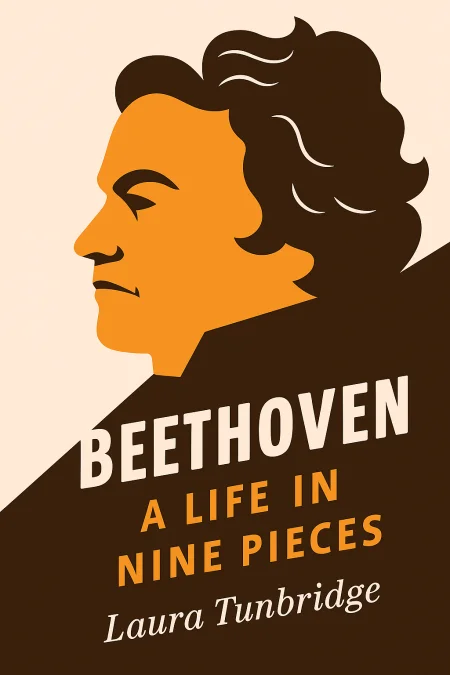
Beethoven
A Life in Nine Pieces
Book Edition Details
Summary
To the world, Beethoven often emerges as the quintessential solitary genius, his image etched as a storm of wild hair and intense concentration. Yet, Laura Tunbridge's biography, crafted in honor of his 250th birthday, reveals a man far more intertwined with his era and the people within it. Here, Beethoven's story unfolds through nine pivotal compositions, each a window into his complex humanity. Far from the isolated savant, we meet a composer who navigates social currents, cherishes bonds, and deftly maneuvers the business of music. Tunbridge’s narrative dismantles the myth of the tortured artist, unveiling instead a vibrant figure who thrived amidst the vivid tapestry of his time, redefining how we understand his enduring legacy.
Introduction
In the winter of 1808, Vienna's Theater an der Wien witnessed one of music history's most extraordinary concerts. For over four hours, Ludwig van Beethoven presented a program featuring the premieres of his Fifth and Sixth Symphonies, his Fourth Piano Concerto, and the Choral Fantasy. The audience, shivering in the unheated theater, experienced music that would forever change how we understand artistic expression and human emotion. This was Beethoven at his most ambitious, a composer who refused to accept the limitations of his time and instead forged a new musical language that spoke directly to the human soul. Beethoven lived through one of Europe's most turbulent periods, witnessing the French Revolution, the Napoleonic Wars, and the reshaping of an entire continent. Yet his personal struggles—progressive deafness, failed romances, family disputes, and social isolation—proved equally transformative to his art. From these challenges emerged a composer who elevated music from mere entertainment to profound philosophical statement, creating works that continue to move audiences more than two centuries later. Through Beethoven's remarkable journey, we discover how artistic genius emerges not despite adversity but often because of it. His story reveals the power of unwavering dedication to one's craft, the courage to innovate when convention feels insufficient, and the profound human capacity to transform personal suffering into universal beauty. In examining his life, we encounter not just a musical revolutionary, but a model for how creative individuals can reshape their fields while remaining true to their deepest convictions.
Early Success and Musical Innovation in Vienna
Beethoven's arrival in Vienna in 1792 marked the beginning of a career that would revolutionize classical music. The young composer from Bonn quickly established himself in the city's aristocratic salons, where his improvisational skills at the piano left audiences spellbound. Unlike the polite, predictable performances they were accustomed to, Beethoven brought raw emotional power and spontaneous creativity that seemed to channel something beyond mere technical proficiency. His early works, particularly the Piano Sonatas and String Quartets of the 1790s, demonstrated a composer willing to push boundaries while respecting classical forms. The famous "Pathétique" Sonata revealed his gift for dramatic contrast and emotional depth, while his First Symphony showed he could honor the traditions of Haydn and Mozart while adding his own distinctive voice. These compositions established Beethoven as more than just another talented musician—they announced the arrival of an artist with something urgent to say. The success of works like the Septet in E-flat major proved Beethoven's ability to connect with both connoisseurs and general audiences. This charming piece, with its memorable melodies and skillful orchestration, became one of his most popular works during his lifetime. Yet even in these early successes, we can detect the restless spirit that would drive Beethoven to constantly evolve his musical language. By 1800, Beethoven had secured his reputation as Vienna's most exciting young composer. His concerts drew enthusiastic crowds, his compositions were eagerly sought by publishers, and aristocratic patrons competed for his attention. However, this early success came with a price—the growing awareness of his hearing loss, which would soon force him to confront the possibility that his career as a performer might be ending just as his creative powers were reaching their peak.
Heroic Period: Triumph Through Personal Adversity
The years between 1803 and 1812 witnessed Beethoven's transformation from a gifted composer into a musical revolutionary. This period, often called his "heroic" phase, produced some of the most influential works in classical music history, including the "Eroica" Symphony, the "Emperor" Concerto, and the opera "Fidelio." These compositions reflected not just artistic maturity but a fundamental shift in how music could express human experience and social ideals. The "Eroica" Symphony marked a turning point both in Beethoven's career and in the history of symphonic music. Originally dedicated to Napoleon Bonaparte, whom Beethoven initially admired as a champion of democratic ideals, the work stretched the symphony far beyond its traditional boundaries. Its unprecedented length, emotional scope, and structural innovations announced that instrumental music could carry the weight of philosophical and political ideas. When Napoleon crowned himself Emperor, Beethoven famously scratched out the dedication, but the symphony's heroic character remained, celebrating the triumph of human will over adversity. During this period, Beethoven's personal struggles with deafness paradoxically fueled his creative breakthrough. The famous "Heiligenstadt Testament," a letter to his brothers that he never sent, revealed his contemplation of suicide as his hearing deteriorated. Yet from this crisis emerged a renewed commitment to his art and a determination to create music that would outlast his physical limitations. His Fifth Symphony, with its famous opening motif representing "fate knocking at the door," became a testament to the human capacity to overcome seemingly insurmountable obstacles. The opera "Fidelio" demonstrated Beethoven's engagement with the political ideals of his time, telling the story of a woman who rescues her husband from political imprisonment. Though it struggled initially to find its audience, the work embodied Beethoven's belief in freedom, justice, and the power of love to triumph over tyranny. These themes would resonate throughout his career, establishing him not just as a composer but as a voice for human dignity and liberation.
Late Masterworks: Transcendence Despite Physical Isolation
Beethoven's final years were marked by increasing isolation and physical suffering, yet they produced some of his most profound and innovative compositions. As his deafness became complete and his health deteriorated, he withdrew from public performance and focused entirely on composition. The late piano sonatas, string quartets, and the monumental "Missa Solemnis" represent music of unprecedented spiritual depth and technical complexity. The custody battle over his nephew Karl consumed much of Beethoven's emotional energy during this period, revealing both his capacity for fierce devotion and his sometimes destructive need for control. His relationship with Karl was complicated by his own childhood trauma and his desperate desire to create the loving family he had never experienced. When Karl attempted suicide in 1826, Beethoven was forced to confront the limitations of his ability to shape others' lives, even as he continued to reshape the musical world. The late string quartets, composed between 1824 and 1826, pushed musical expression into previously unexplored territories. These works, initially dismissed by many contemporaries as the products of a deaf man's imagination run wild, are now recognized as among the greatest achievements in chamber music. They demonstrate Beethoven's willingness to sacrifice immediate comprehensibility for deeper truth, creating music that seems to exist outside normal temporal boundaries. The "Missa Solemnis," Beethoven's setting of the Catholic Mass, represented his most ambitious attempt to reconcile his personal spiritual beliefs with traditional religious forms. Drawing on his study of Bach and Handel while incorporating his own revolutionary harmonic language, the work created a new model for sacred music that was both deeply personal and universally meaningful. These late works established Beethoven as a composer whose vision extended far beyond his own time, creating music for future generations to discover and understand.
Legacy: The Enduring Impact of Artistic Courage
Beethoven's death in 1827 marked the end of an era, but his influence on music and culture was just beginning. His funeral in Vienna drew thousands of mourners, including fellow composer Franz Schubert, who recognized that a giant had passed from their midst. The works Beethoven left behind would reshape not only how music was composed but how it was understood, performed, and experienced by audiences around the world. The Romantic composers who followed—Brahms, Wagner, Mahler, and countless others—all grappled with Beethoven's legacy, either building upon his innovations or deliberately reacting against them. His expansion of musical forms, his integration of personal expression with universal themes, and his elevation of the composer from craftsman to artist-prophet became foundational principles of 19th-century music. Even today, his influence can be heard in film scores, popular music, and contemporary classical composition. Beyond music, Beethoven became a symbol of artistic integrity and the triumph of creative spirit over physical limitation. His image as the tortured genius who transformed personal suffering into transcendent art has inspired countless artists across all disciplines. His famous declaration that "what is difficult is also beautiful, good, great" continues to challenge creators to push beyond comfortable boundaries in pursuit of deeper truth. Perhaps most significantly, Beethoven democratized serious music, creating works that could speak to both sophisticated listeners and general audiences. His belief that music should serve humanity rather than merely entertain the elite established a model for socially conscious artistry that resonates strongly in our contemporary world. Through his life and work, Beethoven proved that individual artistic vision, when pursued with unwavering dedication and courage, can indeed change the world.
Summary
Ludwig van Beethoven's greatest legacy lies not merely in the beautiful music he created, but in his demonstration that artistic vision, pursued with absolute integrity and courage, can transcend any limitation and speak to the deepest aspects of human experience. His journey from a talented young pianist to a revolutionary composer who reshaped an entire art form offers profound lessons about the transformative power of dedication, the necessity of innovation, and the courage required to remain true to one's creative vision even when the world seems indifferent or hostile. From Beethoven's example, we learn that our greatest challenges often become the source of our most meaningful contributions, and that true artistic achievement requires not just technical skill but the willingness to risk failure in pursuit of something genuinely new and important. His life reminds us that the most enduring works of human creativity emerge not from comfort and ease, but from the struggle to express what seems inexpressible and to reach beyond the limitations of our circumstances. For anyone seeking to make a lasting impact in their chosen field, Beethoven's unwavering commitment to his artistic vision, despite deafness, social isolation, and personal turmoil, stands as an enduring testament to the power of human creativity and determination.
Related Books
Download PDF & EPUB
To save this Black List summary for later, download the free PDF and EPUB. You can print it out, or read offline at your convenience.

By Laura Tunbridge
