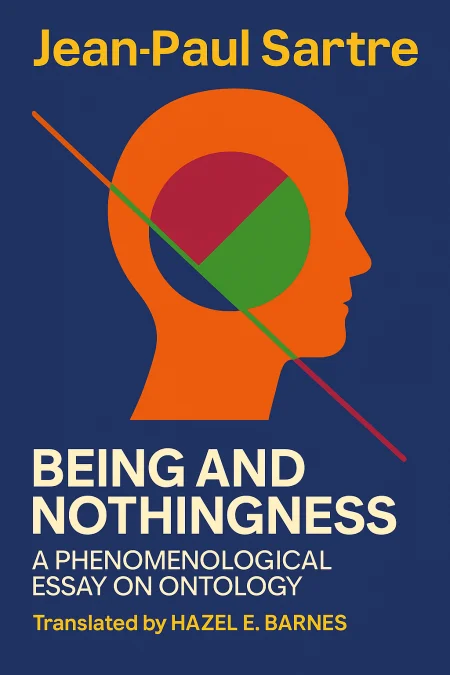
Being and Nothingness
A Phenomenological Essay on Ontology
byJean-Paul Sartre, Hazel E. Barnes
Book Edition Details
Summary
In the labyrinth of human consciousness, Jean-Paul Sartre’s "Being and Nothingness" invites readers to confront the raw, unfiltered essence of existence. Written in the tumultuous era of 1943, this philosophical titan unravels the tensions between freedom and determinism, and the dance of objectivity with subjectivity. Sartre challenges us to peer into the void, questioning the very fabric of our choices and identities. With existential psychoanalysis as its backbone, this groundbreaking work peels back the layers of what it means to truly "be." It’s a cerebral exploration that demands introspection, poised to ignite the minds of those willing to grapple with life's profound complexities.
Introduction
What does it mean to exist as a conscious being in a world that seems fundamentally indifferent to our presence? This profound question drives us to examine the very nature of human reality and its relationship to existence itself. The philosophical framework presented here offers a revolutionary understanding of consciousness not as a thing or substance, but as a dynamic process of negation and transcendence that fundamentally distinguishes human beings from objects in the world. Through rigorous phenomenological investigation, this work establishes a comprehensive theory of human existence characterized by freedom, responsibility, and the perpetual creation of meaning in an apparently meaningless universe. The analysis addresses three core theoretical problems that define the human condition: the nature of consciousness as a temporal, self-questioning structure that introduces nothingness into being; the complex dynamics of human relationships where we encounter others as both subjects and objects; and the paradoxical relationship between absolute freedom and concrete factual constraints that shape every human situation. These insights provide a systematic framework for understanding authenticity, bad faith, and the ongoing project of self-creation that constitutes human existence.
The Problem of Nothingness and Bad Faith
Nothingness emerges not as mere absence but as an active force that consciousness introduces into the world through its capacity to question, doubt, and imagine alternatives to what exists. Unlike objects that simply are what they are with complete self-identity, human consciousness operates through negation, constantly defining itself by what it is not and creating distance between itself and immediate circumstances. This nihilating power manifests in our ability to ask "What if things were different?" or to experience the haunting presence of someone we expected to meet but who fails to arrive. The structure of nothingness operates through three interconnected mechanisms that reveal consciousness as fundamentally different from material existence. Through interrogation, every question implies the possibility of a negative response, introducing non-being into our relationship with reality. Through temporal awareness, consciousness exists as perpetual flight from past toward future, creating absence at the heart of present experience. Through the phenomenon of absence itself, missing objects or people can organize our entire perception, demonstrating how nothingness actively shapes lived experience rather than simply representing lack. Bad faith emerges as a primary strategy for escaping the anxiety that accompanies this radical freedom to negate and transcend circumstances. When individuals pretend they have no choice in their actions, claiming determination by roles, circumstances, or fixed nature, they engage in self-deception that provides temporary relief from the burden of choice. Consider the waiter who completely identifies with his role, moving with exaggerated precision as if he were nothing more than a waiter-thing, denying his freedom to choose different possibilities. This performance serves to escape the dizzying recognition that identity is not given but must be constantly created through choices and actions. The recognition of bad faith becomes crucial for authentic existence because it reveals how extensively we participate in creating our own limitations while opening possibilities for genuine self-creation through honest acknowledgment of freedom. Understanding these dynamics helps explain why human existence feels fundamentally unstable compared to the solid existence of things, while pointing toward more authentic ways of embracing the responsibility that comes with radical freedom.
Being-for-itself and Temporal Structure of Consciousness
Human consciousness exists as being-for-itself, a unique mode of existence characterized by self-awareness and the fundamental inability to achieve complete self-coincidence. Unlike a rock that simply is what it is without question or doubt, consciousness exists as a perpetual relationship to itself, always aware of its own awareness yet never able to grasp itself as a finished object. This creates an essential instability at the heart of human existence, where we are condemned to be free precisely because we cannot achieve the solid, unchanging identity of material things. The temporal structure of consciousness reveals itself through three interconnected dimensions that form the foundation of human existence. The past exists as facticity, representing what we have been and providing the weight of accumulated experience, yet it gains meaning only through present projects toward future possibilities. The present manifests as pure flight, a nihilating activity that separates us from both past and future while creating the space where freedom actualizes itself through choice. The future contains our possibilities, the projects toward which we constantly transcend ourselves, giving direction and meaning to present action while remaining fundamentally open and undetermined. These temporal dimensions work together to create consciousness as essentially historical, always existing in tension between inherited circumstances and projected possibilities. Consider how we experience making a significant life decision, such as choosing a career path. The past provides accumulated experiences and skills that inform our choice, yet we cannot simply repeat what has been. The present moment of decision feels urgent and immediate, yet exists only as a bridge between what was and what might be. The future beckons with possibilities that simultaneously attract and intimidate us, representing potential selves we might become through our choices. This temporal structure explains why human beings experience anxiety in ways that objects cannot, revealing the groundless nature of human choice and the responsibility that comes with radical freedom. Understanding being-for-itself helps us recognize why authentic existence requires accepting uncertainty and embracing the ongoing project of self-creation rather than seeking refuge in fixed identities or predetermined roles.
Being-for-others and Intersubjective Relations
The encounter with other conscious beings introduces a fundamental dimension of existence that transforms our relationship to ourselves and reveals aspects of our being that remain invisible to solitary reflection. When we recognize another person as a conscious subject rather than merely an object, we discover that we ourselves exist as an object for their consciousness, creating the complex phenomenon of being-for-others where part of our being escapes our direct control and exists in the realm of another's perception and judgment. The dynamics of interpersonal relations operate through the fundamental experience of "the look," which serves as the primary revelation of other minds. When we feel the gaze of another person upon us, our entire relationship to ourselves undergoes radical transformation as we discover ourselves simultaneously as subjects experiencing the world and as objects within another's experience. This creates patterns of conflict, seduction, and attempts at possession that characterize much of human social life, as each consciousness seeks to maintain its subjectivity while inevitably becoming an object for others. The phenomenon manifests clearly in experiences of shame, pride, or anxiety under the observation of others. Consider being caught in an embarrassing act, such as eavesdropping at a keyhole. The sudden awareness of being observed transforms our entire relationship to our action and ourselves, creating shame not just for the specific behavior but for our existence as an object in another's world. This everyday example reveals how intersubjectivity fundamentally shapes human existence, introducing dimensions of meaning and evaluation that we cannot fully control or predict. Love represents one attempt to resolve the fundamental tension of being-for-others by seeking to possess another's freedom while maintaining our own, yet this project reveals its own contradictions as it seeks to transform the other's free subjectivity into a possession. Understanding these intersubjective dynamics helps explain the complexity of human relationships and the ongoing challenge of maintaining authentic selfhood while engaging meaningfully with others who possess equal claims to freedom and recognition.
Freedom, Facticity and the Human Situation
Human freedom operates not as abstract possibility but always within concrete situations that both limit and enable our choices, creating what can be understood as the fundamental structure of the human condition. We are free, but we are free within the constraints of our historical moment, cultural background, physical embodiment, and relationships with others. These constraints do not eliminate freedom but rather provide the context and raw material from which we create our projects and define ourselves through action. The concept of situation reveals that freedom and limitation are not opposed but interdependent aspects of human existence. A person born into poverty faces different possibilities than someone born into wealth, but both confront the fundamental task of choosing what to make of their circumstances. The constraints of situation do not determine our choices but rather establish the framework within which freedom operates, providing both obstacles to overcome and resources to utilize in the ongoing project of self-creation. This understanding of situated freedom carries profound implications for how we comprehend responsibility and authenticity in human existence. We cannot choose our initial circumstances, including our family background, historical period, or physical characteristics, but we bear complete responsibility for what we make of these given conditions. The person who blames failures entirely on background circumstances engages in bad faith by denying their freedom to transcend limitations, while the person who ignores real constraints engages in equally problematic self-deception. Authentic existence requires acknowledging both our radical freedom and the concrete limitations within which that freedom operates, accepting full responsibility for our choices while recognizing that these choices always occur within situations we did not entirely create. Consider how individuals respond differently to similar challenging circumstances, such as economic hardship or physical disability. Some allow circumstances to define their possibilities, while others use constraints as springboards for creative solutions and personal growth. Understanding this paradoxical relationship between freedom and facticity provides tools for approaching life with both courage and realism, recognizing that we are the authors of our existence within the complex web of relationships and situations that constitute human reality.
Summary
Human existence reveals itself as fundamentally characterized by the paradox of being condemned to be free in a world that provides no predetermined essence or meaning, forever creating ourselves through choices while bearing absolute responsibility for who we become. This existential framework illuminates how consciousness, temporality, and human relationships constitute the essential structures through which we navigate the burden and dignity of existence, offering profound insights into authenticity, responsibility, and the ongoing human project of self-creation. The implications extend far beyond academic philosophy to provide practical wisdom for approaching modern life with greater awareness and intentionality, recognizing that while we may be thrown into existence without choosing our initial circumstances, we possess the remarkable capacity and inescapable responsibility to define ourselves through our responses to the situations we encounter.
Related Books
Download PDF & EPUB
To save this Black List summary for later, download the free PDF and EPUB. You can print it out, or read offline at your convenience.
By Jean-Paul Sartre
