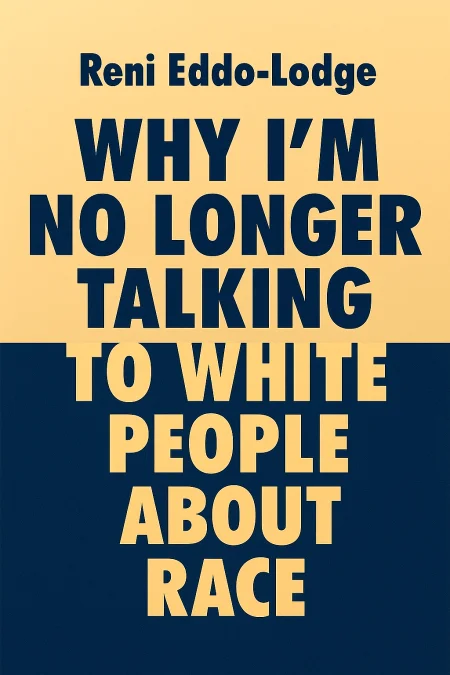
Why I'm No Longer Talking to White People About Race
Understand racism and white privilege
Book Edition Details
Summary
Reni Eddo-Lodge's pivotal work confronts the deep-rooted conversations about race that often bypass those most affected by it. Born from her viral blog post, "Why I'm No Longer Talking to White People About Race" challenges the prevailing narratives, offering a fresh lens on Britain's racial dynamics. Eddo-Lodge delves into the erased chapters of black history, the intertwining of class and race, and the exclusionary nature of mainstream feminism. With incisive clarity, she dismantles the constructs of white dominance, urging readers to engage in meaningful dialogue. This book is not just a critique; it's an invitation to acknowledge, understand, and actively address racism, making it an essential read for anyone committed to fostering genuine equality.
Introduction
The complexities of racial discourse in contemporary Britain reveal themselves through persistent communication gaps, defensive reactions, and systematic avoidance of uncomfortable truths. Rather than examining race as an abstract concept, this exploration delves into the concrete mechanisms through which racial inequality perpetuates itself within British society. The analysis moves beyond individual prejudices to examine structural systems that maintain racial hierarchies while appearing neutral or colorblind. The approach centers on empirical evidence drawn from historical records, statistical analysis, and lived experiences to challenge prevailing narratives about British racial harmony. Through careful documentation of institutional practices, policy outcomes, and cultural patterns, the investigation reveals how seemingly progressive attitudes often mask deeper structural inequalities. The methodology involves tracing connections between historical legacies and contemporary disparities, examining how past injustices continue to shape present realities through institutional memory and systemic bias. This examination requires confronting the discomfort that arises when questioning fundamental assumptions about fairness, meritocracy, and national identity. The analytical framework demands sustained attention to evidence that contradicts comfortable narratives, while maintaining rigorous standards for distinguishing between correlation and causation in complex social phenomena.
The Historical Foundations of Structural Racism in Britain
British racial inequality cannot be understood without examining its historical foundations, particularly the centuries-long involvement in slavery and colonialism that shaped both economic structures and cultural attitudes. The transatlantic slave trade operated as a systematic business enterprise from 1562 to 1833, generating enormous wealth that became embedded in British institutions, families, and infrastructure. This 271-year period established economic relationships and social hierarchies that outlasted formal abolition. The wealth generated through enslaved labor extended far beyond plantation owners to encompass insurance companies, banks, shipping firms, and countless individuals who purchased shares in slave-trading ventures. When slavery was abolished in 1833, the British government paid £20 million in compensation to slave owners for their financial losses, while providing nothing to the enslaved people themselves. This compensation scheme, equivalent to billions in today's currency, represented one of the largest government expenditures of the 19th century and was only fully paid off by British taxpayers in 2015. Post-war immigration policies reveal how historical attitudes persisted into the modern era. Despite actively recruiting labor from Commonwealth countries to rebuild after World War II, Britain quickly implemented restrictions when immigrant communities became visible and established. The Commonwealth Immigrants Act of 1962 transformed former "citizens" into "immigrants," while race riots in cities like Nottingham and Notting Hill in 1958 demonstrated violent resistance to racial integration. The pattern of official response to racial violence consistently prioritized maintaining social order over addressing underlying injustices. Rather than confronting the causes of anti-immigrant hostility, authorities typically implemented repatriation schemes and tighter immigration controls. This established a template where racial minorities bear responsibility for the racism directed against them, while broader society avoids examining its own role in perpetuating discriminatory attitudes and structures.
White Privilege and the Mechanisms of Racial Inequality
White privilege operates as an absence of racial barriers rather than the presence of special advantages, making it difficult to recognize for those who benefit from it. This privilege manifests in countless daily interactions where white people navigate institutions, social situations, and professional environments without their race being viewed as problematic or requiring explanation. The cumulative effect of these small advantages creates vastly different life trajectories based on racial identity. Statistical evidence demonstrates how racial disparities compound throughout the life course. Black schoolchildren face exclusion rates three times higher than the general population, while experiencing systematic undergrading by teachers that disappears when papers are marked anonymously. In higher education, black students are less likely to gain admission to prestigious Russell Group universities and more likely to receive lower degree classifications despite similar entry qualifications. Employment discrimination persists across all skill levels, with research showing that applicants with "white-sounding" names receive significantly more interview invitations than those with African or Asian names, even when qualifications are identical. The pay gap actually widens with higher qualifications, with university-educated black graduates earning 23% less than their white counterparts. This contradicts narratives about education serving as an equalizer and reveals how discrimination intensifies at higher levels of achievement. The criminal justice system demonstrates perhaps the starkest disparities, with black people twice as likely to be charged for drug possession despite lower usage rates, and five times more likely to receive formal charges rather than cautions. The National DNA Database contains profiles of approximately 30% of black men compared to 10% of white men, creating a presumption of criminality that follows black communities throughout their interactions with state institutions.
Intersectionality and the Limits of White Feminism
The concept of intersectionality reveals how multiple forms of oppression interact to create unique experiences that cannot be understood by examining race or gender in isolation. Black women face discrimination that differs qualitatively from both the racism experienced by black men and the sexism experienced by white women. This intersection creates specific vulnerabilities and challenges that mainstream feminism often fails to address or acknowledge. White feminism's resistance to intersectional analysis mirrors broader patterns of racial exclusion within progressive movements. When feminists who were women of color attempted to introduce discussions of race into feminist spaces, they encountered defensive reactions, accusations of divisiveness, and claims that such discussions were too academic or jargon-heavy for ordinary women. This resistance protected white feminist spaces from having to examine their own racial privilege or consider how their advocacy might exclude women of color. The backlash against intersectionality extended beyond feminist circles to influence mainstream political discourse, with right-wing commentators adopting the same arguments initially made by white feminists. This evolution demonstrates how resistance to racial analysis can migrate across political boundaries when it serves to protect existing power structures. The characterization of intersectionality as unnecessarily complex or divisive serves to maintain systems that benefit from simplified analyses that ignore racial dynamics. Contemporary discussions of issues like sexual violence often reveal these intersectional blind spots. When sexual assault is framed primarily through the lens of foreign cultural practices, it obscures the prevalence of sexual violence within mainstream British society while reinforcing racist stereotypes. Similarly, campaigns against objectification that focus primarily on representations of white women may inadvertently reinforce hierarchies that position white women as more deserving of protection or respect than women of color.
Moving Beyond Individual Solutions to Systemic Change
Structural racism cannot be dismantled through individual attitude changes or colorblind approaches that ignore racial dynamics. The evidence demonstrates that racial disparities persist across all major institutions regardless of the personal beliefs of individuals within those institutions. This suggests that the problem lies in systemic processes, organizational cultures, and institutional practices rather than simply personal prejudice. Positive discrimination measures face intense resistance precisely because they threaten to disrupt established patterns of racial advantage. Opposition to quotas and diversity targets typically invokes meritocracy arguments that assume current hiring and promotion practices already select the best candidates. This assumption ignores overwhelming evidence of racial bias in recruitment, evaluation, and advancement processes across virtually all professional sectors. The language of "end points" and "post-racial" society serves to avoid sustained engagement with structural change by promising that racial justice is either imminent or already achieved. These narratives function to discourage the long-term commitment required for meaningful institutional transformation. They also place the burden of racial reconciliation on those affected by racism rather than those who benefit from racial privilege. Effective anti-racist work requires recognizing that racism is fundamentally a white problem that requires white people to examine and transform the institutions and cultures they control. This involves moving beyond performative gestures toward sustained engagement with uncomfortable truths about how racial advantage operates. It demands understanding that true equality will require redistributing power and resources rather than simply adding diversity to existing structures. The work is necessarily long-term and will require multiple generations to complete, but avoiding this reality only perpetuates the systems that create racial inequality in the first place.
Summary
The analysis reveals that British racism operates through sophisticated structural mechanisms that maintain racial hierarchies while appearing neutral or progressive. These systems prove remarkably resilient because they adapt to changing social norms while preserving underlying power relationships. The evidence demonstrates that racial inequality cannot be explained by individual failings or cultural differences, but rather results from institutional processes that consistently advantage white people while disadvantaging racial minorities across all areas of social life. Understanding these dynamics requires abandoning comfortable narratives about British fairness and confronting the reality that racial justice will require fundamental changes to how institutions operate and resources are distributed. This work demands sustained commitment from those who benefit from current arrangements, moving beyond guilt or defensiveness toward active participation in creating genuinely equitable systems.
Related Books
Download PDF & EPUB
To save this Black List summary for later, download the free PDF and EPUB. You can print it out, or read offline at your convenience.
By Reni Eddo-Lodge
