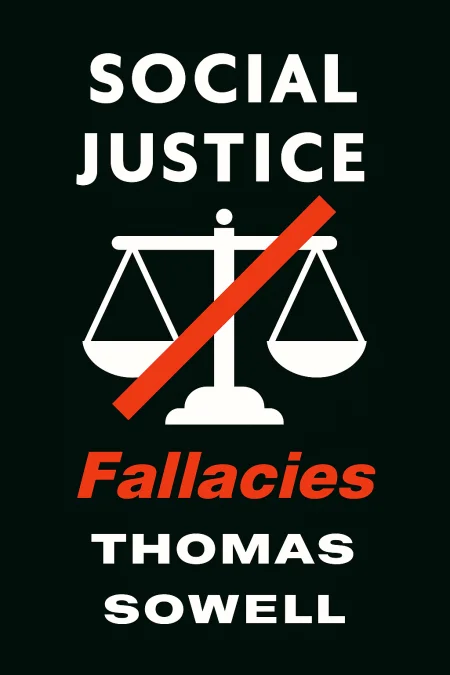
Social Justice Fallacies
A Thought-Provoking Challenge to Modern Social Justice Narratives
Book Edition Details
Summary
In the whirlwind of modern ideological battles, renowned economist Thomas Sowell presents a provocative challenge in "Social Justice Fallacies." This instant bestseller cuts through the noise to dissect the often unquestioned narratives driving the social justice movement. Sowell deftly exposes the chasm between well-intentioned beliefs and the hard-edged truths they sometimes ignore. With a sharp lens on history's lessons, he invites readers to reconsider the true cost of pursuing justice without factual rigor. As he navigates through the maze of myths, Sowell warns of the perilous road paved by unyielding conviction. This book is a call to pause, reflect, and question: Are we hurtling towards progress or peril?
Introduction
Contemporary discussions about social justice often rest on a fundamental assumption that unequal outcomes between different groups automatically indicate unfair treatment or systemic discrimination. This perspective treats statistical disparities as self-evident proof of injustice, leading to policy prescriptions aimed at equalizing results across racial, ethnic, and economic lines. However, this assumption deserves rigorous examination through empirical evidence and logical analysis rather than emotional appeals or moral proclamations. The central challenge to prevailing social justice thinking lies in demonstrating that equal outcomes would be the natural state of affairs absent discrimination or exploitation. This requires examining whether different groups have genuinely equal capabilities, circumstances, and preferences across all endeavors, or whether the observable disparities reflect the complex interplay of geography, culture, historical development, individual choices, and countless other factors that shape human societies. By scrutinizing the logical foundations and empirical claims underlying social justice arguments, we can distinguish between genuine instances of unfair treatment and the natural variations that characterize human societies throughout history and across the globe.
The Equal Chances Fallacy and Statistical Disparities
The fundamental premise underlying much social justice advocacy assumes that all groups would naturally achieve proportional representation in various endeavors if not for discriminatory barriers. This assumption treats statistical disparities as automatic evidence of unfair treatment, yet empirical examination reveals a strikingly different pattern throughout human history and across contemporary societies. No society, anywhere in the world or at any point in recorded history, has achieved the proportional demographic representation that social justice advocates use as their baseline for measuring fairness. Even highly successful groups typically excel in some areas while being underrepresented in others. Asian Americans dominate certain academic fields but remain rare among professional athletes, while different ethnic groups show pronounced clustering in specific sports, occupations, and geographic regions. These patterns persist even when discrimination cannot plausibly explain the disparities. American-born descendants of different European populations show vastly different outcomes in various endeavors, despite sharing the same legal system and educational opportunities. The children of immigrants from specific villages often concentrate in particular neighborhoods and occupations, following chains of personal connections and specialized knowledge that have nothing to do with bias or discrimination. Geographic and environmental factors alone create enormous differences in human development and opportunity. Coastal regions with natural harbors have historically developed more complex economies than landlocked areas. Temperate zones with fertile soil support larger populations and more urbanization than tropical or arctic regions. These geographic advantages and disadvantages compound over generations, creating disparities that persist long after the original environmental constraints have been overcome through technology and trade.
Knowledge Distribution and Surrogate Decision-Making Failures
The social justice vision implicitly assumes that intellectual elites possess sufficient knowledge to design and implement policies that will produce more equitable outcomes than would emerge from the voluntary interactions of millions of individuals. This assumption fundamentally misunderstands both the nature of knowledge and its distribution throughout society. Consequential knowledge exists in countless fragments scattered among individuals, often in forms that cannot be easily articulated or transferred. A parent knows intimate details about their child's needs and capabilities that no outside expert could possibly possess. Local businesspeople understand market conditions and customer preferences that distant policymakers cannot access. Workers know practical details about their jobs and industries that academic theorists have never encountered. When surrogate decision-makers preempt individual choices in the name of helping disadvantaged groups, they consistently produce counterproductive results. Minimum wage laws, intended to help low-income workers, systematically price inexperienced young people out of the job market. Housing regulations designed to improve living standards for the poor often reduce the supply of affordable housing. Educational policies meant to benefit minority students frequently harm their prospects by mismatching them with institutions where they are likely to struggle and fail. The track record of expert intervention reveals a pattern of unintended consequences that stem from the impossibility of centralizing the vast amount of local, specific, and often tacit knowledge required to coordinate complex social and economic activities. Well-intentioned policies consistently founder on the reality that no individual or institution can possess the comprehensive understanding of circumstances and preferences that would be necessary to improve upon the outcomes generated by voluntary individual decisions.
Merit, Racism, and Policy Consequences Examined
The concept of merit in social justice discussions conflates two distinct issues: the factual question of which individuals possess capabilities relevant to specific endeavors, and the moral question of whether those capabilities were fairly acquired. This confusion obscures the practical consequences of different approaches to selection and evaluation. While some people undoubtedly benefit from advantages they did nothing to earn, these "unmerited" advantages often benefit not just their possessors but society as a whole. When airlines hire the most skilled pilots available, regardless of how those pilots acquired their expertise, all passengers benefit from increased safety. When businesses employ the most productive workers they can find, consumers benefit from better products and lower prices. Demographic representation may satisfy ideological preferences, but it typically comes at the cost of reduced performance in the activities that matter to the supposed beneficiaries. The empirical evidence on policies designed to combat racism reveals a troubling pattern of harm to the very groups they purport to help. Affirmative action in college admissions systematically places minority students in academic environments where they are likely to struggle, leading to higher dropout rates and lower graduation rates in demanding fields like science and engineering. When these policies are eliminated, overall minority graduation rates typically increase as students attend institutions better matched to their preparation levels. Similarly, the historical record shows that the most dramatic progress for disadvantaged minorities occurred during periods when they faced the greatest legal discrimination but also the fewest well-intentioned interventions. Black Americans experienced their most rapid economic advancement in the decades before the civil rights era, when they relied primarily on their own efforts and institutions rather than on government programs or activist organizations.
Visions, Vocabularies, and the Dangers of Dogmatic Reform
The social justice worldview represents more than a set of policy preferences; it embodies a fundamental vision of how societies should be organized and how human differences should be understood. This vision assumes that disparities in outcomes reflect disparities in treatment, that expert knowledge should override individual choice, and that government power can be safely expanded to achieve egalitarian goals. Historical experience provides sobering evidence about the dangers of implementing such visions with insufficient attention to practical constraints and unintended consequences. The twentieth century witnessed numerous attempts to create more equal societies through expanded government control, often initiated by sincere intellectuals and activists pursuing noble ideals. The consistent result was not greater equality but rather the concentration of power in the hands of political elites who proved no more virtuous or competent than the systems they replaced. The vocabulary of social justice itself shapes thinking in ways that obscure rather than illuminate important distinctions. Terms like "social justice," "equality," and "fairness" carry such powerful emotional resonances that they discourage critical examination of the assumptions underlying their use. When "racism" becomes an explanation for any statistical disparity, it becomes impossible to investigate the actual causes of different outcomes or to evaluate whether proposed remedies will help or harm their intended beneficiaries. The ultimate tragedy of dogmatic social justice advocacy lies not in its good intentions but in its systematic displacement of approaches that have actually succeeded in improving conditions for disadvantaged groups. By attributing all disparities to discrimination and all progress to government intervention, this worldview obscures the historical record of how people have actually escaped poverty and achieved upward mobility through their own efforts, mutual aid, and voluntary institutions.
Summary
The most profound insight emerging from this analysis concerns the danger of substituting ideological certainty for empirical investigation when addressing complex social phenomena. Statistical disparities between groups, rather than automatically indicating unfair treatment, typically reflect the countless factors that make equal outcomes virtually impossible to achieve or maintain across different populations with different histories, cultures, geographic circumstances, and individual preferences. The consistent failure of policies based on assumptions of group equality suggests that human societies are far too complex to be successfully reorganized according to abstract theoretical principles, regardless of how appealing those principles may appear to their advocates.
Related Books
Download PDF & EPUB
To save this Black List summary for later, download the free PDF and EPUB. You can print it out, or read offline at your convenience.
By Thomas Sowell
