
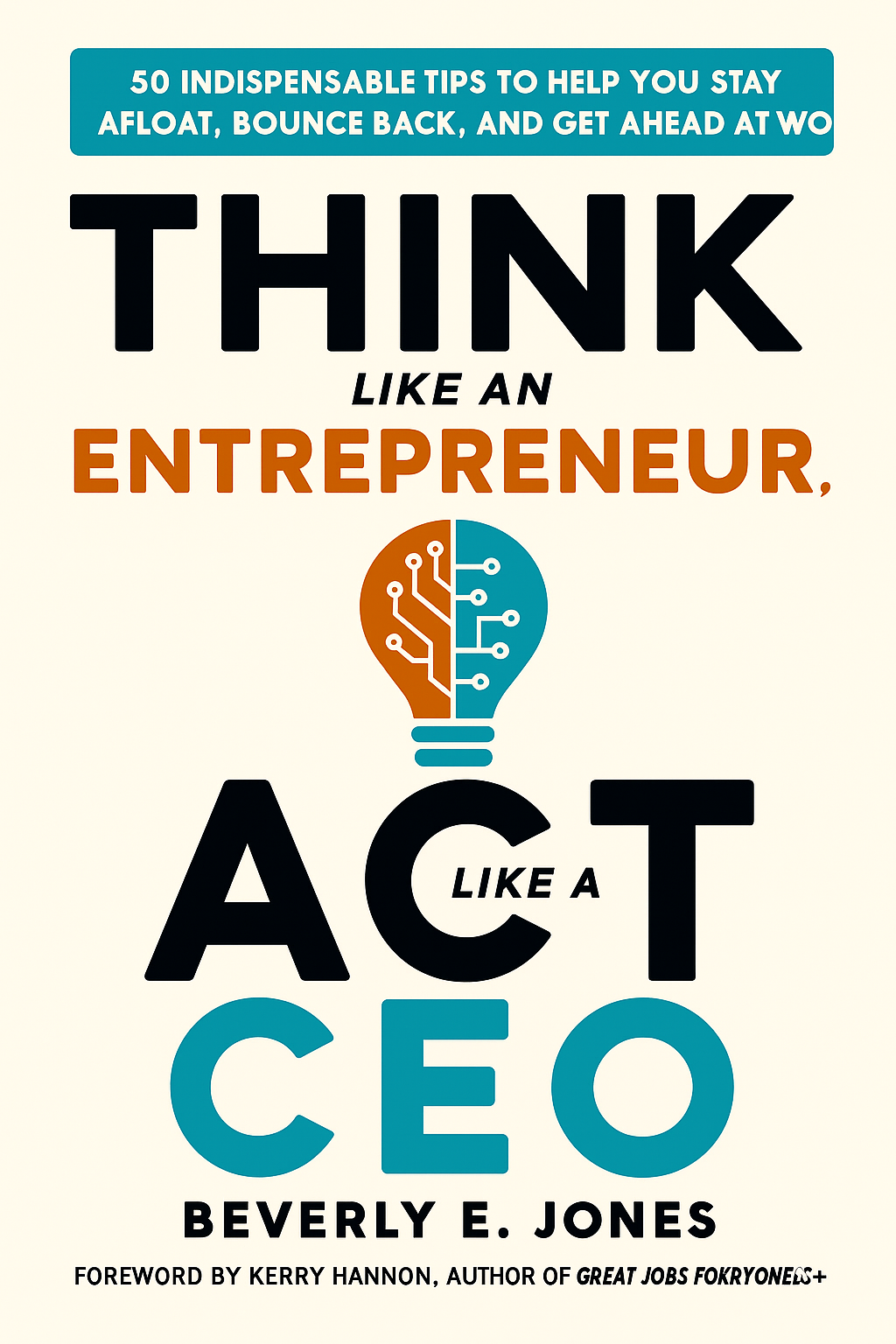
Think Like an Entrepreneur, Act Like a CEO
50 Indispensable Tips to Help You Stay Afloat, Bounce Back, and Get Ahead at Work
Book Edition Details
Summary
In the ever-shifting landscape of modern careers, where old certainties have crumbled, resilience and adaptability reign supreme. "Think Like an Entrepreneur, Act Like a CEO" by Beverly E. Jones serves as your essential guide to navigating the chaos with poise and confidence. Through captivating real-life narratives, Jones reveals the secret to mastering career upheavals: embrace change with entrepreneurial savvy and executive finesse. From transitioning between jobs with elegance to bouncing back from stress and setbacks, this book offers a treasure trove of strategies for thriving in unpredictability. It’s not just about managing the common challenges but conquering the unexpected ones, equipping you with the tools to transform every surprise into an opportunity.
Introduction
In today's rapidly evolving professional landscape, the traditional career path of climbing a single organizational ladder has become obsolete. We're living in an era where adaptability trumps loyalty, where resilience matters more than tenure, and where your ability to reinvent yourself determines your success more than your current job title. The modern professional faces unprecedented challenges: constant technological change, organizational restructuring, economic uncertainty, and the need to continuously prove their value in an increasingly competitive marketplace. Yet within these challenges lies extraordinary opportunity for those who learn to think differently about their careers. The key is developing an entrepreneurial mindset while cultivating the executive skills needed to lead, regardless of your position on the organizational chart. This transformation isn't just about survival; it's about thriving in a world where the only constant is change itself.
Build Your Entrepreneurial Mindset and Leadership Brand
An entrepreneurial mindset begins with a fundamental shift in perspective. Instead of viewing yourself as an employee dependent on others for direction, you must see yourself as the CEO of your own career. This means taking complete ownership of your professional trajectory, understanding that no one else will manage your success for you. Entrepreneurs are inherently goal-oriented, passionate about their work, and constantly seeking ways to add value to their customers' lives. Consider the story of Sally, a talented project manager who was repeatedly passed over for promotions despite her excellent technical skills. Her colleagues described her as "a flake" because she allowed her personal interests in fantasy conventions to overshadow her professional capabilities. Sally's quirky fashion choices and endless chatter about her hobbies created a brand that undermined her competence. When she finally recognized this disconnect, Sally embarked on a three-pronged transformation. She adopted a more mainstream professional appearance, developed expertise in cutting-edge technology, and began presenting herself as a leader in meetings and projects. The results were remarkable. Within months, Sally had completely transformed her professional brand. Her manager began describing her as someone who had "finally grown up," and she was soon assigned to a key project. Sally's story illustrates that entrepreneurial thinking requires you to view yourself as a product in the marketplace, constantly seeking ways to enhance your value proposition. To develop your entrepreneurial mindset, start by understanding your organization's mission and how your role supports it. Focus relentlessly on your customers, whether they're external clients or internal colleagues. Embrace failure as a learning opportunity rather than a career setback. Practice optimism by consciously reframing negative thoughts and focusing on solutions rather than problems. Most importantly, build your personal brand intentionally, ensuring that others perceive you as someone who delivers results, thinks strategically, and leads with integrity.
Master Communication, Networking and Workplace Skills
Effective communication forms the cornerstone of professional success, yet many talented individuals sabotage their careers through poor interpersonal skills. The most powerful communication tool you possess isn't your ability to speak eloquently but your capacity to listen deeply. When you truly listen to others, you meet their fundamental need to be heard and understood, creating connections that extend far beyond the immediate conversation. George, a successful team manager, found himself exhausted by constant battles to protect his high-performing team from other divisions trying to poach his staff. The stress was overwhelming until he reframed the situation as a strategic game rather than personal attacks. By viewing his colleagues as players in a complex game with their own objectives, George could step back from taking their actions personally and focus on his bigger goals. This shift in perspective transformed his stress into strategic thinking, making his work both more effective and more enjoyable. George's transformation demonstrates how communication extends beyond words to include emotional intelligence and relationship management. When you approach workplace interactions with curiosity rather than defensiveness, you create space for collaboration and mutual success. The key is understanding that everyone operates from their own set of goals and constraints, and most workplace conflicts stem from misalignment rather than malice. Master communicators also understand the power of positive feedback and authentic appreciation. Research shows that teams perform best in environments where approximately eighty percent of feedback is positive. This doesn't mean avoiding difficult conversations, but rather creating a foundation of trust and recognition that makes constructive criticism more effective. Practice giving specific, timely praise that reinforces the behaviors you want to see more of. Build your network systematically by being genuinely helpful to others, looking for ways to make introductions, share resources, and support colleagues' success. Remember that networking isn't about collecting business cards; it's about building meaningful relationships that provide mutual value over time.
Navigate Change with Resilience and Strategic Thinking
Change is the only constant in modern professional life, and your ability to navigate uncertainty with grace and strategic thinking will largely determine your long-term success. Resilience isn't an innate trait reserved for a lucky few; it's a skill that can be developed through practice and conscious choice. The most resilient professionals share a common characteristic: they focus on what they can control while accepting what they cannot. Andrea Wilkinson exemplifies this principle. Throughout her career in the pharmaceutical industry, she has successfully navigated multiple mergers, restructurings, and industry upheavals. Her secret isn't superhuman adaptability but rather a systematic approach to change management. Andrea consistently invests time in understanding her industry's broader trends, maintains extensive professional networks, and keeps herself financially prepared for transitions. When organizational change occurs, she doesn't take it personally but instead focuses on positioning herself for the new reality. Andrea's approach reveals the fundamental truth about resilience: it requires both mental flexibility and practical preparation. When facing uncertainty, resist the temptation to become paralyzed by worry or bitter about circumstances beyond your control. Instead, channel your energy into activities that strengthen your position regardless of how events unfold. This might mean developing new skills, expanding your network, building financial reserves, or simply maintaining your physical and emotional well-being during stressful periods. Strategic thinking during times of change involves accepting that discomfort is temporary while growth is permanent. Create your own change process using small, consistent actions that move you toward your goals even when the destination isn't entirely clear. Document your progress to maintain motivation and adjust your approach as new information becomes available. Most importantly, remember that your attitude toward change influences not only your own experience but also that of everyone around you. By modeling resilience and optimism, you become a valuable leader regardless of your official title.
Summary
The modern professional landscape demands a fundamental reimagining of how we approach our careers. Success no longer comes from climbing a single ladder within one organization but from developing the adaptability, resilience, and leadership skills needed to thrive in any environment. As the author wisely notes, "You can't predict where your career path will take you. But you can prepare for it." This preparation involves thinking like an entrepreneur about your professional development while acting like a CEO in your daily interactions and decisions. The most successful professionals take complete ownership of their careers, build meaningful relationships, communicate with authenticity and skill, and approach change as an opportunity for growth rather than a threat to avoid. Your journey toward professional fulfillment begins with a single decision: choosing to see yourself not as a passive employee but as the active architect of your own success. Start today by identifying one small action that aligns with your long-term vision, and commit to taking that step forward regardless of external circumstances.
Related Books
Download PDF & EPUB
To save this Black List summary for later, download the free PDF and EPUB. You can print it out, or read offline at your convenience.
By Beverly E. Jones
