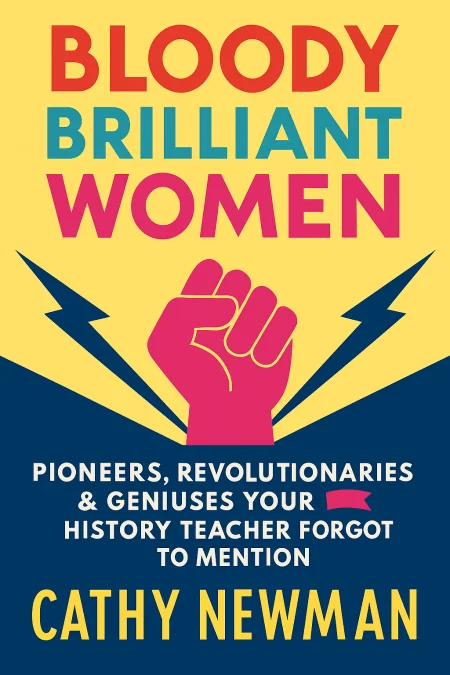
Bloody Brilliant Women
Pioneers, Revolutionaries, and Geniuses Your History Teacher Forgot to Mention
Book Edition Details
Summary
In the shadowy recesses of history, where men have long dominated the narrative, Cathy Newman illuminates the extraordinary legacies of Britain's unsung heroines. "Bloody Brilliant Women" isn't just a recounting of accomplishments; it's a vibrant tapestry woven from the courage and genius of women who challenged the status quo. With dynamic prose, Newman resurrects the stories of trailblazers who transformed medicine, politics, and engineering, yet remain largely unrecognized. From the daring journalist Dorothy Lawrence to the ingenious engineer Beatrice Shilling, these women defied convention and altered the course of history. Their stories, meticulously unearthed from diaries and letters, reflect a Britain forever changed by their resilience and vision. For readers seeking an electrifying and overdue celebration of female brilliance, this book serves as both revelation and tribute, acknowledging the powerful forces that shaped modern Britain.
Introduction
Picture a young woman in 1880s Britain, legally invisible upon marriage, barred from voting, and facing insurmountable barriers to professional life. Now imagine her great-granddaughter in 2017, perhaps serving as Prime Minister, leading a major corporation, or pioneering scientific research. The transformation between these two moments represents one of the most profound social revolutions in British history, yet it unfolded not through grand proclamations but through countless individual acts of courage, defiance, and determination. This remarkable journey reveals how ordinary women became extraordinary agents of change, challenging everything from voting rights to workplace equality, from reproductive freedom to political representation. Their struggles illuminate fundamental questions about democracy, power, and human dignity that extend far beyond gender issues. We discover how each generation built upon previous achievements while confronting new obstacles, creating a complex legacy of progress and setback that continues to shape contemporary debates. For anyone curious about the hidden forces that shaped modern Britain, fascinated by stories of social transformation, or seeking to understand how seemingly impossible change actually happens, these battles offer both inspiration and practical wisdom about the long, difficult work of creating a more just society.
Breaking Through: Suffrage and the New Woman (1880-1918)
The late Victorian era presented Britain with a fundamental contradiction that would prove impossible to sustain. The nation that prided itself on democratic values and individual liberty systematically excluded half its population from political participation. Women could neither vote nor hold office, faced severe restrictions on property ownership, and encountered nearly insurmountable barriers to higher education and professional careers. This glaring inconsistency between democratic ideals and social reality created the conditions for revolutionary change. The suffrage movement emerged from this tension, but it represented far more than a simple demand for voting rights. Women like Millicent Garrett Fawcett pursued constitutional methods through the National Union of Women's Suffrage Societies, believing that patient lobbying and moral persuasion would eventually triumph. Meanwhile, the Pankhurst family's Women's Social and Political Union embraced increasingly militant tactics, their motto "deeds, not words" reflecting growing impatience with gradual reform. These parallel approaches revealed different philosophies about how democratic change occurs and whether existing institutions could accommodate such fundamental transformation. The movement's true genius lay in its ability to unite women across traditional class boundaries. Middle-class suffragettes found common cause with working-class women facing exploitation in factories and sweatshops. The 1888 matchgirls' strike demonstrated how women's industrial action could capture public imagination and force concrete improvements in working conditions. These alliances revealed that women's oppression took different forms but shared common roots in legal and economic powerlessness. World War I became the great catalyst, pulling women into munitions factories, hospitals, and government offices in unprecedented numbers. Their contributions proved indispensable to the war effort, making it impossible to maintain the fiction that women lacked capacity for serious work or public responsibility. The partial franchise granted in 1918 represented not just recognition of wartime service, but acknowledgment of a transformed social reality that could no longer be ignored or reversed.
Between Wars: Progress and Resistance in Changing Times (1918-1945)
The interwar period brought both unprecedented opportunities and stubborn resistance to women's advancement. Having won partial suffrage and demonstrated their capabilities during wartime, women faced the complex challenge of translating political gains into broader social and economic transformation. What emerged was a period of remarkable contradictions, where legal progress coexisted with cultural backlash and new freedoms came with unexpected constraints. The 1920s witnessed the emergence of the "modern woman" who embraced shorter skirts, bobbed hair, and greater sexual freedom. Pioneers like Marie Stopes revolutionized discussions about sexuality and birth control, breaking Victorian silence around intimate relationships while advocating for women's reproductive autonomy. Her bestselling manual "Married Love" and network of birth control clinics offered working-class women unprecedented control over their fertility, though her eugenic beliefs revealed the darker currents within progressive thinking. Legislative advances during this period dismantled many formal barriers to women's participation in public life. The Sex Disqualification Removal Act opened professions previously barred to women, while changes to marriage and property law began eroding the legal doctrine of coverture that had rendered married women legally invisible. Women entered Parliament, the civil service, and professions like law and medicine in growing numbers, yet these gains often came with significant caveats including marriage bars that forced women to choose between career and family. The economic pressures of the Depression years highlighted women's continued vulnerability in the job market while simultaneously creating new opportunities for female leadership. Eleanor Rathbone's successful campaign for family allowances recognized that traditional male breadwinner families often couldn't survive on one income, challenging fundamental assumptions about economic dependency and family structures. As fascism rose across Europe and another world war approached, women found themselves once again called upon to serve their country in ways that would further transform social expectations and possibilities.
Post-War Transformations: Welfare, Rights and Revolution (1945-1981)
The creation of Britain's post-war welfare state promised security and opportunity for all citizens, yet its architects largely assumed women would remain primarily wives and mothers. The Beveridge Report, which laid the foundation for the National Health Service and social security system, explicitly treated married women as dependents rather than independent citizens, reflecting deep-seated assumptions about gender roles that would take decades to challenge effectively. Despite these institutional limitations, the post-war boom created expanding opportunities for women, particularly in growing sectors like education, healthcare, and the emerging service economy. The National Health Service opened up nursing and other medical careers, while the expansion of secondary education created unprecedented demand for female teachers. Consumer culture began reshaping domestic life with new appliances and convenience foods that potentially freed women from some traditional household burdens, though these changes often reinforced rather than challenged women's primary responsibility for home and family. The 1960s brought cultural revolution that challenged established norms about sexuality, marriage, and women's roles in society. The availability of the contraceptive pill gave women unprecedented control over their reproductive lives, while changing attitudes toward divorce and single motherhood began eroding the assumption that marriage was every woman's inevitable destiny. Writers like Germaine Greer articulated new feminist theories that questioned whether women had been conditioned to accept their own oppression. The 1970s witnessed an explosion of organized feminist activism that demanded not just legal equality but complete transformation of social relationships between men and women. Legislative victories came rapidly with the Equal Pay Act of 1970 and Sex Discrimination Act of 1975, while industrial disputes like the Ford Dagenham strike demonstrated working-class women's growing confidence in challenging workplace discrimination. By 1979, when Margaret Thatcher became Prime Minister, the landscape had shifted dramatically, though her own complex relationship with feminism would embody the contradictions of women's progress in the decades ahead.
Modern Battles: From Thatcher to Contemporary Feminism (1981-2017)
Margaret Thatcher's premiership embodied the profound contradictions of women's advancement in late twentieth-century Britain. As the nation's first female Prime Minister, she shattered the ultimate glass ceiling while simultaneously rejecting feminism and doing little to advance other women's careers. Her success seemed to validate the notion that individual determination could overcome any barrier, yet her policies often made life more difficult for working mothers and single parents who lacked her exceptional advantages and support systems. The 1980s and 1990s saw women making significant breakthroughs across business, media, and politics, though often at enormous personal cost. Female entrepreneurs built retail empires while politicians fought to put women's issues on the political agenda despite being dismissed as strident or shrill. The emergence of "ladette culture" in the 1990s raised complex questions about whether women's newfound freedom to behave badly represented genuine progress or simply a different kind of trap that reinforced rather than challenged sexist assumptions. New Labour's 1997 victory brought record numbers of women into Parliament, yet the "Blair's Babes" phenomenon revealed how female politicians continued to face unique scrutiny and stereotyping based on their appearance and personal lives rather than their political abilities. While policies like the minimum wage and tax credits helped working mothers, the government's often laddish culture frequently marginalized women's voices on key issues, demonstrating that numerical representation didn't automatically translate into substantive influence. The period concluded with growing recognition that formal legal equality hadn't eliminated deeper structural barriers to women's full participation in British society. The gender pay gap persisted despite decades of anti-discrimination legislation, while women remained significantly underrepresented in senior positions across most sectors. The rise of social media created new platforms for feminist activism and consciousness-raising but also enabled new forms of harassment and abuse that disproportionately targeted women. The journey toward genuine equality clearly had much further to go, requiring not just additional legal changes but fundamental shifts in cultural attitudes and institutional practices.
Summary
The central thread running through more than a century of British women's struggle for equality reveals a persistent tension between individual achievement and systemic barriers. Time and again, exceptional women proved their capabilities in extraordinary circumstances, only to see those gains rolled back when normal conditions returned. This pattern repeats across generations: suffragettes winning the vote but facing continued economic discrimination, wartime workers demonstrating essential contributions before being pushed back into domestic roles, and modern professionals breaking glass ceilings while confronting persistent pay gaps and underrepresentation in leadership positions. This historical record demonstrates that progress is neither inevitable nor permanent, requiring sustained collective action rather than relying solely on exceptional individual merit. The most successful advances occurred when women organized across class, racial, and political lines, connecting their struggles to broader movements for social justice and democratic reform. Legal equality proved insufficient without accompanying cultural transformation, while formal rights meant little without the economic independence and social support necessary to exercise them effectively. For contemporary readers, these stories offer both inspiration and practical wisdom about ongoing struggles for gender equality. First, recognize that current inequalities aren't natural or inevitable but the product of specific historical choices that can be challenged and changed. Second, understand that lasting transformation requires building coalitions and maintaining pressure over extended periods, not just achieving symbolic victories. Finally, remember that progress often comes in waves, with periods of advance followed by backlash, requiring each generation to defend previous gains while pushing for new ones. The difficult women of British history remind us that ordinary people can achieve extraordinary change when they refuse to accept the limitations others impose upon them.
Related Books
Download PDF & EPUB
To save this Black List summary for later, download the free PDF and EPUB. You can print it out, or read offline at your convenience.
By Cathy Newman
