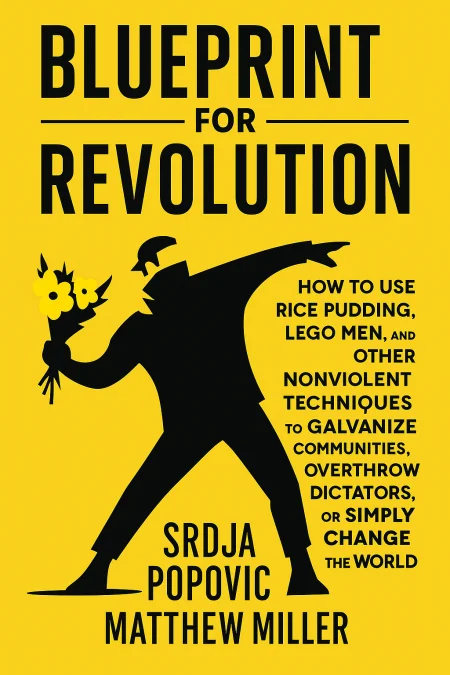
Blueprint for Revolution
How to Use Rice Pudding, Lego Men, and Other Non-Violent Techniques to Galvanize Communities, Overthrow Dictators or Simply Change the World
bySrdja Popovic, Matthew Miller
Book Edition Details
Summary
In a world where laughter can topple tyrants and wit outshines weaponry, "Blueprint for Revolution" stands as your indispensable guide to peaceful protest. This electrifying manifesto empowers activists, dreamers, and change-makers to outsmart oppression with creativity and resolve. Discover how to transform an opponent's strength into their downfall, and shift the power dynamics by targeting the bedrock of authority. With a blend of humor and strategic brilliance, author Srdja Popovic offers a toolkit for uniting diverse groups under a shared vision, crafting compromises, and converting adversaries into allies. Brimming with real-world triumphs, from the fall of Hosni Mubarak to the Cedar Revolution, this book is both a call to arms and a reminder that the path to justice can be paved with joy.
Introduction
When ordinary people face extraordinary oppression, how do they fight back without becoming the very thing they oppose? This fundamental question has shaped some of history's most pivotal moments, from the streets of Belgrade to the squares of Cairo, from the salt marches of Gandhi to the lunch counters of the American South. The power of nonviolent resistance lies not in its moral superiority alone, but in its proven effectiveness at toppling dictatorships, dismantling systems of injustice, and creating lasting democratic change. This exploration reveals how movements succeed when they master the art of strategic nonviolence - understanding that humor can defeat fear, that unity trumps division, and that careful planning often matters more than passionate idealism. Through the experiences of activists who brought down some of the world's most entrenched autocrats, we discover that the most powerful weapon against tyranny is not violence, but the organized withdrawal of a people's consent to be governed by force. These lessons speak to anyone who has ever wondered whether one person can truly make a difference, whether in the face of global authoritarianism or local injustice. The stories and strategies contained here offer both hope and practical wisdom for those ready to challenge the status quo.
From Local Resistance to Global Movement (1990s-2000s)
The collapse of the Berlin Wall in 1989 marked more than the end of communism in Eastern Europe - it signaled the beginning of a new era of people-powered revolutions. In the 1990s and 2000s, a generation of activists discovered they could topple dictators not through armed rebellion, but through coordinated campaigns of civil disobedience, creative protest, and strategic nonviolent resistance. Serbia became the laboratory for this new form of revolution. In 1998, a group of university students formed Otpor, meaning "resistance," to challenge Slobodan Milošević's brutal regime. Armed with nothing more than spray paint, humor, and an unshakeable belief in their cause, they covered Belgrade with their distinctive clenched-fist logo and began organizing what would become one of history's most successful nonviolent campaigns. Their secret weapon was not ideology but fun - they made resistance cool, turning arrests into badges of honor and police brutality into public relations disasters for the regime. The Serbian model proved infectious. By the early 2000s, activists from Georgia to Ukraine, from the Maldives to Egypt, were studying Otpor's methods and adapting them to their own struggles. The Rose Revolution in Georgia, the Orange Revolution in Ukraine, and ultimately the Arab Spring all drew inspiration from the realization that laughter could defeat fear, that creative resistance could outmaneuver state violence, and that ordinary citizens possessed extraordinary power when they acted together. What made these movements truly revolutionary was not their goals, but their methods. They understood that in the age of global media and instant communication, oppression could backfire spectacularly when exposed to public scrutiny. A single act of police brutality, captured on camera and shared worldwide, could do more damage to a dictator than years of armed resistance.
Strategic Principles: Unity, Planning, and Discipline
The most successful nonviolent movements of the modern era succeeded not through spontaneous uprisings, but through careful adherence to three fundamental principles that form the holy trinity of people power: unity, planning, and nonviolent discipline. These weren't abstract ideals but practical necessities, learned through trial and error by activists who discovered that even the most passionate cause could fail without proper organization. Unity proved to be both the most important and most difficult principle to master. Successful movements learned to draw clear lines of division that placed as many people as possible on their side and as few as possible on the other. This required setting aside ideological purity in favor of broad coalitions united around achievable goals. The Egyptian revolutionaries who brought down Hosni Mubarak understood this instinctively, creating powerful symbols of religious unity when Christians protected Muslims at prayer and Muslims returned the favor on Sunday. Strategic planning distinguished successful movements from mere protests. Following military principles of inverse sequence planning, effective campaigns began with their ultimate goal and worked backward to identify every step needed to achieve it. This approach revealed that most movements failed not because their goals were wrong, but because they hadn't thought through how to reach them. The path to victory required understanding which battles could be won and which should be avoided, at least initially. Nonviolent discipline emerged as perhaps the most challenging requirement. Maintaining peaceful resistance in the face of violent oppression demanded both moral courage and tactical sophistication. Movements learned to train their members in nonviolent techniques, to identify and isolate potential provocateurs, and to turn each act of government violence into a public relations victory. When police arrested peaceful protesters, successful movements made heroes of those arrested and villains of those doing the arresting. These principles worked because they exploited a fundamental weakness in authoritarian rule: dictatorships depend on fear, but fear dissolves when people discover they can resist without becoming monsters themselves.
Making Oppression Backfire: Historical Lessons
Throughout history, the strongest weapon in the nonviolent arsenal has been the ability to make oppression backfire on those who practice it. This principle transforms the dictator's greatest strength - his capacity for violence - into his greatest weakness by exposing the moral bankruptcy of his rule and rallying public opinion against him. The mechanism of backfire operates on a simple psychological truth: people instinctively side with the underdog when the contest appears unfair. When armed police attack unarmed protesters, when powerful governments crush peaceful dissent, when uniformed soldiers fire on children and grandmothers, something fundamental shifts in public consciousness. The oppressor's violence, intended to demonstrate strength and deter resistance, instead reveals weakness and desperation while generating sympathy for the oppressed. Burma's Saffron Revolution in 2007 provided a textbook example of this dynamic. When the military junta opened fire on Buddhist monks - the most revered figures in Burmese society - they committed a tactical blunder of enormous proportions. The images of soldiers attacking holy men in their distinctive saffron robes created a moral crisis that undermined the regime's legitimacy both domestically and internationally. What began as an attempt to crush dissent became a catalyst for broader resistance. The key to making oppression backfire lies in preparation and documentation. Successful movements train their members to maintain nonviolent discipline even under extreme provocation, understanding that a single act of retaliation can shift public sympathy away from the protesters. They also ensure that government violence is captured, recorded, and disseminated as widely as possible, using modern technology to broadcast the regime's brutality to global audiences. This strategy works because it forces oppressive governments into lose-lose scenarios. If they ignore peaceful protest, the movement grows. If they respond with violence, they discredit themselves. The only winning move for dictators is not to play - but by that point, the movement has already achieved its goal of disrupting the normal order.
Finishing What You Started: Sustainable Change
The most dangerous moment in any nonviolent revolution comes not during the struggle itself, but in the immediate aftermath of apparent victory. History is littered with successful movements that toppled dictators only to watch their hard-won freedoms slip away through poor planning, internal divisions, or the machinations of more organized forces waiting in the wings. Egypt's experience after the fall of Hosni Mubarak illustrates this tragic pattern perfectly. The same young activists who had masterfully organized the occupation of Tahrir Square made the crucial error of declaring victory too early. Once Mubarak was gone, they went home, leaving the field to the Muslim Brotherhood and the military - the two most organized forces in Egyptian society. Within two years, Egypt had traded one form of authoritarianism for another, and then another. Successful movements understand that toppling a dictator is only the first step in a much longer process of democratic transformation. Real victory requires building new institutions, establishing the rule of law, and creating systems of accountability that prevent future authoritarianism. This unglamorous work of institution-building demands the same strategic thinking and organizational discipline that brought down the old regime, but it lacks the excitement and media attention of street protests. The Serbian experience offers a more positive model. After Milošević's fall, the activists who had led the revolution continued their work, monitoring the new government and holding it accountable to democratic principles. They understood that their goal wasn't just removing one bad leader, but creating a system that would prevent future bad leaders from consolidating power. Their persistence paid off - Serbia today, while imperfect, remains a functioning democracy more than two decades after the revolution. The lesson is clear: sustainable change requires movements to define victory carefully, maintain unity beyond the initial triumph, and commit to the long-term work of democratic consolidation. The revolution ends not when the dictator falls, but when democratic institutions are strong enough to survive without revolutionaries protecting them.
Summary
The history of nonviolent resistance reveals a profound truth about political power: it flows not from the barrel of a gun, but from the consent of the governed. When ordinary people discover they can withdraw that consent collectively and strategically, even the most entrenched dictatorships become vulnerable. The successful movements of the past three decades have proven that laughter defeats fear, that unity trumps division, and that creative resistance can outmaneuver state violence. Yet this history also carries sobering lessons about the fragility of democratic gains and the importance of finishing what you start. Too many movements have discovered that toppling a tyrant is easier than building a democracy, that unity in opposition is simpler than unity in governance, and that the skills needed for revolution differ from those required for democratic consolidation. For today's activists facing authoritarianism's global resurgence, these historical lessons offer both inspiration and practical guidance. Success requires patient preparation, strategic thinking, and the wisdom to choose battles that can be won. Most importantly, it demands understanding that sustainable change comes not from a single dramatic confrontation, but from the slow work of building movements that can outlast any individual leader or moment. The arc of history may bend toward justice, but only when enough people are willing to do the bending.
Related Books
Download PDF & EPUB
To save this Black List summary for later, download the free PDF and EPUB. You can print it out, or read offline at your convenience.
By Srdja Popovic
