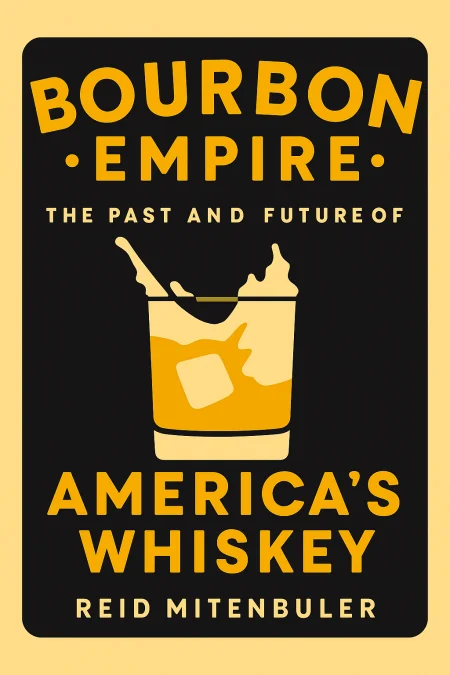
Bourbon Empire
The Past and Future of America's Whiskey
Book Edition Details
Summary
From the fiery heart of rebellion to the polished corridors of power, "Bourbon Empire" spills the untold story of America's cherished whiskey. Reid Mitenbuler's lively narrative dances through time, unmasking the mystique of bourbon's storied past. This isn't just a drink; it's a mirror reflecting the nation's soul, shaped by the gritty hands of pioneers and the slick moves of Madison Avenue moguls. Uncover how this spirited elixir weathered Prohibition's chill and triumphed over scandalous plots, carving its legacy into the American ethos. For those captivated by the alchemy of history and innovation, this book offers an intoxicating blend of insight and allure, painting bourbon as both a symbol of tradition and a beacon of cultural renaissance.
Introduction
In 1964, a handful of congressmen found themselves debating whether to declare bourbon a distinctive American product. Behind this seemingly patriotic gesture lurked a more complex reality: the resolution was actually pushed by Lewis Rosenstiel, head of one of the largest liquor companies in the world, who needed to move massive whiskey surpluses into overseas markets. This moment perfectly captures bourbon's true nature—a spirit that embodies American capitalism in all its contradictory glory. This journey through bourbon's evolution reveals how individual entrepreneurship gave way to corporate consolidation, what role government regulation played in shaping entire industries, and how we reconcile romantic myths with complex realities. The spirit's recipe was determined by westward migration patterns, its flavor perfected by scientific innovation, and its reputation forged through political lobbying and marketing genius. From colonial corn farmers to Gilded Age monopolists, from Prohibition bootleggers to Madison Avenue marketers, the people behind bourbon mirror America's own transformation from agricultural colony to industrial empire. Anyone seeking to understand American business culture, the tension between tradition and innovation, or the power of storytelling in commerce will find bourbon's evolution both enlightening and surprisingly relevant to today's economic debates. This narrative illuminates the eternal struggle between authentic craftsmanship and mass production, between democratic ideals and corporate realities.
Colonial Origins and Revolutionary Independence (1600s-1800s)
The story begins in a Virginia swamp where Captain George Thorpe, one of America's first corn distillers, was brutally killed during the 1622 Powhatan Uprising. Thorpe's primitive experiments with native corn represented bourbon's genesis—the first attempt to create a distinctly American spirit from New World ingredients. His death symbolized the violent birth pangs of a colonial society struggling to establish its identity while displacing indigenous peoples. The American Revolution transformed whiskey from colonial curiosity into patriotic necessity. British blockades of Caribbean molasses shipments crippled rum production, forcing Americans to embrace grain spirits made from domestic crops. George Washington himself switched his troops from rum to whiskey rations, while Scotch-Irish frontiersmen—skilled distillers fleeing European oppression—provided crucial military support. These backwoods fighters brought both distilling expertise and anti-authoritarian attitudes that would define American whiskey culture. The ideological battle between Alexander Hamilton and Thomas Jefferson over whiskey taxation revealed competing visions for America's economic future. Hamilton's whiskey tax favored large, efficient distilleries over small frontier operations, promoting industrial consolidation and federal authority. Jefferson championed the yeoman farmers operating thousands of tiny stills across the countryside. The Whiskey Rebellion of 1794 became a violent test of federal power, with Washington personally leading troops to suppress tax resisters who saw the levy as tyrannical overreach. This early conflict established patterns that would echo through bourbon's entire history: the tension between individual liberty and collective order, between small-scale craftsmanship and industrial efficiency, between local autonomy and national authority. Jefferson's eventual victory—he eliminated the whiskey tax upon becoming president—allowed distillers the freedom to experiment and refine their craft, setting the stage for bourbon's golden age of development.
Industrial Growth and Gilded Age Corruption (1800s-1920)
The nineteenth century witnessed bourbon's transformation from frontier moonshine into America's national drink, driven by technological innovation and expanding markets. James Crow, a Scottish physician working in Kentucky, revolutionized whiskey production by applying scientific methods to an ancient craft. His use of instruments ending in "ometer"—thermometers, hydrometers, saccharometers—brought precision to fermentation and distillation. Meanwhile, the ice trade pioneered by Frederic Tudor created demand for chilled cocktails like the mint julep, elevating whiskey from utilitarian necessity to sophisticated pleasure. The rise of brand names marked bourbon's entry into modern capitalism. Distillers like George Garvin Brown began selling Old Forester in sealed bottles, guaranteeing quality and building consumer loyalty. Edmund H. Taylor Jr. combined scientific production methods with aggressive marketing, creating the first luxury bourbon brands. These entrepreneurs understood that selling whiskey meant selling stories—tales of frontier heritage, family traditions, and American authenticity that resonated with consumers seeking connection to their roots. However, bourbon's golden age was shadowed by Gilded Age corruption. The Whiskey Ring scandal of 1875 revealed how distillers and politicians conspired to evade taxes, with bribes reaching President Grant's personal secretary. Industrial consolidation led to the formation of the Whiskey Trust, a monopoly that controlled three-quarters of America's liquor trade through predatory pricing and violence against competitors. Quality suffered as rectifiers flooded the market with adulterated spirits containing everything from prune juice to sulfuric acid. The Pure Food and Drug Act of 1906 represented bourbon's moral reckoning. Reformers like Harvey Wiley fought to establish labeling requirements that would distinguish genuine aged whiskey from cheap imitations. This battle between "straight" and "rectified" whiskey became a populist crusade, with bourbon positioned as honest workingman's drink against the fraudulent products of corporate manipulators. The victory of truth-in-labeling laws established regulatory frameworks that still govern whiskey production today, proving that sometimes government intervention serves to protect rather than stifle authentic craftsmanship.
Prohibition Crisis and Corporate Consolidation (1920-1980s)
Prohibition represented both bourbon's darkest hour and its ultimate transformation into a corporate industry. The policy, driven by a coalition of religious zealots, industrial titans, and racial demagogues, succeeded through brilliant organization despite never having majority support. Wayne Wheeler's Anti-Saloon League perfected single-issue lobbying, using local-option laws to build grassroots momentum while employing propaganda that mixed legitimate social concerns with fabricated statistics and ethnic prejudice. The whiskey industry's response to Prohibition revealed its fundamental weaknesses. Distillers remained divided between straight whiskey producers and rectifiers, preventing unified opposition. Many ignored the threat entirely, assuming the government wouldn't eliminate its own tax revenue source. When the ban took effect, quality bourbon virtually disappeared, replaced by dangerous industrial alcohol doctored with toxins. Only a handful of companies survived by exploiting the "medicinal whiskey" loophole, creating the foundation for post-Prohibition consolidation. Bootleggers like George Remus demonstrated Prohibition's fundamental hypocrisy. A teetotaling lawyer who became America's biggest bourbon smuggler, Remus legally purchased distilleries and government permits, then had his own men hijack the shipments to sell at black market prices. His empire, worth $40 million at its peak, was built on the same loopholes that allowed President Harding to stock the White House with quality bourbon while ordinary Americans risked poisoning from denatured alcohol. Repeal in 1933 marked bourbon's resurrection under corporate control. The industry that emerged was dominated by the "Big Four" companies—National, Schenley, Seagram, and Hiram Walker—which had consolidated hundreds of brands during Prohibition's chaos. Small family distilleries like Jim Beam and Heaven Hill survived by partnering with outside investors, trading their authentic heritage for the capital needed to compete in a transformed marketplace. This marriage of frontier mythology with modern marketing created the bourbon industry we know today—one where romantic stories of pioneer distillers mask the reality of corporate ownership and scientific production methods.
Modern Revival and Craft Renaissance (1980s-Present)
The 1970s marked bourbon's nadir as vodka's rise and changing consumer preferences drove sales to historic lows. Yet from this crisis emerged the premium revolution that would reshape American whiskey. Maker's Mark, launched by Bill Samuels Sr. in the 1950s but achieving breakthrough success in the 1980s, pioneered the strategy of charging higher prices for supposedly superior quality. Their famous slogan "It tastes expensive... and is" represented more than marketing cleverness—it signaled bourbon's transformation from blue-collar commodity to aspirational luxury good. This premiumization trend accelerated through the 1990s and 2000s as brands like Blanton's, Booker's, and Pappy Van Winkle created new categories of super-premium bourbon. These products succeeded not necessarily because they tasted better than traditional offerings, but because they satisfied consumers' desire for exclusivity and authenticity in an increasingly homogenized marketplace. The phenomenon revealed how modern capitalism had learned to monetize scarcity and heritage, turning age statements and limited releases into powerful marketing tools. The craft distillery boom of the 2000s and 2010s represented both rebellion against corporate consolidation and its ultimate validation. New distilleries like Corsair and Coppersea challenged industrial orthodoxy through experimental techniques and transparent production methods, yet many were ultimately built to be acquired by larger companies seeking to capture the craft movement's authenticity. This cycle of independence and absorption reflected broader patterns in American business, where entrepreneurial innovation repeatedly gets absorbed into corporate structures. Today's bourbon landscape embodies the eternal American tension between democratic accessibility and elite exclusivity. While craft distilleries proliferate and rare bottles command astronomical prices at auction, the fundamental industry structure remains dominated by a handful of multinational corporations. The current boom has created unprecedented variety and quality, but it has also generated speculation bubbles and authenticity debates that echo the industry's nineteenth-century growing pains, proving that bourbon's story continues to evolve through the same forces of innovation, consolidation, and consumer desire that have shaped it for over two centuries.
Summary
Bourbon's journey from colonial experiment to global commodity illuminates the central tension in American capitalism: the conflict between individual craftsmanship and corporate efficiency, between authentic tradition and manufactured heritage. Throughout its history, bourbon has served as both symbol and catalyst for broader economic transformations, from the Jeffersonian ideal of yeoman farmers to the Hamiltonian reality of industrial consolidation. The spirit's evolution reveals how American industries develop through cycles of innovation, corruption, crisis, and reform. Each generation of bourbon makers faced the same fundamental challenge: how to preserve authentic quality while achieving the scale necessary for survival. The most successful companies learned to package genuine craftsmanship within corporate structures, using stories of frontier heritage to differentiate mass-produced products in competitive markets. For modern entrepreneurs and consumers, bourbon's history offers three crucial lessons: First, authenticity matters, but it must be combined with operational excellence to survive market pressures. Second, regulatory frameworks, when properly designed, can protect quality and innovation rather than stifle them. Third, the most powerful brands are built on genuine stories, even if those stories evolve over time to meet changing market needs. In an era of craft movements and corporate consolidation, bourbon's journey reminds us that the tension between tradition and progress isn't a problem to be solved, but a creative force to be harnessed.
Related Books
Download PDF & EPUB
To save this Black List summary for later, download the free PDF and EPUB. You can print it out, or read offline at your convenience.
By Reid Mitenbuler
