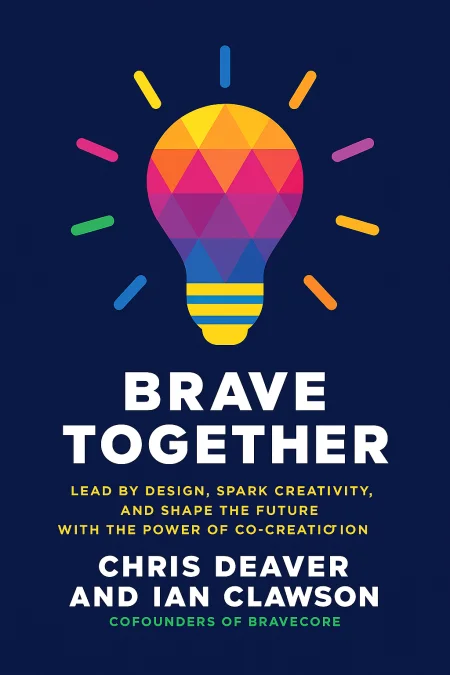
Brave Together
Lead by Design, Spark Creativity, and Shape the Future with the Power of Co-Creation
Book Edition Details
Summary
What if the secret to groundbreaking success lies not in solitary genius, but in the art of co-creation? In "Brave Together," Chris Deaver and Ian Clawson dismantle the myth of the lone innovator, revealing a bold new blueprint for leadership and creativity. Through riveting stories and tested strategies, they show how Apple transformed from a culture of secrecy to one of collaborative brilliance, and how Pixar outshone its competitors. By challenging the hustle culture that's burning us out, this book invites you to reimagine the way we work—not harder, but more creatively and collectively. With principles like "The Mirror Test" and "The Hero's Sacrifice," Deaver and Clawson equip leaders with tools to inspire shared innovation and build cultures people love. If you're ready to lead a future where success is co-authored, "Brave Together" is your essential guide.
Introduction
Sarah stared at her laptop screen, feeling the familiar weight of isolation pressing down on her shoulders. Despite being surrounded by colleagues in the bustling open office, she felt utterly alone. Her innovative ideas seemed to disappear into the void of endless meetings, her passion slowly dimming under the fluorescent lights of corporate conformity. She wasn't alone in this feeling—across industries and continents, millions of talented individuals find themselves trapped in systems that prioritize individual achievement over collective brilliance, competition over collaboration. This epidemic of workplace disconnection has reached a tipping point. We live in an era where technology promises to bring us closer together, yet we've never felt more isolated in our professional lives. The old paradigms of success—climbing the corporate ladder alone, building personal empires, and viewing colleagues as competitors—are crumbling before our eyes. The symptoms are everywhere: burnout, quiet quitting, and a mental health crisis that spans every industry and level of leadership. But what if there's another way? What if the future belongs not to those who brave it alone, but to those who dare to be brave together? This exploration reveals a revolutionary approach to work, leadership, and life itself—one that transforms isolation into connection, competition into collaboration, and individual achievement into collective innovation. Through powerful stories and practical insights, we'll discover how the most successful teams, companies, and movements throughout history have harnessed the extraordinary power of working together with courage, vulnerability, and shared purpose.
Breaking Free from Fear and Status Quo
Mohammad Anwar stood before one hundred employees in a town hall meeting, his heart pounding as he asked the question that would change everything: "Do you still trust me?" Only two hands rose in the air. The rest sat in stony silence, their faces reflecting years of broken promises and failed leadership. His company, Softway, had grown from zero to millions in revenue over thirteen years, but now it teetered on the edge of bankruptcy. Employees were fleeing in droves, clients were abandoning ship, and Mohammad faced the darkest moment of his professional life. The weight of failure pressed down on him as he left that meeting. He could have chosen the easy path—blaming market conditions, pointing fingers at competitors, or making excuses about timing. Instead, he found himself at a University of Houston football game, watching his undefeated team fall behind by twenty points in the fourth quarter. As fans began to leave, Mohammad started to get up too, but something made him stay. In those final moments, he witnessed something extraordinary: the team rallied together, supporting each other through every play, and won the game with thirty seconds left on the clock. The next day, Mohammad watched the post-game press conference, desperate to understand the secret behind such an incredible comeback. Head coach Tom Herman's words hit him like lightning: the key was love—the love players had for one another, the kind of love that builds cultures capable of achieving the impossible. In that moment, Mohammad realized he had been leading from a place of fear rather than love, control rather than connection. Fear has become our baseline emotion in the modern workplace, manifesting in ways that trap us in cycles of mediocrity and isolation. We experience fear imposed by others—the micromanaging boss, the toxic colleague, the culture of judgment that makes us hide our authentic selves. We inflict fear upon ourselves through perfectionism, imposter syndrome, and the relentless comparison to others' highlight reels. Breaking free from these fear-based patterns isn't just about individual courage—it requires the collective bravery to reimagine how we work and live together.
The Hero's Sacrifice: Trading Ego for Empathy
Steve Jobs sat in the sleek conference room at Apple, his black turtleneck a stark contrast against the white walls, as his team presented their latest innovation. But something remarkable happened that day—something that would have been unthinkable in the early days of his career. As a junior engineer challenged his perspective with compelling data and a fresh approach, Steve paused, considered the argument carefully, and then did something that shocked everyone in the room: he changed his mind completely, right there on the spot. When asked later why he had pivoted so dramatically, his response was simple: "The new idea was more compelling—it doesn't matter where it came from." This moment represented a profound transformation in one of history's most iconic leaders. The Steve Jobs who returned to Apple in 1997 was fundamentally different from the one who had been ousted twelve years earlier. Ed Catmull, who worked with Jobs longer than anyone else, witnessed this evolution firsthand. The early Steve was brilliant but brutal, innovative but isolated, capable of creating groundbreaking products but incapable of sustaining the relationships necessary for lasting success. The changed Steve had learned the most difficult lesson any leader can master: that true power comes not from being right, but from being open to being wrong. The journey from ego to empathy isn't just a nice-to-have leadership quality—it's the fundamental shift that separates those who achieve temporary success from those who create lasting impact. In our culture of personal branding and self-promotion, we've been conditioned to believe that strength means never showing weakness, that leadership means having all the answers, and that success requires us to outshine everyone around us. But the most innovative teams and transformative leaders understand a deeper truth: the moment we sacrifice our need to be the smartest person in the room is the moment we unlock the collective intelligence of everyone around us. This hero's sacrifice—trading our ego for empathy, our need to be right for our commitment to do right—creates the psychological safety necessary for true innovation. When team members know their ideas will be heard rather than dismissed, when they feel valued for their contributions rather than threatened by their colleagues' success, something magical happens. The energy that was once wasted on office politics and self-protection gets redirected toward solving problems, creating solutions, and building something greater than any individual could achieve alone.
Co-Creating the Future Through Shared Vision
In the summer of 1963, as 250,000 people gathered in the sweltering heat of Washington D.C., history was about to be made in an unexpected way. Dr. Martin Luther King Jr. stood at the podium with his carefully prepared speech, ready to deliver remarks that had been crafted and refined over weeks of preparation. But as he began to speak, something extraordinary happened. Mahalia Jackson, the legendary gospel singer whose voice had inspired a nation, stood among the crowd and called out, "Tell them about the dream, Martin! Tell them about the dream!" In that moment of spontaneous collaboration, Dr. King set aside his prepared text and began to improvise the words that would echo through history: "I have a dream." This pivotal moment reveals a profound truth about how the future is actually created—not through the solitary genius of individual visionaries, but through the dynamic interplay of shared inspiration and collective courage. The speech wasn't just Dr. King's dream; it was Jackson's dream, it was the dream of every person standing in that crowd, and it became the dream of millions who heard those words and felt their hearts stirred to action. The power of that moment lay not in one person's ability to articulate a vision, but in the community's readiness to co-create a future that seemed impossible but felt inevitable. Today's most successful organizations understand this same principle. At companies like Apple, Pixar, and other innovation leaders, breakthrough products don't emerge from isolated departments working in secrecy, but from cross-functional teams that share ideas early and often, challenge each other's assumptions with respect and curiosity, and build upon each other's insights to create something none of them could have imagined alone. They've learned that the phrase "think different" is incomplete—the real magic happens when diverse minds "think different together." The shift from individual achievement to collective innovation requires us to fundamentally reimagine what success looks like. Instead of asking "How can I get ahead?" we begin to ask "How can we move forward together?" Instead of hoarding our best ideas for fear they'll be stolen, we share them generously, knowing that in the hands of talented collaborators, they'll become something far more powerful than we ever conceived. This transformation from scarcity to abundance thinking doesn't just change our work—it changes who we become as human beings.
Summary
The stories woven throughout these pages reveal a fundamental truth that our individualistic culture has obscured: the future belongs not to those who brave it alone, but to those who find the courage to be brave together. From Mohammad's transformation from a fear-based leader to one who leads with love, to Steve Jobs' evolution from ego-driven genius to empathetic collaborator, to the spontaneous co-creation that gave birth to one of history's most powerful speeches, we see the same pattern emerging again and again. The most profound breakthroughs, the most sustainable successes, and the most meaningful transformations happen when we move beyond the limitations of individual effort and tap into the exponential power of collective creativity. This shift requires us to challenge three fundamental assumptions that have shaped our approach to work and life. First, we must move beyond fear as our default operating system, recognizing that the courage to be vulnerable, to admit what we don't know, and to ask for help actually makes us stronger, not weaker. Second, we must sacrifice the ego-driven need to be the hero of our own story and instead find fulfillment in being part of something larger than ourselves. Finally, we must embrace the messy, unpredictable, and ultimately more rewarding process of co-creating the future with others, trusting that shared vision and collective action will take us places we could never reach alone. The path forward isn't about abandoning individual excellence or personal growth—it's about recognizing that our greatest individual potential can only be realized in relationship with others. When we bring our authentic selves to collaborative endeavors, when we lead with curiosity rather than certainty, and when we measure our success by the collective impact we create rather than the personal accolades we accumulate, we don't just change our own lives—we become part of the force that's reshaping the future of work, leadership, and human connection itself.
Related Books
Download PDF & EPUB
To save this Black List summary for later, download the free PDF and EPUB. You can print it out, or read offline at your convenience.
By Chris Deaver
