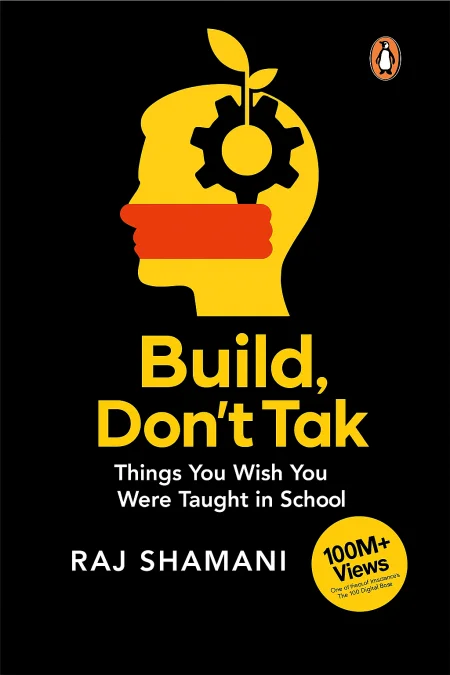
Build, Don't Talk
Things You Wish You Were Taught in School
Book Edition Details
Summary
Life's most crucial lessons often bypass the classroom, leaving us adrift in the sea of adulthood without a compass. "Build, Don’t Talk" by Raj Shamani is your definitive guide to mastering the unspoken curriculum of success. Through the lens of an accomplished entrepreneur, this book shatters the myth that we're ill-equipped for the real world. Instead, it empowers you with actionable strategies to navigate the complexities of personal finance, relationship-building, and mental wellness. This isn't just advice; it's a powerful toolkit for crafting the life you've always envisioned. If you're ready to transcend mere participation and truly excel in the game of life, Shamani's insights will teach you to not only run the race but to win it.
Introduction
Picture a seventeen-year-old boy standing in his high school hallway, watching his cousins celebrate their academic achievements while he clutches a report card showing 43 percent. The teachers call him "useless," his classmates mock his English, and even his own family seems to have given up on traditional success paths for him. This was the reality for a young dreamer who would later build multiple income streams, speak in twenty-six countries, and inspire millions through his content. His journey from academic failure to entrepreneurial success reveals a fundamental truth: the most important life skills—financial literacy, personal branding, sales mastery, and emotional intelligence—are rarely taught in classrooms. The gap between what schools teach and what life demands has never been wider. While students memorize formulas they'll never use, they graduate without knowing how to negotiate, invest money, build relationships, or create value in the real world. This isn't just an educational oversight; it's a systemic failure that leaves young people unprepared for the challenges and opportunities of modern life. Through raw honesty and practical wisdom gained from years of trial and error, this exploration offers the blueprint for bridging that gap. You'll discover how to transform perceived weaknesses into strengths, build wealth through strategic thinking, and develop the mindset that turns obstacles into stepping stones toward extraordinary success.
From Academic Failure to Entrepreneurial Awakening
The transformation from a struggling student to a successful entrepreneur rarely begins with a single moment of clarity. Instead, it unfolds through a series of seemingly disconnected experiences that eventually weave together into wisdom. Consider the young man who tried everything to fit in and succeed within conventional frameworks. He attempted sports but was too short for basketball, too injury-prone for football, and too impatient for table tennis. Music seemed promising until he discovered the guitar's demanding finger positions and realized his natural rhythm didn't translate to DJing beyond shouting "Everybody jump!" Even his foray into financial trading ended in confusion when he couldn't distinguish profits from losses after eight months of effort. Each failure felt devastating in the moment, but these experiences were actually building something invaluable: resilience and self-awareness. The constant experimentation taught him that traditional paths weren't always the right fit, and more importantly, that failure wasn't a reflection of worth but rather valuable data about preferences and strengths. When he finally stumbled upon his first business opportunity in FMCG, creating a dishwashing gel that competed with established brands, he applied everything he'd learned from his previous attempts. The product succeeded not because he'd found his calling, but because he'd developed the courage to try, the wisdom to adapt, and the persistence to continue despite setbacks. This pattern reveals a crucial truth about success: it's rarely about finding the perfect path immediately. Instead, it's about developing the capacity to navigate uncertainty, learn from mistakes, and maintain optimism in the face of repeated disappointments. The skills that matter most—resilience, adaptability, creative problem-solving, and emotional intelligence—are forged in the crucible of apparent failure, not in the comfort of early success.
Building Wealth Through Personal Branding and Content
The digital age has democratized wealth creation in unprecedented ways, but most people miss the fundamental shift that's occurred. Traditional success required gatekeepers, credentials, and institutional approval. Today's opportunities belong to those who understand that authenticity and value creation matter more than perfection or pedigree. One content creator discovered this when he started sharing business news in thirty-second videos, not because he was the most qualified financial expert, but because he could make complex information accessible and engaging. His breakthrough came when he realized that being average and relatable was actually a superpower. While others tried to impress audiences with complex vocabulary and sophisticated analysis, he focused on explaining things so clearly that anyone could understand. This approach resonated because most people aren't looking for the smartest person in the room; they're looking for someone who can help them become smarter themselves. By consistently showing up, sharing knowledge, and maintaining authenticity, he built an audience of millions who trusted him enough to engage with his content, purchase his courses, and invite him to speak at their events. The transformation from consumer to producer represents one of the most powerful wealth-building strategies available today. Every hour spent consuming content could potentially be redirected toward creating content. Every skill learned could become a teaching opportunity. Every problem solved could become a service offered to others facing similar challenges. The shift requires nothing more than changing the fundamental question from "What can I get?" to "What can I give?" This mindset change unlocks opportunities that remain invisible to those focused solely on consumption. The beauty of this approach lies in its accessibility. You don't need advanced degrees, significant capital, or industry connections to begin. You simply need to start sharing what you're learning, helping others solve problems you've already solved, and consistently adding value to people's lives. The compound effect of this consistent value creation eventually translates into multiple income streams, expanded opportunities, and genuine wealth that goes far beyond monetary compensation.
Mastering Sales, Investment, and Business Strategy
The art of persuasion isn't about manipulation or pressure; it's about understanding human psychology and creating genuine value exchanges. Every successful business transaction begins with preparation, moves through emotional connection, and concludes with urgency that feels natural rather than forced. Consider how one entrepreneur approached selling a digital marketing consultation to a major car company. Instead of immediately pitching his services, he first demonstrated genuine interest in their success, then presented a specific solution to their identified problem, and finally created urgency by showing how delay would cost them opportunities. This three-step framework—preparation, emotion, and urgency—applies to every sales situation, from convincing an investor to fund a startup to negotiating a salary increase. Preparation means understanding the other party's needs, constraints, and motivations. Emotional connection happens when you align your solution with their aspirations or fears. Urgency emerges naturally when the cost of inaction becomes clear. The key insight is that effective selling feels like helpful consulting rather than aggressive pushing. Investment strategy follows similar principles of preparation and emotional intelligence. The most successful investors don't chase trends or follow hot tips; they develop systems for evaluating opportunities based on their risk tolerance, time horizon, and financial goals. One proven approach involves allocating investments across different risk levels: fifty percent in established companies with strong management teams, thirty percent in calculated risks like promising startups, ten percent in speculative opportunities like cryptocurrency, and ten percent in absolute certainties like real estate and insurance. This strategic approach to both selling and investing reflects a deeper understanding of human nature and market dynamics. Success comes not from finding perfect opportunities but from developing reliable systems for evaluation, execution, and improvement. Whether negotiating a business deal or choosing an investment, the same principles apply: understand the landscape, prepare thoroughly, connect authentically, and act decisively when the moment is right.
Life Skills School Should Have Taught Us
The gap between formal education and practical life skills has created generations of people who can solve complex mathematical equations but struggle to manage their personal finances, negotiate effectively, or build meaningful relationships. The most successful individuals often share a common trait: they've learned to treat life as a laboratory where every interaction becomes an opportunity to practice essential skills that were never formally taught. Communication stands out as perhaps the most valuable skill that schools systematically fail to develop. Beyond basic literacy lies the art of persuasion, the science of active listening, and the strategy of building rapport with diverse personalities. These capabilities determine career advancement, relationship quality, and personal satisfaction far more than academic achievements ever will. The student who learns to ask engaging questions, give genuine compliments, and create positive interactions with strangers develops social capital that compounds throughout life. Financial literacy represents another critical gap in traditional education. While students spend years studying theoretical concepts, they graduate without understanding compound interest, investment diversification, tax optimization, or wealth creation strategies. The practical knowledge of how to evaluate risk, allocate resources, and build multiple income streams remains mysteriously absent from curricula, despite being fundamental to adult success and security. Perhaps most importantly, schools fail to teach the meta-skill of learning how to learn. They provide information but not the frameworks for processing new information, adapting to changing circumstances, or developing expertise in emerging fields. The most valuable education teaches students to become curious observers, effective experimenters, and resilient adapters who can thrive regardless of how quickly the world changes around them. The ultimate lesson isn't that formal education lacks value, but rather that it's incomplete. True preparation for life requires supplementing academic knowledge with practical skills, emotional intelligence, and strategic thinking. Those who recognize this gap early and actively work to fill it gain enormous advantages over peers who assume their education ended with graduation.
Summary
The journey from perceived failure to extraordinary success reveals that our greatest limitations often become our most powerful assets when viewed through the right lens. The student who struggled in traditional academic settings discovered that his authentic, relatable approach to sharing knowledge resonated more powerfully with audiences than polished expertise ever could. His story illuminates a fundamental truth: success in the modern world belongs not to those who fit perfectly into existing systems, but to those who have the courage to create their own path and the wisdom to help others do the same. The real education begins when we stop waiting for permission and start taking action. Whether building a business, creating content, or developing investment strategies, the same principles apply: start with what you have, focus on adding value to others' lives, and maintain consistency even when progress feels slow. The compound effect of showing up authentically, learning from mistakes, and persistently improving creates opportunities that seem impossible from the starting point. Every successful entrepreneur, content creator, and investor shares this common foundation of embracing discomfort, learning continuously, and viewing obstacles as data rather than verdicts. Your own transformation awaits the moment you decide that your current limitations are simply the raw materials for building something extraordinary.
Related Books
Download PDF & EPUB
To save this Black List summary for later, download the free PDF and EPUB. You can print it out, or read offline at your convenience.
By Raj Shamani
