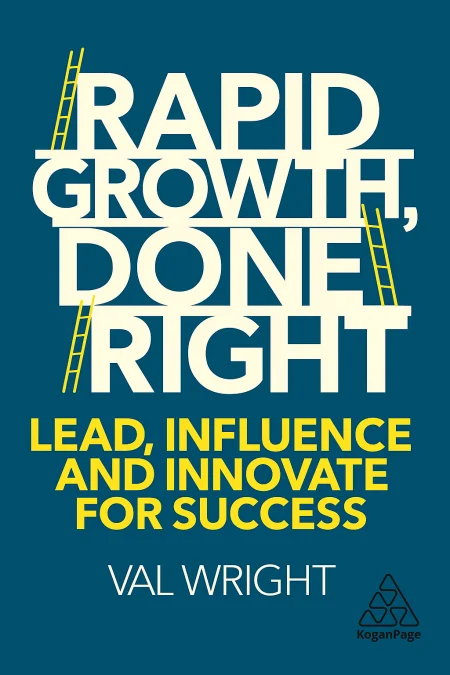
Rapid Growth, Done Right
Lead, Influence and Innovate for Success
Book Edition Details
Summary
In the bustling world of business, where innovation reigns supreme, one question looms large: What truly sets thriving companies apart? At the heart of these success stories lies a delicate dance—an artful symbiosis between the creative dreamers, technical wizards, and business strategists. In "Rapid Growth, Done Right," renowned consultant Val Wright unveils the keys to mastering this complex choreography. With insights drawn from the world's most groundbreaking firms and revealing conversations with top executives, this guide equips both seasoned and aspiring leaders to weave dreams into reality. It's a manifesto for those ready to inspire, innovate, and lead their organizations toward unyielding growth and customer devotion.
Introduction
Sarah stared at the conference room filled with brilliant minds from marketing, engineering, and finance, watching as they spoke past each other in what felt like different languages. The creative team painted grand visions that seemed impossible to build, the technical experts dismissed ideas as technically unfeasible, and the business leaders demanded immediate ROI on concepts still in their infancy. Despite having some of the smartest people in the industry, their company was stuck in endless cycles of miscommunication and missed opportunities. This scenario plays out in organizations worldwide, where talented professionals work in silos, each group convinced that their perspective is the only one that matters. The marketing genius speaks in terms of customer delight and brand experience, while the technical expert focuses on scalability and system architecture. Meanwhile, the business leader demands clear revenue projections and cost analyses. Each speaks their native language, but none truly understands the others. Yet there exists a different reality, one where these diverse perspectives merge into something extraordinary. Companies that achieve rapid, sustainable growth have discovered the secret of creating genuine collaboration between creative, technical, and business minds. They've learned to translate across disciplines, building bridges instead of walls. These organizations don't just grow fast; they grow smart, creating innovations that delight customers while building sustainable competitive advantages. This exploration reveals how leaders can orchestrate these diverse talents into a symphony of success, transforming potential chaos into purposeful innovation.
Building Your Innovation Power Base
Jennifer Anaya knew she had a problem. As SVP of Marketing at Ingram Micro, she watched brilliant technical innovations die in committee meetings, not because they lacked merit, but because they lacked champions. The most groundbreaking ideas would emerge from hackathons and innovation labs, only to disappear into the corporate void when their creators couldn't navigate the complex web of executive relationships required to turn concepts into reality. She discovered this truth when a young engineer approached her with a revolutionary approach to supply chain optimization. The technology was sound, the market need was clear, and the potential impact was enormous. Yet week after week, the project stalled in endless reviews and requests for more data. The engineer, frustrated by corporate politics, eventually left for a startup where his idea became the foundation for a company that later sold for hundreds of millions. The harsh reality is that innovation without influence is merely intellectual exercise. Even the most brilliant technical breakthrough or creative insight means nothing if it cannot gain the executive support necessary for implementation. Jennifer realized that building a network of power influencers wasn't about office politics or manipulation, but about creating the infrastructure necessary for innovation to thrive. The most successful innovators understand that their circle of influence operates like concentric rings. At the center are the power influencers who make final decisions about resource allocation and strategic direction. Surrounding them are the amplifiers, trusted advisors who shape those critical conversations. The key insight is that chasing power influencers directly often backfires, while building relationships with their amplifiers creates sustainable pathways to influence. This approach recognizes that innovation is fundamentally a social process, requiring not just great ideas but the human connections necessary to bring those ideas to life.
Mastering Cross-Functional Communication
When Xbox faced the threat of Nintendo's Wii revolutionizing gaming, the pressure was immense. Microsoft's gaming division needed breakthrough innovation, but their technical teams spoke in algorithms and architecture diagrams, their creative teams communicated through mood boards and user journeys, and their business teams demanded financial projections and market analysis. Each group had crucial insights, yet their inability to communicate across disciplines was paralyzing progress. The breakthrough came when they created what became known as "the best offsite ever," gathering creative visionaries, technical experts, and business strategists in a mountain retreat with no internet connection. They banned PowerPoint presentations and financial spreadsheets, instead using artists to capture ideas visually, providing Lego and Play-Doh for prototyping, and encouraging wild experimentation. The result was Project Natal, later launched as the Kinect Camera, which sold 10 million units in three months and earned a place in the Guinness Book of World Records. The magic happened when a software developer realized that gesture recognition wasn't just technically possible but could transform Xbox from a hardcore gaming device into a family entertainment center. A creative designer saw how natural hand movements could make gaming accessible to grandparents and young children alike. A business analyst understood how this could expand their addressable market by millions of potential customers. None of them could have reached this insight alone, but together they created something revolutionary. This experience revealed the power of becoming truly trilingual in business, fluent in creative vision, technical possibility, and commercial viability. The most effective leaders learn to translate between these worlds, serving as bridges rather than barriers. They understand that technical constraints can spark creative solutions, that creative ambitions can drive technical innovation, and that business requirements can focus both toward meaningful impact. This trilingual fluency becomes a superpower in organizations, enabling leaders to orchestrate diverse talents toward shared goals and breakthrough results.
Creating High-Performance Growth Systems
Amazon's fashion business transformation began with a recognition that traditional retail metrics and processes couldn't scale to fashion's demands. Jeff Wilke understood that selling shoes required completely different capabilities than selling books. Where book photography needed simple product shots, fashion required models, lifestyle imagery, and seasonal campaigns. Where book customers searched for specific titles, fashion customers browsed for inspiration and style guidance. The company had to build entirely new systems for inventory management, creative production, and customer experience while maintaining Amazon's legendary operational efficiency. They couldn't simply hire fashion experts and hope for the best; they needed to create new frameworks that could blend fashion industry creativity with Amazon's technical precision and business discipline. This required rethinking everything from how they measured success to how they structured teams. The innovation came through developing what they called "working backwards" from the customer experience they wanted to create. Instead of starting with technical constraints or financial targets, they began by imagining the ideal fashion shopping experience, then worked systematically to identify the creative, technical, and business capabilities needed to deliver it. This process revealed gaps in their talent pipeline, forcing them to acquire companies like Zappos and Shopbop not just for their customer bases, but for their fashion expertise and cultural DNA. The transformation succeeded because they created systems that could evolve continuously rather than static processes that would quickly become obsolete. They built feedback loops between creative vision, technical capability, and business performance, allowing each dimension to inform and improve the others. This approach to building high-performance growth systems recognizes that rapid growth requires not just great ideas or excellent execution, but the organizational capabilities to continuously translate between different perspectives and adapt to changing market demands.
Scaling Success While Managing Risk
When Rent the Runway experienced rapid growth, founder Jennifer Hyman faced the classic scaling challenge: maintaining quality and customer experience while expanding operations and introducing new product categories. The company had perfected the model for special occasion dress rentals, but scaling to everyday clothing, children's wear, and home goods created complexity that tested every system they had built. The crisis came during a warehouse system upgrade that resulted in delivery delays, inventory mix-ups, and frustrated customers who took their complaints directly to social media. Instead of hiding behind corporate communications teams, Hyman wrote personally to every customer, acknowledging the problems, explaining the improvements they were making, and asking for patience during the transition. She and her team worked around the clock to resolve issues while implementing the very changes that had caused the temporary disruption. This experience taught them that scaling success requires embracing transparency about challenges rather than pretending everything is perfect. They developed real-time communication systems that could keep customers informed about their orders, created backup logistics networks to prevent single points of failure, and built customer service capabilities that could flex during high-stress periods. Most importantly, they learned to communicate about problems proactively rather than reactively. The lesson extends beyond customer service to the fundamental challenge of rapid growth. As organizations scale, the informal communication and decision-making processes that worked with smaller teams become inadequate. Success requires building systems that can maintain the spirit and culture of the organization while adapting to increased complexity and scale. This means creating clear frameworks for decision-making, communication channels that can handle increased volume and diversity of information, and leadership approaches that can maintain human connection even as organizations become more complex and distributed across geography and function.
Summary
The journey through these interconnected challenges reveals a fundamental truth about modern business success: sustainable growth emerges not from any single perspective or expertise, but from the dynamic interplay between creative vision, technical capability, and business acumen. The organizations that thrive in today's complex marketplace are those that have learned to orchestrate these diverse perspectives into harmonious innovation, creating solutions that are simultaneously desirable, feasible, and viable. The path forward requires leaders who can serve as translators and bridge-builders, helping technical experts understand market dynamics, enabling creative visionaries to work within operational constraints, and showing business leaders how breakthrough innovations create competitive advantages. This isn't about compromise or finding the lowest common denominator, but about achieving synthesis where each perspective elevates the others. When technical precision enables creative ambition, when creative insight drives technical innovation, and when both serve clear business purposes, organizations unlock their potential for exponential growth. The most profound insight is that rapid growth done right isn't about moving fast and breaking things, but about building the capabilities and relationships that enable sustained excellence. Success comes from investing in the human infrastructure of influence and communication, creating systems that can evolve with changing demands, and maintaining the courage to embrace transparency and continuous learning. In a world where change is the only constant, organizations that master these disciplines don't just grow rapidly; they grow wisely, building foundations for lasting impact and meaningful success.
Related Books
Download PDF & EPUB
To save this Black List summary for later, download the free PDF and EPUB. You can print it out, or read offline at your convenience.
By Val Wright
