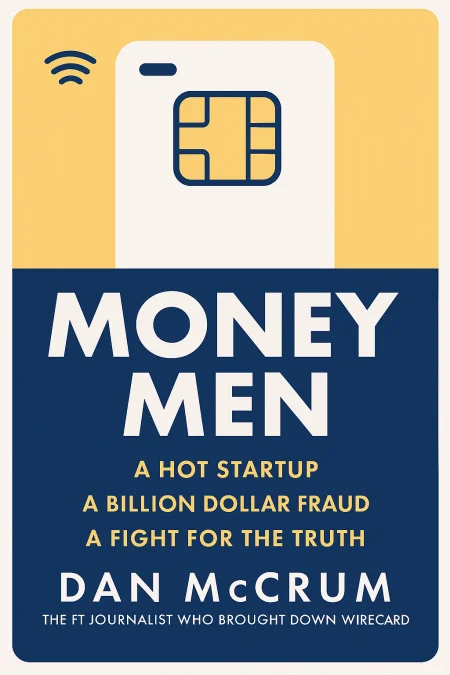
Money Men
A Hot Startup, A Billion Dollar Fraud, A Fight for the Truth
Book Edition Details
Summary
Beneath the polished facade of the tech world lurked a labyrinth of deception, where Wirecard, once Europe’s glittering $30 billion star, hid secrets as dark as they were dangerous. When journalist Dan McCrum tugged on a seemingly innocuous thread, he uncovered a tale more riveting than fiction—a dizzying dance with danger that drew in shadowy figures and corporate titans alike. Fake bank accounts, fabricated offices, and a potentially staged death were just the tip of the iceberg in this gripping narrative. Pursued through London's alleys and shadowed by threats, McCrum found himself ensnared in a thrilling quest to unveil the truth and safeguard his own integrity. "Money Men" is not merely a financial exposé; it's a white-knuckle thriller that casts a stark light on the global economic underworld.
Introduction
In the gleaming towers of Munich's financial district, a company once hailed as Germany's answer to Silicon Valley was orchestrating one of the most audacious corporate frauds in European history. What began as a modest payment processor handling transactions for online gambling and adult entertainment evolved into a twenty-billion-euro fintech darling, complete with prestigious awards, regulatory approval, and a coveted spot in Germany's most exclusive stock index. This extraordinary tale illuminates three critical questions that define our digital age: How can sophisticated financial institutions be systematically deceived by elaborate accounting tricks? Why do regulators sometimes protect the very companies they should be investigating? And what happens when the promise of technological revolution blinds investors, auditors, and authorities to fundamental warning signs of fraud? The story reveals how a small group of investigative journalists and determined short-sellers fought against corporate intimidation, regulatory capture, and international surveillance to expose the truth. This account serves as essential reading for investors navigating the complex world of fintech innovation, regulators grappling with cross-border financial crime, and anyone seeking to understand how modern corporate fraud operates in an interconnected global economy. It demonstrates that behind every digital transaction and technological breakthrough lie timeless questions of trust, verification, and human integrity that no amount of sophisticated technology can eliminate.
From Obscure Payment Processor to Global Fintech Champion (1999-2018)
The Wirecard story began in the shadows of Germany's emerging internet economy, where a small Bavarian company processed payments that traditional banks wouldn't touch. Founded in 1999 to serve online gambling sites and adult entertainment platforms, the company initially operated from modest offices, handling transactions that mainstream financial institutions considered too risky or unsavory for their pristine reputations. The transformation accelerated when Markus Braun, an Austrian consultant with grand visions for digital payments, acquired control in 2002. Braun understood that the future belonged to electronic transactions, positioning Wirecard as the essential bridge between traditional banking and the emerging cashless economy. His strategy focused on aggressive international expansion, particularly across Asia's rapidly growing markets, where regulatory oversight was often fragmented and business practices remained opaque to Western auditors. Central to this expansion was Jan Marsalek, Braun's charismatic lieutenant who cultivated an image as a globe-trotting dealmaker. Marsalek's "Third-Party Acquiring" model involved partnerships with local companies in emerging markets, allowing Wirecard to claim massive transaction volumes without the overhead of direct operations. These arrangements generated extraordinary profit margins that seemed to validate the company's technological superiority and strategic brilliance. By 2018, Wirecard had achieved the ultimate validation: membership in Germany's prestigious DAX 30 index, joining industrial giants like BMW and Siemens. The company's stock price soared as investors embraced the narrative of a homegrown German technology champion disrupting the global payments industry. With a market capitalization exceeding twenty billion euros, Wirecard appeared to prove that European companies could compete with Silicon Valley's tech titans. Yet beneath this spectacular success lay a sophisticated web of deception that would soon attract the attention of skeptical journalists and determined short-sellers.
Investigative Journalism Exposes the Fraud Machine (2014-2019)
The first cracks in Wirecard's facade emerged from an unlikely source: a small team of investigative journalists at the Financial Times who began receiving disturbing tips about the company's Asian operations. Beginning in 2014, reporter Dan McCrum started documenting allegations of forged contracts, phantom revenues, and systematic accounting manipulation across Wirecard's most profitable business lines in Singapore, the Philippines, and Dubai. What McCrum and his colleagues uncovered was a sophisticated deception machine operating across multiple jurisdictions. Wirecard claimed to generate hundreds of millions in revenue from partnerships with companies that either didn't exist, operated from residential addresses, or had been dissolved years earlier. In the Philippines, supposed business partners had no knowledge of any relationship with the German company, while in Singapore, whistleblowers provided evidence of systematic document forgery designed to inflate revenues and hide massive losses. The company's response to these investigations revealed the extraordinary lengths it would go to protect its secrets. Wirecard hired private investigators to surveil journalists and short-sellers, deployed sophisticated hacking operations to infiltrate critics' email accounts, and launched aggressive legal campaigns across multiple countries to silence unfavorable coverage. The company's executives portrayed themselves as victims of a coordinated attack by corrupt journalists working with manipulative speculators to destroy a successful German technology company. Meanwhile, a small group of short-sellers conducted their own forensic investigations, publishing detailed reports that questioned Wirecard's accounting practices and highlighted the impossibility of independently verifying its claimed Asian revenues. These reports triggered violent swings in the company's stock price and fierce public debates about corporate transparency. Rather than investigating these serious allegations, German regulators chose to protect their national champion, banning short-selling of Wirecard shares and launching criminal investigations against the journalists and analysts raising uncomfortable questions. This regulatory capture demonstrated how national pride and economic interests can blind authorities to obvious warning signs of systematic fraud.
The Spectacular Collapse and Regulatory Reckoning (2020-2021)
By early 2020, mounting pressure from investigative reporting and forensic analysis had made Wirecard's position increasingly untenable. The company's supervisory board, facing demands from investors and regulators, commissioned KPMG to conduct a special audit of the controversial Third-Party Acquiring business that generated most of Wirecard's claimed profits. The forensic accountants spent months attempting to verify the existence of the company's most valuable assets and revenue streams. KPMG's investigation revealed the shocking truth that would trigger Wirecard's spectacular collapse. The auditors could find no evidence that the company's most profitable business lines actually existed, despite claims of processing billions in transactions annually. Most damaging of all, Wirecard claimed to hold 1.9 billion euros in cash at Philippine banks, but when auditors demanded verification, the banks declared the account statements to be "spurious" – elaborate forgeries created to deceive investors, auditors, and regulators. The revelation that nearly two billion euros simply didn't exist triggered a cascade of events that destroyed the company within days. Wirecard's stock price plummeted from over one hundred euros to single digits as investors realized the full scope of the deception. CEO Markus Braun was arrested on charges of fraud and market manipulation, while COO Jan Marsalek fled Germany via private jet, eventually disappearing into the shadowy world of international fugitives with possible connections to Russian intelligence services. The aftermath exposed fundamental weaknesses in corporate governance, audit practices, and regulatory oversight that had allowed such massive fraud to persist for years. Ernst & Young, one of the world's largest accounting firms, had signed off on Wirecard's accounts for over a decade without detecting obvious fraud. German financial regulators had spent more energy investigating journalists than examining the company they were meant to oversee. The scandal shattered Germany's reputation for financial probity and forced a comprehensive reckoning with regulatory structures that had failed so spectacularly. Thousands of employees lost their jobs, pension funds suffered massive losses, and the entire European fintech sector faced increased scrutiny from investors who had learned painful lessons about the dangers of unchecked innovation.
Summary
The Wirecard scandal represents far more than a simple case of corporate fraud; it reveals the fundamental vulnerabilities of modern financial systems when confronted with determined criminals who exploit the intersection of technological complexity, regulatory fragmentation, and institutional trust. At its core, this was a classic accounting fraud dressed up in the sophisticated language of fintech innovation, demonstrating that age-old principles of skeptical analysis and rigorous verification remain essential regardless of how revolutionary a company's technology appears. The story offers three profound lessons for our digital age. First, the complexity of global financial networks creates unprecedented opportunities for sophisticated fraudsters to exploit jurisdictional gaps and audit limitations, making independent journalism and market skeptics essential guardians of financial integrity. Second, regulatory capture and national economic interests can blind authorities to obvious warning signs, allowing massive frauds to persist even when evidence of wrongdoing is publicly available. Finally, the intoxicating promise of technological disruption can cause investors, auditors, and regulators to suspend normal standards of scrutiny and accountability, creating perfect conditions for systematic deception. Moving forward, investors must demand greater transparency from fintech companies, particularly regarding their international operations and partnership structures, while maintaining healthy skepticism toward businesses that promise revolutionary returns in regulatory gray areas. Regulators need to develop new frameworks for overseeing complex, cross-border financial businesses while resisting the temptation to protect national champions from legitimate scrutiny. Most importantly, society must recognize that behind every digital transaction and technological breakthrough lie fundamental questions of human integrity and institutional accountability that no amount of sophisticated innovation can eliminate. The price of preventing such frauds is eternal vigilance, robust institutions, and the courage to ask difficult questions even when the answers threaten powerful interests.
Related Books
Download PDF & EPUB
To save this Black List summary for later, download the free PDF and EPUB. You can print it out, or read offline at your convenience.
By Dan McCrum
