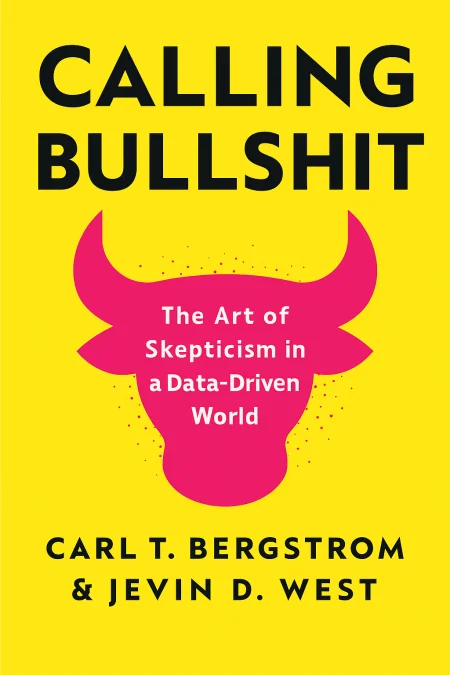
Calling Bullshit
The Art of Skepticism in a Data-Driven World
byCarl T. Bergstrom, Jevin D. West
Book Edition Details
Summary
In a realm where misinformation reigns supreme, two visionary science professors, Carl Bergstrom and Jevin West, arm us with the intellectual artillery to dismantle deceptive data and reclaim clarity in a world awash with fake news. The art of discerning truth from cleverly disguised lies has never been more critical. With their spirited guide, "Calling Bullshit," Bergstrom and West reveal the secret techniques of spotting statistical sleights of hand and exposing the illusions spun by biased data visualization. This is not just a book; it's a manifesto for modern-day skeptics, challenging us to rise above the noise, question the unquestionable, and harness the power of informed skepticism. It's time to sharpen your critical thinking skills and learn to call out the modern breed of BS that cloaks itself in the guise of scientific authority.
Introduction
The modern information landscape presents an unprecedented challenge to human reasoning. We live in an age where data, statistics, and scientific-sounding claims bombard us from every direction, yet many of these seemingly authoritative pronouncements are designed to mislead rather than inform. The problem extends far beyond simple lies or obvious propaganda to encompass a more sophisticated form of intellectual pollution that exploits our natural deference to quantitative authority. This systematic deception operates by wrapping dubious claims in the language of science and mathematics, creating an illusion of rigor while remaining fundamentally indifferent to truth. The challenge lies not merely in identifying outright falsehoods, but in recognizing when legitimate-seeming data visualizations, statistical analyses, and algorithmic processes are being weaponized to serve hidden agendas. The stakes are enormous: when citizens cannot distinguish reliable information from sophisticated manipulation, the very foundation of informed democratic discourse begins to crumble. The analysis that follows provides a comprehensive framework for understanding how misinformation operates in the digital age, examining the specific techniques used to exploit our cognitive biases and the structural features of modern media that amplify deceptive content. Through careful examination of these mechanisms, readers will develop the analytical tools necessary to navigate an information environment where the most dangerous deceptions often wear the mask of objectivity and scientific precision.
The Weaponization of Data and Scientific Authority
Contemporary misinformation differs fundamentally from traditional forms of deception in its relationship to truth itself. While conventional lies involve deliberate falsehoods crafted to mislead specific audiences, modern bullshit represents something more insidious: a complete indifference to accuracy in service of persuasion, impression, or agenda advancement. This distinction proves crucial for understanding how misleading claims achieve credibility in digital environments. The weaponization process begins with the exploitation of scientific and mathematical authority. Numbers possess an almost mystical power in modern discourse, creating an impression of precision and objectivity that can overwhelm critical thinking. This numerical authority makes quantitative claims particularly effective vehicles for deception, as most audiences lack the statistical literacy necessary to evaluate complex data presentations. The same reverence extends to anything bearing the superficial markers of scientific legitimacy: peer-reviewed formatting, academic language, sophisticated visualizations, and algorithmic complexity. Digital platforms amplify these deceptive practices through structural features that prioritize engagement over accuracy. Social media algorithms reward content that provokes strong emotional responses, creating perverse incentives for sensational claims regardless of their veracity. The democratization of publishing tools has eliminated traditional gatekeepers without replacing them with effective quality controls, allowing anyone to produce professional-looking content that mimics the visual markers of authority. The result is an information ecosystem where false claims can achieve viral spread before fact-checkers can respond, exploiting what researchers call the bullshit asymmetry principle: the energy required to refute misleading claims far exceeds that needed to produce them. This asymmetry creates a fundamental challenge for rational discourse, as the sheer volume of sophisticated misinformation can overwhelm the capacity for careful verification and correction.
How Statistical Manipulation Exploits Cognitive Biases
Statistical manipulation operates by exploiting predictable patterns in human reasoning, transforming our natural cognitive shortcuts into vulnerabilities that skilled deceivers can systematically exploit. The human mind evolved to make quick decisions based on limited information, relying on heuristics that work well in many contexts but can be manipulated when applied to complex quantitative claims. The manipulation often begins with the strategic selection and presentation of summary statistics. Percentages can make large numbers appear trivial or small differences seem enormous, depending on the chosen baseline for comparison. The decision to report absolute numbers versus relative changes, or means versus medians, can dramatically alter the impression created by identical underlying data. These choices are rarely neutral; they reflect conscious decisions about which narrative to construct from the available information. Correlation and causation represent perhaps the most fundamental confusion in quantitative reasoning. Human cognition naturally seeks causal explanations for observed patterns, but statistical association alone cannot establish causal relationships. This bias is systematically exploited by those who present correlational data as if it demonstrated causation, leading audiences to draw unwarranted conclusions about everything from medical interventions to policy effectiveness. More sophisticated forms of manipulation include cherry-picking time periods to support desired conclusions, adjusting visual scales to exaggerate or minimize differences, and using inappropriate comparison groups that bias interpretation. The technical complexity of these techniques often places them beyond the scrutiny of non-expert audiences, creating opportunities for systematic deception under the guise of analytical sophistication. Understanding these manipulative techniques becomes essential for maintaining intellectual independence in a data-saturated environment.
Visual Deception and Algorithmic Opacity in Information Systems
Visual representations of data carry unique persuasive power because they appear to let the information speak for itself while actually embedding countless subjective choices about interpretation and emphasis. Every chart, graph, and infographic involves decisions about scale, color, layout, and visual metaphors that can dramatically influence how viewers understand the underlying relationships in the data. The principle of proportional ink provides a crucial framework for evaluating visual integrity: visual elements should correspond directly to the numerical relationships they purport to represent. When this principle is violated through truncated axes, three-dimensional distortions, or inappropriate chart types, the resulting graphics become forms of visual deception that systematically bias interpretation while maintaining an appearance of objectivity. Algorithmic systems present even more complex challenges for critical evaluation. Machine learning algorithms increasingly make decisions that affect human lives, from criminal sentencing to loan approvals to content recommendation, yet these systems often perpetuate and amplify existing biases present in their training data. The mathematical sophistication of these systems creates an illusion of objectivity while potentially encoding systematic discrimination against certain groups. The opacity of algorithmic decision-making compounds these problems significantly. Unlike traditional forms of analysis where reasoning processes can be examined and critiqued, many modern artificial intelligence systems operate as black boxes whose internal logic remains inscrutable even to their creators. This computational complexity creates a new form of authority based not on transparent reasoning but on mathematical sophistication, making it difficult for affected individuals or oversight bodies to understand, challenge, or correct biased outcomes that may systematically disadvantage certain populations.
Building Critical Defense Against Quantitative Misinformation
Developing effective resistance to quantitative manipulation requires cultivating specific analytical habits rather than memorizing technical procedures or statistical formulas. The most crucial skill involves learning to ask penetrating questions about any quantitative claim: What is the source of this data? How was it collected and by whom? What assumptions underlie the analysis? Are there plausible alternative explanations for the observed patterns? Effective skepticism focuses on examining the inputs and outputs of analytical processes rather than their technical details. Most misleading quantitative arguments fail not because of sophisticated statistical errors, but because of fundamental problems with data quality, sample selection, or interpretation of results. By scrutinizing what goes into an analysis and what conclusions are drawn from it, non-experts can often identify serious flaws without needing to understand the mathematical procedures involved. The principle that extraordinary claims require extraordinary evidence provides another crucial heuristic for evaluation. When quantitative analysis produces results that seem too convenient, contradict well-established knowledge, or perfectly align with the interests of those presenting them, heightened skepticism becomes warranted. This does not mean reflexively rejecting all surprising findings, but rather demanding higher standards of evidence when stakes are high or conclusions are suspiciously convenient. Building these defensive capabilities requires practice with real examples and developing comfort with uncertainty and ambiguity. The goal is not to become cynically dismissive of all quantitative claims, but to develop the sophistication needed to distinguish between legitimate analysis and statistical theater. This involves learning to seek multiple perspectives, tolerate incomplete information, and maintain appropriate skepticism while remaining genuinely open to evidence-based reasoning and scientific discovery.
Summary
The central insight emerging from this analysis reveals that our well-founded respect for quantitative reasoning and scientific authority has become a vulnerability that sophisticated actors routinely exploit for manipulation and deception. In a world where data and algorithms increasingly shape human decisions, the ability to think critically about quantitative claims becomes not merely an intellectual luxury but a democratic necessity. The solution lies not in rejecting empirical reasoning or embracing cynical skepticism, but in developing the analytical sophistication needed to distinguish genuine expertise from mere performance of authority. By understanding how statistical claims can be manipulated, how visual presentations can deceive, and how algorithmic systems can embed bias while appearing objective, citizens can better navigate an increasingly complex information environment where the most dangerous falsehoods often masquerade as rigorous analysis.
Related Books
Download PDF & EPUB
To save this Black List summary for later, download the free PDF and EPUB. You can print it out, or read offline at your convenience.
By Carl T. Bergstrom
