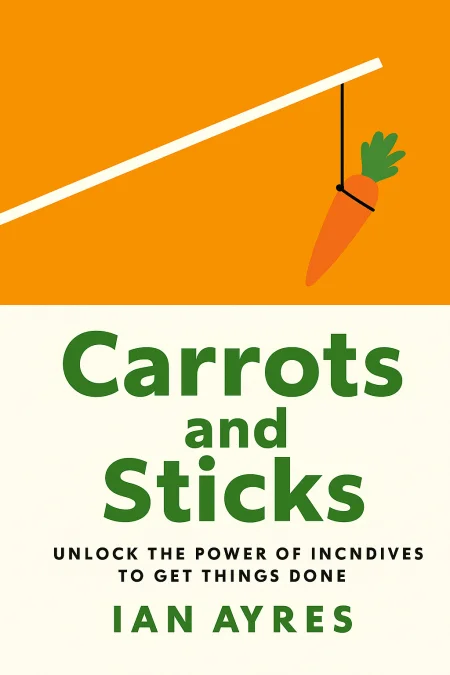
Carrots and Sticks
Unlock the Power of Incentives to Get Things Done
Book Edition Details
Summary
What if the secret to conquering your toughest goals lies in a wager with yourself? Ian Ayres, celebrated author and co-creator of stickK.com, unleashes the power of behavioral economics in "Carrots and Sticks." This groundbreaking guide unveils how "commitment contracts" can revolutionize your approach to personal and professional aspirations. Imagine the thrill of putting your money where your mouth is—whether it's shedding pounds, mastering a new language, or breaking free from smoking. Ayres shares riveting stories and practical tactics that make self-improvement not just possible, but inevitable. Through these clever incentives, you can transform procrastination into productivity and wishful thinking into tangible success. Embrace the dynamic dance of rewards and penalties and discover a transformative strategy that's already empowering individuals and companies nationwide. With Ayres' insights, challenge becomes opportunity, and dreams turn into achievements.
Introduction
Why do we repeatedly fail to stick to our own resolutions, even when we desperately want to change? The gap between our good intentions and actual behavior reveals a fundamental conflict within human psychology. This tension exists between our present selves, who make plans and set goals, and our future selves, who must execute them under different circumstances and temptations. Behavioral economics offers a powerful framework for understanding this internal battle through concepts like hyperbolic discounting and loss aversion. The field reveals that traditional economic models, which assume rational and consistent decision-making, fail to capture how people actually behave when confronted with immediate temptations versus long-term benefits. This book presents commitment contracts as a practical solution, drawing on insights from psychology and economics to help individuals align their actions with their stated goals. The core theoretical questions explored include how to design effective incentive structures, when penalties outperform rewards, the role of social accountability in behavior change, and how to maintain motivation over time. These insights transform abstract behavioral theories into actionable strategies for personal transformation.
The Science of Self-Control and Hyperbolic Discounting
Hyperbolic discounting represents one of the most important discoveries in behavioral economics, explaining why people systematically make choices they later regret. Unlike traditional economic theory, which assumes people discount future rewards at a constant rate, hyperbolic discounting reveals that humans dramatically overweight immediate rewards relative to future ones, but become relatively indifferent to delays when both options are pushed further into the future. This pattern creates what economists call "time-inconsistent preferences." A person might prefer two apples in 366 days over one apple in 365 days, yet choose one apple today over two apples tomorrow. The psychological mechanism behind this involves our dual-system thinking, where an impulsive "present self" battles against a more rational "planning self." The present self experiences immediate temptations with visceral intensity, while future benefits remain abstract and distant. The implications extend far beyond academic theory. Consider procrastination: we genuinely intend to start that important project next week, but when next week arrives, "next week" always feels better. Or diet decisions: we plan to eat healthily tomorrow while reaching for dessert tonight. Even pigeons in laboratory experiments demonstrate this pattern, choosing immediate smaller rewards over delayed larger ones, yet reversing these preferences when both options are pushed into the future. This suggests hyperbolic discounting is deeply embedded in our evolutionary psychology, making it a universal challenge requiring systematic solutions rather than mere willpower.
Designing Effective Commitment Devices and Incentives
Commitment devices work by restricting future choices or making undesired behaviors costly enough to discourage them. The key distinction lies between traditional incentives, which guide choice by changing costs and benefits, and commitment devices, which aim to eliminate choice entirely by making one option prohibitively expensive or practically impossible. Effective commitment design involves several critical elements. First, the stakes must be calibrated appropriately neither too small to be ignored nor so large that they discourage participation. Research shows that people often underestimate what stakes are necessary to change their behavior, while also being reluctant to risk truly meaningful amounts. Second, the commitment must specify clear, verifiable conditions for success or failure, avoiding ambiguous standards that future selves can rationalize away. The framework encompasses both "carrots" and "sticks," but with behavioral twists. Loss aversion research indicates that people work approximately twice as hard to avoid losing something they possess compared to gaining something equivalent. This makes penalty-based commitments often more effective than reward-based ones. However, the framing matters enormously. A health insurance plan that charges smokers an extra premium feels punitive, while one that offers non-smokers a discount feels rewarding, even when economically identical. Real-world applications include everything from savings accounts that penalize early withdrawal to weight-loss programs that forfeit money to causes the participant opposes, leveraging both financial and moral motivations.
Social Context and Accountability in Behavioral Change
Humans are fundamentally social creatures, and commitment effectiveness multiplies when others become involved. Social accountability operates through multiple psychological channels: reputation concerns, reciprocity obligations, and the power of public consistency pressures. The mere act of announcing a goal to others creates psychological pressure to follow through, as failing becomes not just personal disappointment but public embarrassment. The choice of accountability partners proves crucial. Different relationships provide different motivational structures. Professional referees offer objectivity but may lack emotional investment. Friends and family provide strong motivation but might be too supportive, allowing excuses and exceptions. The research suggests that multiple supporters often work better than single referees, as conspiring with one person is easier than coordinating deception across several relationships. Anti-charity mechanisms represent a particularly clever social innovation. Rather than forfeiting money to causes they support, individuals can commit to donate to organizations they actively oppose. This transforms simple financial loss into moral conflict, making failure feel like betrayal of one's own values. The psychological pain of funding opposition causes creates powerful deterrent effects that pure monetary penalties cannot match. Additionally, peer comparison effects demonstrate that people modify behavior more readily when shown how their performance compares to similar others, whether in energy consumption, exercise habits, or charitable giving.
Implementation and Real-World Applications of Commitment Contracts
Modern technology has transformed commitment contracts from informal personal arrangements into sophisticated, scalable systems. Digital platforms can automate verification, process payments, and coordinate complex multi-party agreements that would have been prohibitively expensive to arrange manually. This technological infrastructure makes commitment contracts accessible to millions of people simultaneously. Successful implementation requires careful attention to contract design details. Timing matters: some commitments work better with immediate deadlines that create urgency, while others benefit from extended timelines that allow habit formation. Flexibility provisions can prevent rigid contracts from backfiring when circumstances change, but must be structured to prevent abuse by future selves seeking easy exits. Reset mechanisms allow people to restart after failures rather than abandoning efforts entirely. Real-world applications span diverse domains. Healthcare systems use commitment contracts to improve medication adherence and lifestyle changes. Employers implement wellness programs that combine financial incentives with social accountability to reduce insurance costs. Educational institutions apply these principles to improve student performance and completion rates. Financial services create savings products that restrict access to encourage long-term accumulation. Even personal relationships benefit when couples make mutual commitments with agreed-upon consequences. The key insight is that commitment contracts work best when integrated into existing institutional structures rather than relying purely on individual willpower.
Summary
The fundamental breakthrough of commitment contract theory is recognizing that rational self-control is not a character flaw to overcome but a universal human condition requiring systematic solutions. By understanding the psychological mechanisms behind self-control failures and designing appropriate choice architecture, individuals can align their actions with their genuine long-term interests. This behavioral approach represents a paradigm shift from traditional willpower-based strategies toward evidence-based intervention design. The implications extend beyond individual self-improvement to organizational management, public policy, and social system design. As our understanding of human psychology deepens, commitment contracts offer a practical bridge between behavioral science insights and real-world applications, empowering people to become the person they truly want to be rather than remaining trapped by momentary impulses.
Related Books
Download PDF & EPUB
To save this Black List summary for later, download the free PDF and EPUB. You can print it out, or read offline at your convenience.
By Ian Ayres
