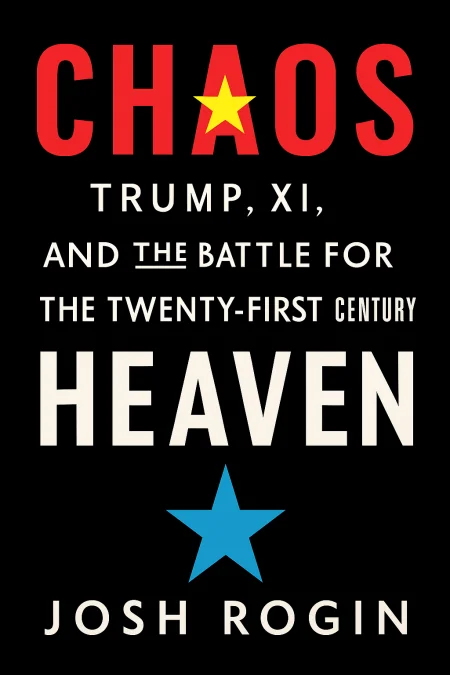
Chaos Under Heaven
America, China, and the Battle for the 21st Century
Book Edition Details
Summary
A political tempest brews as Donald Trump's presidency thrusts the U.S.-China relationship into uncharted waters. "Chaos Under Heaven" by Josh Rogin offers an incisive glimpse into the tumultuous interplay between two global giants. Trump's unexpected rise to power shattered diplomatic norms, launching a volatile dance with China's shrewd leader, Xi Jinping. From fiery trade wars to whispered alliances, Rogin unveils the turbulent saga of ambition, miscalculation, and power plays. As the world teeters on the brink of a new Cold War, this gripping exposé reveals how Trump's erratic strategies ignited a necessary, if chaotic, reckoning with China's burgeoning influence. Peering behind the curtain of global diplomacy, this narrative crackles with tension and revelation, capturing a presidency—and a world—on the edge.
Introduction
In December 2016, as Donald Trump prepared to assume the presidency, Chinese officials found themselves facing an unprecedented challenge: how to navigate a relationship with an American leader who seemed determined to tear up four decades of diplomatic protocol. The phone call Trump accepted from Taiwan's president just weeks after his election victory sent shockwaves through Beijing, signaling that the predictable patterns of US-China engagement were about to be shattered forever. This extraordinary period reveals three fundamental questions that continue to shape our world today. How did the United States transition from viewing China as a strategic partner to recognizing it as a systemic rival? The answer lies in the collision between democratic values and authoritarian expansion, as China's rise challenged not just American economic interests but the entire liberal international order. What happens when economic interdependence meets geopolitical competition? The Trump years demonstrated that trade relationships, once thought to guarantee peace, can become weapons in a larger strategic contest. Finally, how do great powers navigate between cooperation and confrontation in an interconnected world where miscalculation can have global consequences? These questions matter deeply for business leaders navigating an increasingly fragmented global economy, policymakers grappling with the rise of authoritarian powers, and citizens seeking to understand how great power competition affects their daily lives. This story offers both a cautionary tale about the limits of engagement and essential insights into how democracies can respond to authoritarian challenge while preserving their core values and institutions.
From Engagement to Strategic Competition (2017-2018)
The early Trump administration inherited a China policy built on the foundational assumption that economic integration would gradually liberalize China's political system. This four-decade consensus would face its most serious test as Trump's team grappled with a fundamental question: was China a partner to be managed through dialogue or a competitor to be confronted through strength? The period began with characteristic unpredictability as Trump used diplomatic protocol as leverage. His December 2016 phone call with Taiwan's president challenged China's most sensitive red line, yet within months he was hosting Xi Jinping at Mar-a-Lago with great fanfare. This whiplash diplomacy reflected deeper tensions within the administration between Wall Street figures who saw China as a market opportunity and national security hawks who viewed it as an existential threat to American prosperity and security. The awakening came gradually as evidence mounted of China's systematic challenge to the international order. The Chinese Communist Party's "Made in China 2025" plan revealed ambitions that extended far beyond economic development to technological dominance in critical sectors. When American companies found themselves forced to choose between their values and Chinese market access, when universities discovered their research partnerships were feeding China's military capabilities, the true nature of the relationship became undeniable. This recognition transformed American policy from accommodation to strategic competition. Career officials who had long warned about Chinese ambitions finally found receptive audiences as the administration began treating China not as a developing nation deserving special consideration, but as a peer competitor whose success often came at America's expense. The implications would ripple through every aspect of the relationship, setting the stage for a fundamental reordering of global affairs that would outlast any single presidency.
Trade Wars and Technological Confrontation (2018-2019)
What began as a trade dispute evolved into something far more consequential: a struggle for technological supremacy that would determine which system of governance would shape the twenty-first century. The Trump administration's decision to weaponize America's economic advantages marked a decisive break from decades of free-trade orthodoxy and multilateral cooperation. The trade war's opening salvos targeted China's most sensitive vulnerabilities through comprehensive investigations that revealed the systematic nature of Chinese intellectual property theft, estimated to cost the American economy hundreds of billions annually. But the real battle emerged in the technology sector, where companies like Huawei and ZTE found themselves caught between their global ambitions and American security concerns. The targeting of these firms demonstrated how far the United States was willing to go to contain China's technological rise. Behind the headlines lay a deeper strategic calculation that would reshape global commerce. American policymakers recognized that China's economic model represented a fundamental challenge to the liberal international order. State-directed capitalism, massive subsidies, and forced technology transfers weren't simply unfair trade practices; they were tools of national power designed to achieve technological dominance in critical sectors from artificial intelligence to 5G networks that would define the future economy. The escalation revealed how economic interdependence could become a source of vulnerability rather than stability. As tariffs escalated and supply chains faced disruption, both sides discovered the painful costs of decoupling. Yet the momentum toward strategic competition proved irreversible, as what had begun as a trade war transformed into a broader contest between two incompatible visions of how the global economy should function, with implications extending far beyond bilateral trade flows to the very structure of international commerce.
Pandemic Crisis and the Final Break (2020-2021)
The coronavirus pandemic that emerged from Wuhan crystallized every tension that had been building in US-China relations, transforming a bilateral dispute into a global reckoning with China's role in the international system. When Chinese officials sat in the White House in January 2020 to sign a trade deal, their silence about the virus already spreading through their country would define the relationship's final chapter under Trump. The pandemic exposed the fragility of America's dependence on Chinese supply chains and the dangers of trusting authoritarian governments with global public health responsibilities. China's initial cover-up, its threats to withhold medical supplies from countries that criticized its response, and its aggressive "wolf warrior" diplomacy during the crisis shocked even those who had long advocated for continued engagement. The virus became a lens through which Americans viewed every aspect of the relationship, from academic partnerships to financial investments. This period witnessed the most comprehensive pushback against Chinese influence operations in American history. Universities severed ties with Confucius Institutes, the Justice Department launched sweeping investigations of Chinese researchers, and Congress moved to protect American investors from fraudulent Chinese companies. The administration's final months saw a cascade of sanctions, restrictions, and policy changes designed to limit China's access to American technology, capital, and institutions. The pandemic also revealed how China's authoritarian model posed challenges beyond traditional security concerns. Beijing's use of economic coercion against countries that called for investigations into the virus's origins, its systematic dismantling of Hong Kong's democratic institutions, and its oppression of Uyghur Muslims demonstrated that China's rise came with profound costs for human rights and democratic values. The global response to these actions suggested that the world was finally awakening to the true nature of the challenge China represented to the international order.
Summary
The Trump years revealed that the fundamental tension in US-China relations was never really about trade deficits or currency manipulation, but about two incompatible visions of how the world should be organized. China's authoritarian capitalism, with its fusion of state power and market mechanisms, represented a direct challenge to the liberal democratic order that had defined the post-Cold War era and enabled unprecedented global prosperity. This historical moment offers crucial lessons for navigating great power competition in the twenty-first century. Economic interdependence does not automatically create political cooperation; it can just as easily become a source of leverage and vulnerability when core interests and values diverge. Authoritarian regimes will use every tool at their disposal, from trade relationships to academic partnerships, to advance their political objectives and reshape international institutions in their favor. Democratic societies must be willing to accept short-term economic costs to preserve their long-term political values and strategic autonomy. The path forward requires both vigilance and wisdom in equal measure. America and its allies must strengthen their own institutions while building coalitions capable of offering an attractive alternative to China's authoritarian model. This means investing in education, infrastructure, and innovation while protecting democratic values and human rights. Most importantly, it requires recognizing that the competition with China is not primarily military or economic, but ideological, representing a contest between two fundamentally different approaches to organizing human society that will shape the world future generations inherit.
Related Books
Download PDF & EPUB
To save this Black List summary for later, download the free PDF and EPUB. You can print it out, or read offline at your convenience.
By Josh Rogin
