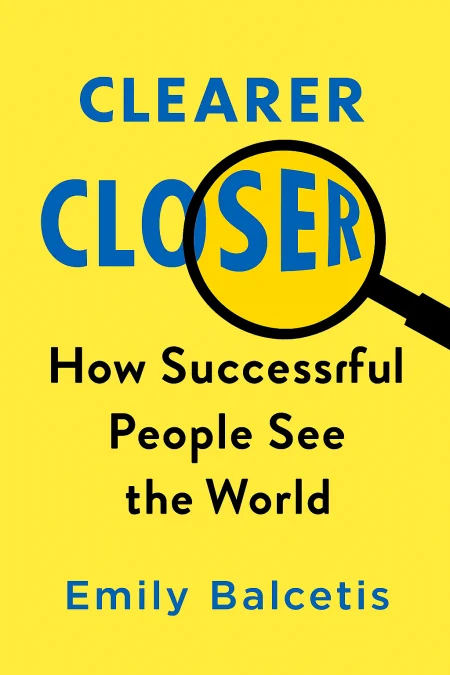
Clearer, Closer, Better
How Successful People See the World
Book Edition Details
Summary
In the realm of human perception, Emily Balcetis reveals a transformative truth: the way we visually interpret our surroundings can shape our destiny. This groundbreaking exploration into the science of vision and motivation unravels the secret strategies of the world's most successful individuals. With vivid narratives from the lives of entrepreneurs, athletes, and artists, Balcetis uncovers four potent visual tactics that can redefine your reality. Whether narrowing your focus to maximize efficiency or broadening your perspective to embrace change, these insights are your toolkit for personal triumph. Dive into a captivating synthesis of cognitive research and real-world application, where your perception isn't just a lens but a powerful instrument for achieving your dreams. Clearer, Closer, Better isn't just a book; it's an invitation to see your world anew and harness the untapped potential of your own eyes.
Introduction
Have you ever wondered why some people seem to effortlessly achieve their goals while others struggle despite having the same resources and determination? The answer might literally be right in front of your eyes. What we see—or more precisely, how we see—profoundly shapes our ability to succeed in everything from fitness and finance to personal relationships and professional achievements. This isn't just about having good vision; it's about understanding that our visual perception is far more malleable and influential than we realize. Our eyes don't simply record reality like a camera; they actively construct our experience of the world in ways that can either help or hinder our progress toward meaningful goals. Through decades of scientific research, we're discovering that by consciously directing our visual attention and framing our experiences differently, we can literally see our way to better outcomes. This book reveals four powerful visual strategies that successful people use, often unconsciously, to overcome obstacles and achieve their aspirations. You'll learn how to harness your visual system as a tool for motivation, why changing what you look at can change what you accomplish, and how the simple act of seeing differently can transform challenges from insurmountable barriers into achievable steps forward.
The Science of Visual Perception and Goal Achievement
Our relationship with vision runs deeper than we imagine. When asked which of their five senses they'd least want to lose, seven out of ten people across sixteen countries chose sight, yet this preference reveals something profound about how visual perception actually works. Vision isn't just about our eyes—it's about the extraordinary collaboration between our eyes and our brain that creates our experience of reality. This system is remarkably adaptable, as demonstrated by Harvard neurologist Alvaro Pascual-Leone's groundbreaking research with blindfolded volunteers who learned Braille in just five days. By the end of their temporary blindness, their visual cortex had rewired itself to process touch, showing that our brain's vision centers are far more flexible than previously understood. This neuroplasticity extends to how we perceive challenges and opportunities in our daily lives. Research consistently shows that people who are physically tired or carrying extra weight literally see distances as longer, hills as steeper, and tasks as more daunting than those who feel energetic and fit. The same objective reality appears different depending on our internal state, revealing that perception is not passive recording but active construction. Our visual system processes information at incredible speed—8.75 megabits per second—and can distinguish friend from stranger in just 1/76 of a second, making it perfectly positioned to influence our moment-to-moment decisions. Understanding this malleable nature of perception opens up powerful possibilities for goal achievement. When we recognize that what we see is influenced by how we feel, where we direct our attention, and what we choose to focus on, we can begin to use our visual system strategically. Rather than being victims of discouraging perceptions that make our goals seem impossible, we can learn to see in ways that make success feel closer and more achievable. The key insight is that our visual experiences directly translate into physical actions through neural pathways that connect our eyes to our motor cortex. What we see literally shapes what we do, which means that by controlling our visual input and attention, we can influence our behavior in profound ways. This isn't about positive thinking or wishful visualization—it's about using evidence-based techniques to align our perception with our aspirations.
Four Perceptual Tools: Focus, Materialization, Framing, and Wide Brackets
Think of visual perception as a toolkit with four distinct instruments, each serving different purposes in your journey toward success. Just as a craftsperson selects the right tool for each job, successful goal pursuit requires knowing when and how to use each perceptual strategy. These four tools—narrow focus, materialization, strategic framing, and wide brackets—work together to help you see opportunities where others see obstacles and maintain motivation when challenges arise. Narrow focus works like a telephoto lens, allowing you to zoom in on what matters most while blurring out distractions. Elite athletes like marathon champion Joan Benoit Samuelson use this technique by focusing on one runner ahead at a time rather than the daunting 26.2-mile distance. Research shows that when people narrow their focus to their finish line while exercising, they perceive the distance as 30% closer, require 17% less effort, and complete the task 23% faster. This isn't just mental trickery—the focused attention actually changes how our brain processes the challenge, making difficult tasks feel more manageable and achievable. Materialization involves making your goals and progress visible and concrete rather than keeping them abstract in your mind. This goes beyond simple vision boards to include three essential components: clearly defining your destination, mapping out specific action steps, and preparing for potential obstacles. Olympic swimmer Gary Hall wrote his goal times directly on his kickboard where he'd see them daily, while Michael Phelps mentally rehearses not just success but also everything that could go wrong and how he'd handle each scenario. When UCLA students practiced materializing their study plans rather than just their desired grades, those who visualized the specific steps of preparation significantly outperformed those who only imagined success. Strategic framing determines what falls within your visual attention and what gets filtered out. Like a photographer choosing what to include in a shot, you can consciously decide what environmental cues to pay attention to. Companies like Google discovered that simply moving healthy snacks to eye level and hiding less nutritious options in opaque containers led employees to consume 3.1 million fewer calories from candy in just seven weeks. The principle applies beyond food: surrounding yourself with visual reminders of your goals while removing tempting distractions can dramatically influence your daily choices without requiring constant willpower. Wide brackets involve stepping back to see patterns and connections across longer time periods, like switching from a close-up lens to a wide-angle view. When New York cab drivers focused day-by-day on reaching income targets, they worked longer hours on low-earning days and shorter hours on high-earning days—exactly backwards from the optimal strategy. Drivers who thought in terms of weekly or monthly patterns made more money while working fewer hours. This broader perspective helps you make decisions aligned with long-term success rather than short-term impulses, revealing opportunities for course correction that narrow focus might miss.
Real-World Applications: From Exercise to Finance to Public Speaking
These visual strategies translate into practical improvements across every area of life where motivation and persistence matter. In fitness, research demonstrates that people who learn to focus narrowly on their exercise goals see workouts as less challenging and perform significantly better. The key is training your eyes like a spotlight, keeping them fixed on your target rather than scanning the environment. This technique helped recreational gym members walk 23% faster to their finish line while reporting the exercise felt 17% easier—a performance boost that could transform a casual exerciser into someone approaching competitive speeds. Financial planning becomes more effective when you use visualization to connect your present self with your future self. When people see computer-aged images of how they'll look in retirement, they're willing to save 6.2% of their salary compared to 4.4% for those who don't see their future selves. This works because abstract future goals become concrete and personal when you can literally see yourself benefiting from today's sacrifices. The effect is so powerful that companies like Prudential now use "savings successor" campaigns based on this research, calculating that if Americans saved just three dollars more per day, we'd collectively accumulate $4.3 trillion more for retirement. Public speaking anxiety—the most common fear, often rated worse than death—can be managed through strategic visual framing. Professional speakers and TED talk coaches teach nervous presenters to identify five or six friendly faces throughout their audience and focus on those supporters rather than scanning for signs of disapproval. This works because our eyes naturally gravitate toward angry or critical expressions, creating a distorted impression that the audience is hostile. Research shows that people who practice focusing on positive faces during stressful situations experience measurably lower cortisol levels and perform better, with benefits extending beyond public speaking to sales performance and general social anxiety. The workplace applications are equally powerful. Emergency room doctors demonstrate that multitasking can improve performance up to a point—adding patients two through five actually speeds up treatment times because moderate cognitive load enhances focus. However, beyond five patients, performance degrades rapidly as mental resources become overwhelmed. This finding helps explain why some people thrive under pressure while others crumble: the key is understanding your cognitive limits and staying within the productive range where challenge enhances rather than impairs performance. Even seemingly intractable problems like procrastination respond to visual strategies. When people track their time and review patterns over weeks rather than days, they discover hidden productivity drains and natural energy cycles they can optimize. The act of making time visible through logs and charts transforms an abstract resource into something concrete that can be managed and improved, leading to better decision-making about how to spend precious hours and mental energy.
Overcoming Mental Barriers Through Strategic Vision
Perhaps the most powerful application of visual strategies lies in overcoming the mental barriers that keep us stuck in unfulfilling patterns. Our psychological immune system naturally protects us from feeling bad about our shortcomings, often by helping us forget our failures or remember our efforts as more successful than they actually were. While this protection serves a purpose, it can prevent the honest self-assessment necessary for real growth and change. Wide bracket thinking helps break through this protective self-deception by revealing patterns that are invisible when examined day-by-day. When filmmaker Patrick Osborne documented one second of his meals every day for a year, he discovered eating patterns that surprised him despite his apparent good health. The broad view revealed connections between his food choices and life circumstances that he'd never noticed, leading to meaningful changes in both diet and lifestyle. This technique works because stepping back to see the full picture makes it harder for our minds to rationalize away problems or dismiss them as isolated incidents. The growth mindset research by Carol Dweck shows how framing failures as learning opportunities rather than reflections of fixed inability transforms our relationship with challenges. People who view setbacks as information about what to try next show different brain activity patterns when making mistakes—their neural systems stay engaged with problem-solving rather than shutting down in self-protection. This difference in perception leads to measurably better performance over time, whether in academics, athletics, or professional development. Strategic disengagement represents perhaps the most sophisticated use of visual perspective. Sometimes the best path forward requires abandoning current goals to pursue better alternatives, but our natural persistence can become counterproductive. Fashion designer Vera Wang's transition from competitive figure skating to design illustrates how wide bracket thinking can reveal when one passion serves another through an unexpected route. By seeing her love of beauty, line, and emotional storytelling as transferable rather than sport-specific, she redirected her efforts toward a career that ultimately proved more fulfilling and successful than her original Olympic aspirations. The key insight is that changing your visual perspective doesn't just change how you see—it changes who you become. When you learn to focus narrowly on immediate targets while simultaneously maintaining a broad view of long-term patterns, you develop the perceptual flexibility that characterizes high achievers across all fields. This isn't about manipulating yourself through positive thinking, but about training your visual attention to support your deepest values and longest-term interests, creating alignment between what you see, what you feel, and what you do.
Summary
The most profound insight from this exploration of visual perception and success is that we have far more control over our experience of reality than we realize, and this control comes through the simple but powerful act of directing our attention strategically. By understanding that our eyes don't just record the world but actively construct our experience of challenge and opportunity, we can learn to see in ways that support our highest aspirations rather than reinforce our limitations. The four perceptual tools—narrow focus, materialization, framing, and wide brackets—provide a practical framework for transforming how we approach everything from daily habits to life-changing decisions, not through wishful thinking but through evidence-based techniques that harness the natural connections between perception and action. As you consider applying these insights, ask yourself: What would become possible in your life if you could see your biggest challenges as 30% closer and 17% easier to overcome? How might your long-term decisions change if you could clearly visualize both your future self and the daily steps needed to reach your goals? This book offers a roadmap for anyone ready to discover that the path to success might be clearer, closer, and more achievable than it appears—once you learn to look in the right way.
Related Books
Download PDF & EPUB
To save this Black List summary for later, download the free PDF and EPUB. You can print it out, or read offline at your convenience.
By Emily Balcetis
