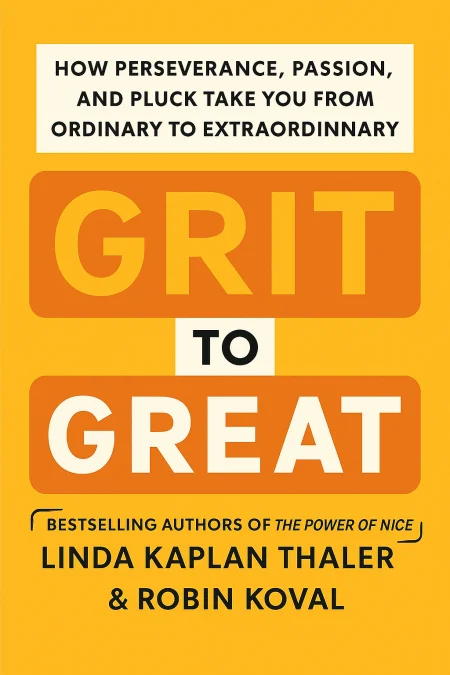
Grit to Great
How Perseverance, Passion, and Pluck Take You from Ordinary to Extraordinary
byLinda Kaplan Thaler, Robin Koval
Book Edition Details
Summary
Beneath the polished veneer of success lies a truth rarely acknowledged: grit, not just talent, propels the exceptional forward. In "Grit to Great," Linda Kaplan Thaler and Robin Koval dismantle the myths of predestined brilliance, drawing on personal journeys from the Bronx to the pinnacle of advertising. With humor and insight, they weave narratives and scientific revelations that champion perseverance over privilege. This book is a testament to the power of relentless drive, illustrating how tenacity, not mere connections or intellect, lights the path to triumph. In a world dazzled by overnight success, "Grit to Great" reminds us that the grind, the grit, and the guts are the true game-changers.
Introduction
Success stories often follow familiar narratives of innate talent meeting golden opportunities. Yet beneath these glossy tales lies a more fundamental question: what truly determines who rises above mediocrity and who remains stuck in place? This exploration challenges the pervasive myth that extraordinary achievement stems primarily from natural gifts or favorable circumstances. Instead, it presents a compelling case for a different kind of power—one that operates through deliberate effort, strategic persistence, and the willingness to endure discomfort in pursuit of meaningful goals. The investigation centers on four interconnected elements that form the foundation of exceptional performance across diverse fields. Through careful analysis of both psychological research and real-world examples, this examination reveals how these components work together to create sustainable progress. Rather than accepting conventional wisdom about talent and luck, readers encounter a framework grounded in behaviors and attitudes that anyone can develop. The journey ahead involves dissecting common assumptions about achievement while building a practical understanding of how ordinary individuals consistently outperform their seemingly more gifted peers.
The Primacy of Grit Over Talent in Achievement
Natural ability creates an early advantage, but this advantage diminishes rapidly when confronted with sustained effort from less naturally gifted competitors. Research consistently demonstrates that raw talent alone fails to predict long-term success across virtually every domain studied. The most compelling evidence emerges from longitudinal studies tracking high-IQ children into adulthood, revealing that many prodigies plateau while their less brilliant peers surpass them through sustained effort and strategic practice. The modern workplace reinforces this pattern. Companies increasingly value what they term "results intelligence"—the demonstrated ability to deliver outcomes under pressure rather than traditional measures of cognitive ability. This shift reflects a deeper understanding that complex challenges require persistence, adaptability, and emotional resilience more than pure intellectual horsepower. When organizations face genuine difficulties, they consistently turn to individuals who have proven they can endure setbacks and maintain performance over extended periods. The talent myth persists because it provides comfort to both the talented and untalented. Those with natural gifts can attribute their early success to inherent superiority, while those without can excuse their lack of progress as genetic destiny. This convenient fiction obscures a more empowering reality: that sustained effort, properly directed, can overcome almost any initial disadvantage. The implications extend far beyond individual achievement, suggesting that societies and organizations that overvalue talent while undervaluing persistence systematically misallocate their human resources. Academic research supports this counterintuitive conclusion through careful measurement of what actually drives exceptional performance. Studies of elite athletes, musicians, and professionals consistently find that total practice time predicts achievement better than early indicators of talent. More importantly, the quality of that practice—its focus, difficulty, and strategic design—matters more than any innate capacity for the activity itself.
Four Essential Components: Guts, Resilience, Initiative, and Tenacity
The architecture of exceptional achievement rests on four distinct but interconnected psychological capacities. Guts represents the willingness to attempt difficult challenges despite uncertain outcomes. This involves calculated risk-taking rather than reckless behavior—the courage to declare ambitious intentions even when success appears unlikely. Individuals with genuine guts distinguish themselves by their willingness to face potential failure publicly, understanding that meaningful achievement requires stepping beyond comfortable certainties. Resilience operates as the psychological elasticity that enables recovery from inevitable setbacks. Rather than the rigid strength that breaks under pressure, resilience resembles bamboo—bending dramatically while maintaining its essential structure and capacity for growth. This quality transforms failures into learning opportunities and defeats into motivation for renewed effort. Resilient individuals develop sophisticated strategies for managing disappointment while maintaining their commitment to long-term objectives. Initiative functions as the activation energy that transforms potential into kinetic achievement. Unlike passive waiting for opportunities, initiative involves creating circumstances that favor success. This means identifying problems that need solving, gaps that need filling, or improvements that need making. Initiative-driven individuals consistently find ways to add value in any situation, making themselves indispensable through their proactive contributions rather than their formal qualifications. Tenacity provides the sustained focus necessary to complete complex, long-term projects. This extends beyond simple stubbornness to include strategic persistence—the ability to maintain direction while adapting tactics based on feedback and changing circumstances. Tenacious individuals develop systems for maintaining motivation across the extended timelines that meaningful achievements typically require. They understand that breakthroughs often occur just beyond the point where most people abandon their efforts.
Dispelling Common Myths About Success and Age Limits
Society imposes artificial constraints on achievement through pervasive beliefs about optimal timing and age-related limitations. These myths create self-fulfilling prophecies that prevent capable individuals from pursuing ambitious goals simply because they have passed arbitrary deadlines. The "thirty under thirty" phenomenon exemplifies this destructive thinking, suggesting that meaningful achievement must occur within narrow timeframes or not at all. Neuroscientific research demolishes these age-based assumptions by demonstrating the brain's remarkable plasticity throughout the human lifespan. Cognitive abilities can improve well into advanced age when properly challenged, and new neural pathways continue forming regardless of chronological age. The key lies in maintaining intellectual engagement and accepting the discomfort of learning new skills. Individuals who embrace lifelong learning often outperform younger competitors who rely primarily on previously acquired knowledge. Historical analysis reveals that many celebrated achievements occurred much later than popular narratives suggest. Artists, inventors, entrepreneurs, and leaders frequently produce their most significant work after decades of apparent struggle or moderate success. These late bloomers benefit from accumulated experience, refined judgment, and the wisdom that comes from surviving multiple cycles of failure and recovery. The retirement concept itself represents a historically recent invention with little basis in human biology or psychology. Many individuals reach their peak creative and productive capacity in their sixties, seventies, or beyond, precisely when social expectations encourage withdrawal from meaningful work. Organizations and societies that fail to harness this accumulated expertise and refined capability systematically waste their most valuable human resources.
Grit as a Learnable Skill for Personal and Social Impact
The most encouraging discovery about exceptional achievement is its accessibility to anyone willing to develop the necessary psychological capacities. Unlike fixed traits such as height or eye color, the components of sustained high performance can be systematically cultivated through deliberate practice and strategic experience design. This means that current performance levels need not constrain future possibilities. Effective grit development requires creating controlled challenges that stretch existing capabilities without overwhelming them. This might involve taking on progressively more difficult projects, seeking feedback from demanding mentors, or deliberately placing oneself in situations that require growth. The key lies in maintaining optimal stress levels—enough challenge to stimulate development without so much that panic or withdrawal occurs. Organizations and communities that successfully cultivate these qualities create cultures of sustained excellence rather than relying on periodic injections of talent. They design systems that reward persistence alongside achievement, celebrate intelligent failures as learning opportunities, and provide support structures that help individuals maintain motivation during difficult periods. These environments consistently produce exceptional results from seemingly ordinary people. The broader social implications extend far beyond individual success stories. Communities that develop widespread grit-building capabilities can tackle complex, long-term challenges that require sustained collective effort. From addressing climate change to reducing poverty to advancing scientific knowledge, the problems that matter most demand exactly the qualities that individual grit development cultivates.
Summary
The evidence converges on a powerful conclusion that challenges fundamental assumptions about human potential and achievement. Sustained excellence emerges not from favorable circumstances or genetic lottery winnings, but from the systematic cultivation of psychological capacities that enable persistent effort toward meaningful goals. This framework shifts attention from fixed attributes to developable behaviors, from passive waiting for opportunities to active creation of favorable conditions. The four-component model provides a practical roadmap for anyone seeking to maximize their impact, while the age-agnostic approach eliminates artificial constraints that prevent late-blooming achievements. Most significantly, the learnable nature of these capabilities suggests that societies can dramatically expand their collective problem-solving capacity by teaching these skills systematically rather than hoping for occasional flashes of brilliance.
Related Books
Download PDF & EPUB
To save this Black List summary for later, download the free PDF and EPUB. You can print it out, or read offline at your convenience.
By Linda Kaplan Thaler
