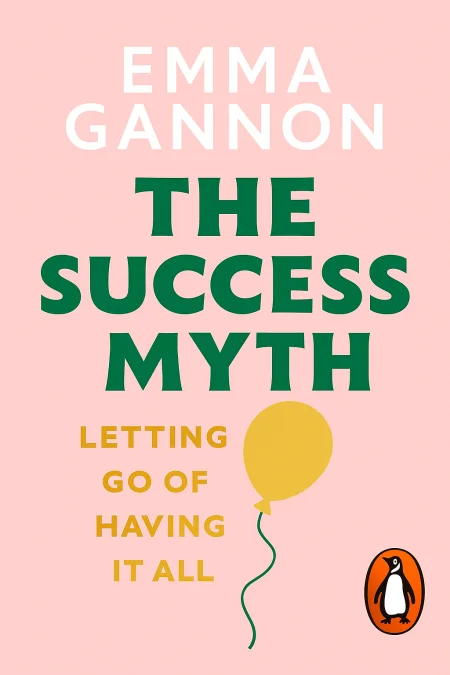
The Success Myth
Letting Go of Having It All
Book Edition Details
Summary
Success—it's a siren call that often leads us into the depths of burnout and disillusionment. Emma Gannon, celebrated podcaster and author, pulls back the curtain on the hollow pursuit of conventional achievements in "The Success Myth." With an insightful gaze honed from personal experience and poignant interviews, she lays bare the pitfalls of society's relentless race for more. Gannon's manifesto is a rallying cry for those weary of the tick-box life; she urges readers to redefine success on their own terms, seeking joy over mere accomplishment. Unshackled from comparison and societal pressure, Gannon provides a roadmap to genuine fulfillment—a life of ambition that doesn't sacrifice happiness. Critics and readers alike hail it as a transformative read, prompting a reevaluation of what it truly means to succeed.
Introduction
Modern society presents us with a compelling narrative: follow the prescribed path of education, career advancement, material accumulation, and social recognition, and happiness will inevitably follow. This seductive promise drives millions to pursue external markers of achievement while experiencing profound emptiness despite their apparent success. The fundamental disconnect between what we're told will fulfill us and what actually does reveals a systematic deception embedded in our cultural understanding of success itself. The traditional success paradigm operates on several interconnected myths that this analysis will systematically dismantle. These myths persist because they serve economic and social systems that benefit from our perpetual striving, but they fail to deliver the psychological satisfaction they promise. Through careful examination of the happiness fallacy, productivity obsession, identity confusion, celebrity worship, monetary fixation, unchecked ambition, social conformity, and arrival fantasy, we can understand why conventional success often leads to disillusionment. Rather than accepting these cultural prescriptions at face value, we must engage in rigorous questioning of their underlying assumptions. This inquiry reveals that true fulfillment emerges not from external achievement but from internal alignment with authentic values and sustainable practices. The path forward requires dismantling these myths one by one, understanding their psychological mechanisms, and constructing a more coherent framework for human flourishing.
Deconstructing Success: Why Traditional Metrics Lead to Emptiness
Traditional success metrics operate on a fundamental logical fallacy: the assumption that external achievement necessarily generates internal satisfaction. This premise fails because it conflates correlation with causation while ignoring the complex psychological mechanisms that actually produce well-being. The conventional success formula promises that accumulating specific achievements will result in lasting happiness, yet empirical evidence consistently demonstrates the opposite. The psychological phenomenon known as hedonic adaptation explains why traditional success metrics inevitably disappoint. When individuals achieve desired goals, their baseline happiness levels return to previous states within relatively short periods. The promotion, house purchase, or social recognition provides temporary elevation, but the mind quickly adjusts to new circumstances as normal. This adaptation mechanism evolved to help humans survive by remaining motivated to seek resources, but it renders the pursuit of happiness through external achievement fundamentally futile. Moreover, the competitive nature of relative status means that success metrics are inherently unstable. Individual achievement exists only in relation to others' performance, creating a zero-sum dynamic where personal worth becomes dependent on maintaining superiority over peers. This comparative framework generates anxiety, insecurity, and continuous pressure to escalate achievement levels. The successful individual discovers that their accomplishments provide security only as long as others haven't surpassed them. The emptiness resulting from traditional success pursuit stems from its misalignment with intrinsic human needs for autonomy, mastery, and purpose. External achievements often require sacrificing these fundamental psychological requirements, creating internal conflict that no amount of recognition or material reward can resolve. True fulfillment emerges from activities that satisfy these deeper needs rather than from accumulating society's prescribed markers of worth.
The Mythology of Achievement: Productivity, Status, and Arrival Fallacies
The productivity myth rests on the erroneous belief that human worth correlates directly with output, transforming individuals into optimization machines rather than recognizing them as complex beings with varied needs and capacities. This mechanistic view of human potential ignores biological rhythms, emotional cycles, and the creative processes that actually generate meaningful work. The relentless focus on measurable output creates a feedback loop where individuals lose connection with their intrinsic motivations and begin evaluating themselves purely through external metrics. Status-seeking behavior represents another mythological construct that promises security through social positioning. The status game operates on scarcity principles, where individuals compete for limited recognition within hierarchical structures. However, status is inherently unstable and dependent on others' perceptions, making it an unreliable foundation for self-worth. Those who achieve high status often discover that maintaining their position requires constant vigilance and performance, creating chronic stress rather than the security they initially sought. The arrival fallacy perhaps represents the most seductive myth, suggesting that reaching specific milestones will provide lasting satisfaction and resolve life's challenges. This temporal displacement of happiness creates a perpetual state of deferment where individuals sacrifice present experience for imagined future fulfillment. The fallacy operates by convincing people that their current dissatisfaction stems from not yet having achieved enough, rather than from pursuing the wrong objectives entirely. These mythologies interconnect to create a comprehensive worldview that keeps individuals trapped in cycles of striving without satisfaction. Breaking free requires recognizing that productivity, status, and arrival are cultural constructs rather than natural laws, and that human flourishing operates according to different principles entirely. The alternative involves embracing process over outcome, intrinsic over extrinsic motivation, and present-moment awareness over future-focused achievement.
Redefining Personal Success: Values, Boundaries, and Authentic Fulfillment
Authentic fulfillment emerges from aligning daily actions with deeply held values rather than pursuing externally defined objectives. This values-based approach to success requires individuals to engage in honest self-examination to identify what genuinely matters to them, independent of social expectations or cultural programming. Values provide stable reference points that remain consistent across changing circumstances, offering more reliable guidance than shifting external opportunities or pressures. Establishing healthy boundaries becomes essential for protecting authentic success from external interference. Boundaries represent conscious choices about how to allocate time, energy, and attention in ways that support genuine well-being rather than social approval. This often means declining opportunities that appear attractive but conflict with core values, or accepting that authentic success may look unremarkable to others who remain trapped in conventional thinking. The process of redefinition involves recognizing that success is highly individualized and cannot be standardized across different personalities, life circumstances, or developmental stages. What constitutes fulfillment for one person may create misery for another, making it essential to develop internal clarity rather than following external models. This personalized approach requires ongoing adjustment as individuals grow and change throughout their lives. Authentic success typically emphasizes sustainable practices over dramatic achievements, recognizing that well-being depends more on consistent daily choices than on occasional peak experiences. This might involve prioritizing relationships over career advancement, creativity over income maximization, or personal growth over social recognition. The key insight is that authentic success serves the individual's actual needs rather than society's projected expectations.
Beyond the Myths: Creating Your Own Framework for Meaningful Life
Constructing a personal framework for meaningful life requires systematic questioning of inherited assumptions about success, happiness, and human purpose. This framework must be grounded in empirical understanding of what actually produces well-being rather than what we've been taught should produce it. Research consistently demonstrates that meaningful relationships, engagement in purposeful activity, regular connection with nature, and practices that foster self-awareness contribute more to life satisfaction than traditional achievement markers. The new framework prioritizes intrinsic over extrinsic motivations, recognizing that activities pursued for their own sake generate more sustainable satisfaction than those undertaken for external rewards. This means focusing on the quality of experience during daily activities rather than on their potential to produce future benefits. The framework also emphasizes present-moment awareness as the foundation for all satisfaction, since happiness can only be experienced in the present regardless of past achievements or future possibilities. Flexibility becomes crucial within this personalized framework, allowing for adjustment as circumstances change and understanding deepens. Unlike rigid success formulas that promise universal applicability, authentic frameworks evolve with the individual's growth and changing life circumstances. This adaptive quality prevents the framework itself from becoming another source of pressure or self-judgment. Implementation requires practical strategies for maintaining alignment with the chosen framework despite social pressure to conform to conventional success metrics. This might involve regular reflection practices, supportive community connections, and conscious choice-making processes that prioritize authentic values over immediate gratification or social approval. The goal is creating a sustainable approach to living that generates genuine fulfillment rather than impressive appearances.
Summary
The fundamental insight revealed through systematic analysis of success myths is that human fulfillment operates according to principles entirely different from those promoted by contemporary achievement culture. The pursuit of external validation, material accumulation, and social status creates predictable patterns of emptiness because it misaligns with the psychological mechanisms that actually generate well-being. True success emerges from internal alignment with authentic values, sustainable practices that honor human complexity, and present-moment awareness that transcends the perpetual deferment of satisfaction to imagined future achievements. This understanding liberates individuals from the exhausting cycle of never-ending striving while opening pathways to genuine contentment that remains stable regardless of external circumstances.
Related Books
Download PDF & EPUB
To save this Black List summary for later, download the free PDF and EPUB. You can print it out, or read offline at your convenience.
By Emma Gannon
