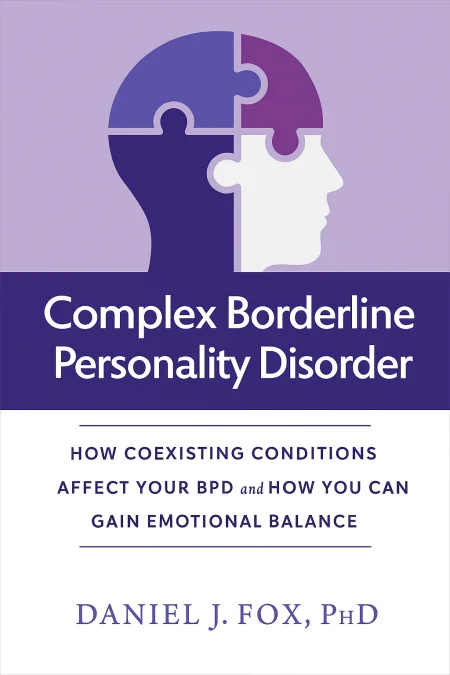
Complex Borderline Personality Disorder
How Coexisting Conditions Affect Your BPD and How You Can Gain Emotional Balance
Book Edition Details
Summary
What if the chaos of emotions could be untangled with newfound clarity? In "Complex Borderline Personality Disorder," psychologist Daniel J. Fox invites you on a transformative journey to understand and manage the multifaceted world of BPD. This pioneering guide peels back the layers of this complex condition, revealing how it intertwines with other mental health issues like bipolar disorder, depression, and PTSD. With insightful checklists and empowering strategies, this book is your key to tailoring a management plan that speaks to your unique needs. Whether you're navigating your own symptoms or supporting a loved one, this guide empowers you to forge resilience and build healthier relationships. Unlock your potential for personal growth with the tools and wisdom found within these pages, and step forward with confidence into a life of greater understanding and self-compassion.
Introduction
Imagine trying to navigate daily life while your emotional compass spins wildly, pointing in different directions depending on invisible forces you can't quite understand. For millions of people living with borderline personality disorder, this isn't just a metaphor—it's reality. But what happens when BPD doesn't appear alone? What if it brings along companions like depression, bipolar disorder, ADHD, or trauma-related conditions, creating a complex web of symptoms that can leave both individuals and their healthcare providers feeling overwhelmed and confused? This intricate phenomenon, known as Complex Borderline Personality Disorder, represents one of the most challenging yet misunderstood areas of mental health. Unlike the traditional view of BPD as a standalone condition, CBPD acknowledges that most people with borderline personality disorder—up to 97 percent—actually experience multiple co-occurring mental health conditions simultaneously. This revelation transforms how we understand treatment, diagnosis, and recovery. Through examining real-world cases and evidence-based approaches, we'll uncover how recognizing these overlapping conditions can lead to more accurate diagnoses, more effective treatments, and ultimately, more hope for those seeking to understand and manage their complex mental health landscape.
Understanding Pure vs Complex Borderline Personality Disorder
The distinction between Pure BPD and Complex BPD represents a fundamental shift in how we conceptualize this challenging condition. Pure BPD occurs when all symptoms and behaviors can be traced back to borderline personality disorder alone, without the influence of other mental health conditions. Think of it as a single instrument playing a complex melody—while the music may be intricate and difficult to follow, it originates from one source. Complex BPD, however, is like an entire orchestra where multiple instruments play simultaneously, sometimes in harmony, sometimes creating discord. This occurs when BPD symptoms interweave with other mental health conditions such as bipolar disorder, major depression, ADHD, or trauma-related disorders. The result is a clinical presentation that's far more intricate than the sum of its parts. What makes this distinction crucial is that only 3 to 15 percent of people diagnosed with BPD actually have the pure form. The vast majority experience Complex BPD, yet this reality has been largely overlooked in both clinical practice and research. This oversight leads to what experts call the "cycle of symptom dismissal," where additional symptoms are incorrectly attributed solely to BPD, leaving other conditions untreated and individuals feeling frustrated with their lack of progress. Understanding whether you're dealing with Pure or Complex BPD isn't just academic—it directly impacts treatment success. Pure BPD responds well to targeted personality disorder treatments, while Complex BPD requires a more comprehensive approach that addresses all co-occurring conditions simultaneously. This recognition opens the door to more effective, personalized treatment strategies that acknowledge the full scope of an individual's mental health landscape rather than trying to fit everything into a single diagnostic box.
Common Co-Occurring Conditions: Depression, Bipolar, and ADHD
Depression frequently accompanies BPD, creating a particularly challenging combination that affects up to 83 percent of individuals with borderline personality disorder. However, distinguishing between BPD-related mood episodes and major depressive disorder requires careful attention to timing and triggers. BPD depressive episodes typically last hours to a few days and often follow identifiable stressors like perceived abandonment or relationship conflicts. In contrast, major depressive episodes persist for at least two weeks regardless of external circumstances. The interplay becomes even more complex when bipolar disorder joins the mix. Approximately 27.6 percent of people with BPD also meet criteria for bipolar disorder, creating a volatile combination of mood instability from multiple sources. While BPD emotional swings are typically triggered by interpersonal stressors and last hours to days, bipolar episodes occur in distinct periods lasting weeks to months, often without clear external triggers. The manic or hypomanic episodes of bipolar disorder can amplify BPD's impulsivity, leading to particularly destructive consequences. ADHD presents its own unique challenges when co-occurring with BPD, affecting approximately 38 percent of individuals with borderline personality disorder. Both conditions share symptoms like impulsivity, emotional dysregulation, and difficulty maintaining relationships, but their origins and manifestations differ significantly. ADHD symptoms stem from attention and executive function deficits, while BPD symptoms arise from core emotional wounds and attachment disruptions. The key to managing these co-occurring conditions lies in understanding their distinct patterns and triggers. Depression medication may help stabilize mood, bipolar disorder requires mood stabilizers to prevent episodes, and ADHD often responds well to stimulant medications. However, medication alone isn't sufficient for Complex BPD. The personality disorder component requires therapeutic work addressing core emotional patterns, while the co-occurring conditions need their own targeted interventions. Success comes from treating the whole person rather than isolated symptoms.
Trauma-Related Complications: PTSD and Dissociative Symptoms
Trauma and BPD share an intricate relationship that significantly complicates both diagnosis and treatment. While trauma isn't required for a BPD diagnosis, approximately 71 percent of individuals with borderline personality disorder have experienced significant childhood adversity. When post-traumatic stress disorder or complex PTSD develops alongside BPD, the resulting symptom picture becomes particularly challenging to untangle. The distinction between PTSD and Complex PTSD is crucial for understanding trauma-related complications in BPD. PTSD typically develops after specific traumatic events and includes symptoms like flashbacks, avoidance, and hypervigilance. Complex PTSD, however, results from prolonged, repeated trauma—often childhood abuse or domestic violence—and includes additional symptoms like emotional dysregulation, negative self-concept, and relationship difficulties. These additional symptoms overlap significantly with BPD characteristics, creating diagnostic complexity. Dissociative symptoms add another layer of complication to this already complex picture. While dissociation can occur in both trauma responses and BPD, the underlying mechanisms differ. Trauma-related dissociation typically involves flashbacks or re-experiencing the traumatic event, while BPD dissociation tends to be a more global disconnection from self and surroundings during times of intense stress. Some individuals experience both types, further complicating their clinical presentation. The treatment implications are significant. Trauma-focused therapies like EMDR or prolonged exposure may be necessary to address PTSD symptoms, while BPD requires approaches that focus on emotional regulation and interpersonal skills. When both conditions are present, treatment must carefully balance trauma processing with skills building, often requiring a longer timeline and more intensive support. The goal isn't just symptom reduction but helping individuals develop a coherent sense of self that integrates their traumatic experiences without being overwhelmed by them. Understanding these distinct but interrelated conditions allows for more targeted, effective treatment approaches.
Managing Complex BPD: Treatment Strategies and Recovery
Successfully managing Complex BPD requires a comprehensive approach that addresses both the personality disorder and all co-occurring conditions simultaneously. Unlike treating a single condition, Complex BPD treatment resembles conducting an orchestra—each instrument must be tuned and coordinated to create harmony rather than chaos. This integrated approach represents a significant departure from traditional sequential treatment models. The foundation of effective Complex BPD treatment begins with accurate identification of all present conditions. This involves detailed assessment using structured interviews and validated screening tools, as unstructured approaches miss co-occurring conditions more than 50 percent of the time. Once the complete clinical picture is clear, treatment planning can address both surface-level symptoms and underlying core content—the deep-seated beliefs and emotional patterns that drive maladaptive behaviors. Medication plays a crucial but limited role in Complex BPD treatment. While psychiatric medications can effectively manage surface symptoms like depression, anxiety, or ADHD, they cannot address the core personality disorder features such as emptiness, abandonment fears, or identity disturbance. The most effective treatment combines medication for co-occurring conditions with evidence-based psychotherapies like Dialectical Behavior Therapy, Mentalization-Based Therapy, or Transference-Focused Psychotherapy for the BPD component. Recovery from Complex BPD is possible but requires patience, persistence, and often longer treatment timelines than single conditions. Success is measured not just by symptom reduction but by improved relationships, increased emotional stability, and a stronger sense of identity. Many individuals with Complex BPD go on to live fulfilling, productive lives once they receive appropriate, comprehensive treatment. The key is recognizing that recovery isn't about eliminating all symptoms but about developing the skills and self-understanding necessary to manage them effectively. With proper support and treatment, the complex web of symptoms can be untangled, allowing individuals to reclaim their lives and relationships.
Summary
Complex Borderline Personality Disorder represents a paradigm shift in understanding mental health, revealing that effective treatment requires addressing not just isolated symptoms but the intricate web of co-occurring conditions that affect the vast majority of individuals with BPD. Rather than viewing borderline personality disorder as a standalone condition, recognizing its complex manifestations opens doors to more accurate diagnoses, comprehensive treatment approaches, and ultimately, better outcomes for those struggling with this challenging constellation of symptoms. The journey through Complex BPD is neither simple nor quick, but it is navigable with the right understanding and support. As we continue to advance our knowledge of these interconnected conditions, how might this integrated approach to mental health transform treatment for other complex psychological presentations? What would happen if we applied this comprehensive lens to other areas where multiple conditions intersect, potentially revolutionizing how we understand and treat the full spectrum of human psychological experience?
Related Books
Download PDF & EPUB
To save this Black List summary for later, download the free PDF and EPUB. You can print it out, or read offline at your convenience.
By Daniel J. Fox
