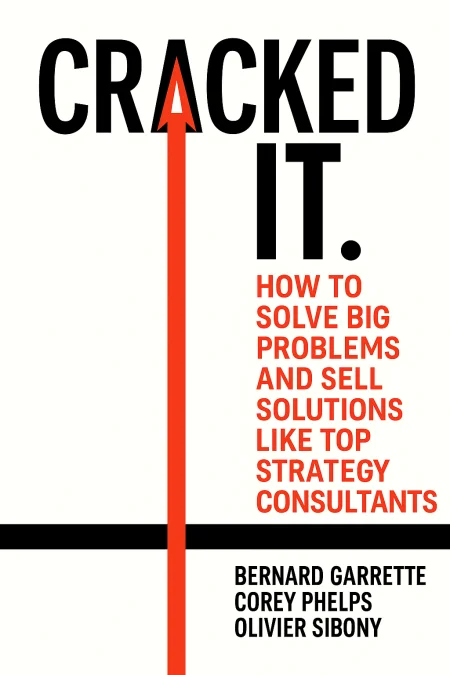
Cracked it!
How to solve big problems and sell solutions like top strategy consultants
byBernard Garrette, Olivier Sibony, Corey Phelps
Book Edition Details
Summary
In the relentless maze of modern business challenges, clarity is the ultimate game-changer. "Cracked It!" is your strategic compass, crafted by three masterminds of problem-solving: Bernard Garrette, Corey Phelps, and Olivier Sibony. This book isn’t just another business manual; it’s a revelation, drawing from the secret arsenal of top consultants and cutting-edge psychological insights. Imagine navigating complex dilemmas with a four-step method that not only dissects problems but also packages solutions in a way that resonates. With vivid stories and real-world cases, this guide empowers you to transform confusion into precision, and hesitation into decisive action. For those ready to rise as indispensable problem-solvers, this is your toolkit to make waves and inspire change within your organization.
Introduction
Why do intelligent professionals, equipped with advanced degrees and years of experience, consistently make spectacular mistakes when facing complex business challenges? The answer lies not in their intelligence or expertise, but in their approach to problem-solving itself. Most people rely on intuitive, fast thinking that leads them to jump to conclusions without properly understanding the problem at hand. This cognitive tendency, while efficient for routine tasks, becomes dangerous when dealing with complex, ill-defined challenges that require systematic analysis and creative solutions. The human mind naturally seeks patterns and coherent narratives, even when dealing with incomplete or misleading information. This book presents a comprehensive framework that transforms problem-solving from an art into a disciplined process. The methodology addresses fundamental questions about how to define problems accurately, structure them systematically, analyze them rigorously, and communicate solutions persuasively. Rather than relying on expertise alone, which can become a trap when facing unfamiliar situations, this framework provides a generalizable approach that works across industries and contexts, helping practitioners avoid common pitfalls while developing innovative solutions that can be successfully implemented.
State and Structure: Problem Definition and Analytical Frameworks
The foundation of effective problem-solving lies in properly stating and structuring the challenge before attempting to solve it. Most problem-solvers rush immediately toward solutions, but this approach often leads to solving the wrong problem or addressing symptoms rather than root causes. The problem definition process requires systematic examination of five critical elements: the underlying trouble that makes the problem urgent and present, the specific owner who has authority and responsibility for addressing it, clear success criteria that define what victory looks like, realistic constraints that limit the solution space, and key actors whose interests and influence will affect implementation. This framework transforms vague concerns into actionable questions. Consider how the music industry initially defined digital file-sharing as a piracy problem requiring legal enforcement, when a more productive framing might have been asking how to create value in a world where technology fundamentally changes music distribution. The difference in problem definition led to vastly different strategic responses and outcomes. Once properly defined, problems must be structured using either hypothesis-driven or issue-driven approaches. Hypothesis-driven structuring begins with a candidate solution and tests whether supporting conditions hold true, creating a pyramid of logical requirements. Issue-driven structuring breaks complex problems into component questions without assuming solutions, building comprehensive trees of mutually exclusive and collectively exhaustive issues. Both approaches rely on analytical frameworks that provide pre-packaged, tested ways of decomposing common business problems. Industry frameworks capture value drivers specific to particular sectors, while functional frameworks offer universal tools for analyzing marketing, finance, operations, and strategic questions. These frameworks serve as mental scaffolding that prevents overlooking critical factors while ensuring systematic coverage of all relevant dimensions.
Solve: Analysis Methods and Design Thinking Approaches
Problem-solving requires moving from structure to analysis, conducting the investigations needed to answer fundamental questions or test key hypotheses. This analytical work spans eight degrees of complexity, from simple fact-gathering to sophisticated judgment calls that require expert input and scenario planning. Effective analysis demands rigorous attention to data quality, ensuring the right numbers are used within appropriate timeframes and avoiding sampling biases that distort conclusions. Assumptions must be made explicit, tested for consistency, and benchmarked against relevant comparables to maintain credibility and enable productive dialogue with stakeholders. However, not all problems yield to traditional analytical approaches. Complex, human-centered challenges often require design thinking methodologies that begin with empathy rather than analysis. This alternative path involves immersing oneself in the experiences of people who face the problem, observing their behaviors, engaging them in conversations about their needs, and sometimes literally living their challenges to develop deep understanding. The insights generated through ethnographic research methods often reveal unexpected dimensions of problems that pure logical analysis would miss. Design thinking proceeds through iterative cycles of ideation, prototyping, and testing that transform abstract insights into tangible solutions. Rather than trying to perfect solutions through analysis alone, designers create rough approximations of their ideas and test them with real users, learning from feedback to refine their approaches. This experimental methodology proves especially valuable when solving novel problems that lack clear precedents or when developing solutions that must appeal to diverse stakeholders with different needs and constraints. The process balances creative exploration with analytical rigor, ensuring solutions are both innovative and practical.
Sell: Communication Strategies and Persuasive Presentation Techniques
Discovering the right solution represents only half the challenge; the other half involves persuading decision-makers to implement it. Effective solution-selling requires abandoning the natural tendency to tell the story of the search and instead crafting the story of the solution itself. Most problem-solvers organize their presentations chronologically, walking through their analytical journey from problem identification through various investigations to final recommendations. This approach frustrates audiences who want to understand the answer and its rationale rather than reliving the discovery process. The pyramid principle provides a superior communication structure that leads with the core message followed by supporting arguments arranged in logical hierarchy. This approach immediately orients the audience toward the recommended action while providing clear reasoning that can withstand scrutiny and questioning. The governing thought must be concise and directional, triggering productive dialogue rather than confused wandering through analytical details. Successful presentations can follow either grouping patterns, where multiple independent reasons support the same conclusion, or argument patterns that build logical sequences from situation through complication to resolution. The choice depends on audience receptivity and message complexity. Grouping works well for straightforward recommendations to supportive audiences, while argument patterns help navigate more complex or controversial situations by building understanding gradually. Both approaches require careful attention to the modular structure that enables presenters to adjust their communication strategy based on time constraints and audience engagement. The ultimate goal extends beyond intellectual agreement to motivating action, transforming analysis into implementation through compelling storytelling that respects both logical rigor and human psychology.
Summary
Mastering complex problem-solving requires replacing intuitive approaches with systematic methodology that integrates analytical rigor, creative thinking, and persuasive communication into a coherent process. This framework recognizes that expertise and intelligence, while necessary, prove insufficient for addressing the non-routine, ambiguous challenges that define modern business and social problems. By providing structured approaches to problem definition, systematic methods for analysis and solution generation, and proven techniques for selling recommendations, this methodology transforms problem-solving from an art dependent on individual brilliance into a learnable skill that can be applied across diverse contexts. The framework's greatest contribution lies not in any single tool or technique, but in demonstrating how disciplined process can overcome cognitive limitations and organizational barriers that prevent even smart, experienced people from developing and implementing effective solutions to the challenges that matter most.
Related Books
Download PDF & EPUB
To save this Black List summary for later, download the free PDF and EPUB. You can print it out, or read offline at your convenience.
By Bernard Garrette
