
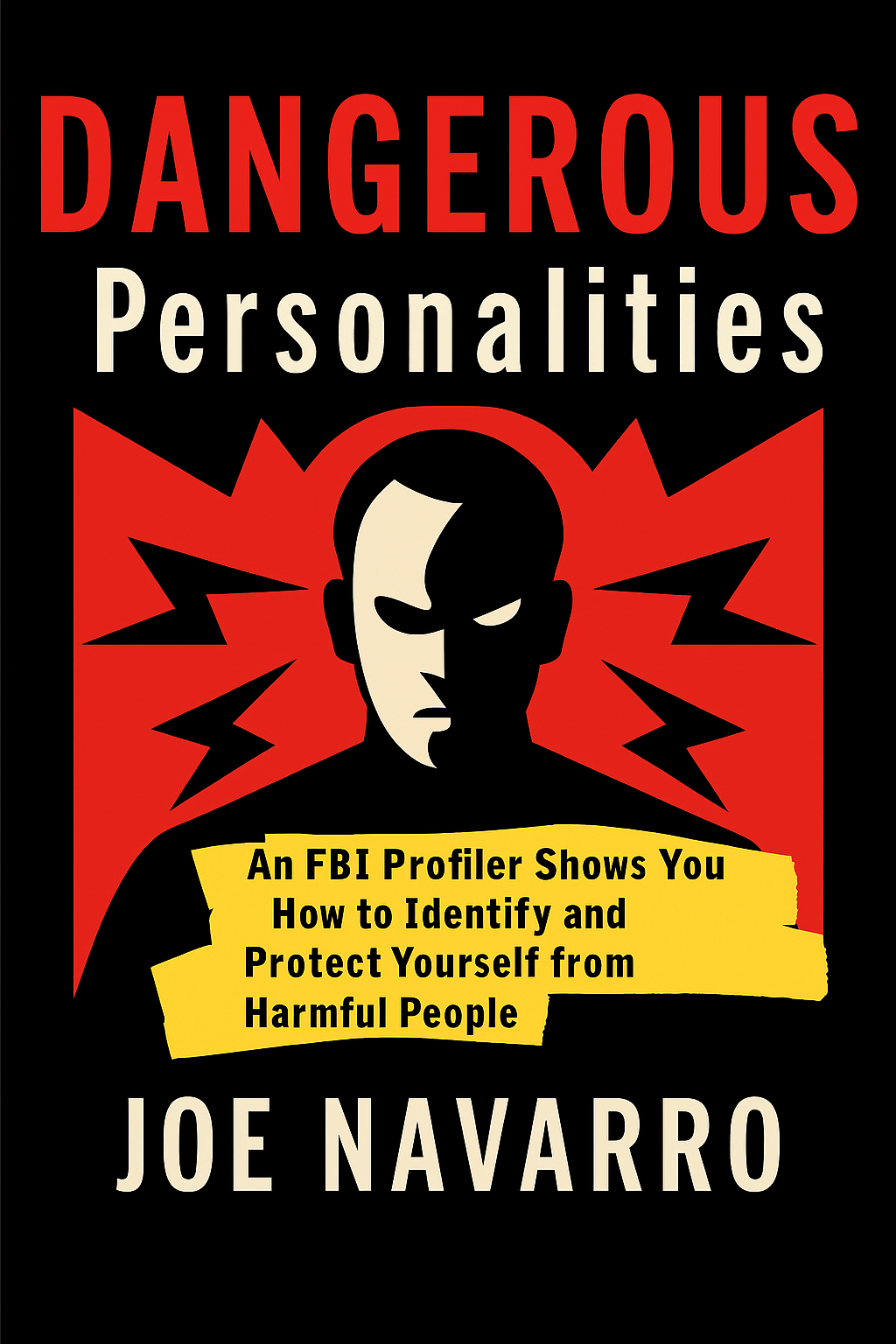
Dangerous Personalities
An FBI Profiler Shows You How to Identify and Protect Yourself from Harmful Personalities
byJoe Navarro, Toni Sciarra Poynter
Book Edition Details
Summary
In a world where danger often lurks in the most unexpected places, "Dangerous Personalities" by former FBI profiler Joe Navarro offers an eye-opening guide to the human psyche's darker corners. With a chilling precision, Navarro unveils the hidden traits of the Narcissist, Predator, Paranoid, and Unstable Personality—archetypes that walk among us, sometimes unnoticed. This gripping narrative not only reveals how these personalities can wreak havoc on lives but also arms readers with the tools to recognize and defend against them. As the book peels back the layers of what makes these personalities so perilous, it empowers everyday individuals to protect themselves from potential threats before they escalate. Here lies an essential blueprint for survival in a world where vigilance is your greatest ally.
Introduction
Human society has always grappled with individuals whose behavior patterns pose significant threats to community safety and wellbeing. Yet most people lack the systematic understanding needed to identify these dangerous personalities before they cause harm. The challenge becomes particularly acute in our modern, interconnected world where traditional community safeguards have weakened, leaving individuals more vulnerable to predatory behavior. This exploration draws upon decades of federal law enforcement experience to establish a comprehensive framework for recognizing four distinct categories of dangerous personalities that repeatedly appear in criminal investigations and victim accounts. Unlike academic approaches that focus primarily on clinical diagnosis, this analysis prioritizes practical identification techniques that ordinary citizens can apply in their daily lives. The methodology centers on observable behaviors rather than internal psychological states, making it accessible to anyone seeking to protect themselves and their loved ones. The approach challenges conventional wisdom that suggests most interpersonal problems can be resolved through communication and understanding. Instead, it argues that certain personality types are fundamentally resistant to change and that recognition followed by strategic disengagement represents the most effective protection strategy. This perspective shift from rehabilitation to prevention offers readers a powerful lens through which to evaluate relationships, workplace dynamics, and social interactions with greater clarity and purpose.
The Four Dangerous Personality Types Defined
Four distinct personality patterns emerge consistently across criminal investigations, victim testimonies, and behavioral analysis: the narcissistic personality, the emotionally unstable personality, the paranoid personality, and the predator. Each represents a fundamental deviation from healthy interpersonal functioning, characterized by specific behavioral signatures that trained observers can learn to recognize. The narcissistic personality operates from a core belief in their own superiority and entitlement. These individuals consistently overvalue themselves while systematically devaluing others, creating relationships built on exploitation rather than mutual respect. Their grandiose self-perception drives them to manipulate situations and people to maintain their inflated sense of importance, often leaving a trail of damaged relationships and violated trust in their wake. Emotionally unstable personalities create chaos through their inability to regulate emotional responses and maintain consistent interpersonal boundaries. Their relationships follow predictable cycles of idealization and devaluation, creating exhausting dynamics for those around them. The unpredictability of their emotional states makes them particularly difficult to navigate, as others must constantly adjust to rapidly shifting moods and demands. Paranoid personalities view the world through a lens of suspicion and mistrust, interpreting neutral or benign actions as threats or conspiracies. This distorted worldview leads them to accumulate grievances and respond disproportionately to perceived slights. Their rigid thinking patterns make them resistant to alternative perspectives and prone to escalating conflicts unnecessarily. The predator represents perhaps the most dangerous category, characterized by a fundamental lack of empathy and conscience. These individuals view others as objects to be used for their own benefit, showing no genuine remorse for the harm they cause. Their ability to mimic normal emotional responses while pursuing purely selfish goals makes them particularly effective at gaining trust before exploiting it.
Behavioral Patterns and Assessment Methods
Recognition of dangerous personalities requires systematic observation of behavioral patterns rather than reliance on first impressions or surface charm. The assessment process focuses on consistency of behavior across different situations and relationships, as dangerous personalities typically reveal their true nature through repeated actions rather than isolated incidents. Key behavioral indicators include boundary violations, where individuals consistently ignore or test limits established by others. This pattern often begins with minor transgressions that escalate over time as the person gauges how much inappropriate behavior will be tolerated. The progression from small violations to major breaches follows predictable patterns that serve as early warning systems for those who know what to observe. The assessment methodology emphasizes the importance of tracking behavioral frequency and intensity rather than focusing solely on specific incidents. Dangerous personalities demonstrate their patterns through repetition, making single events less significant than overall behavioral trajectories. This approach helps distinguish between temporary stress responses and ingrained personality characteristics that indicate long-term risk. Environmental factors and situational stressors can amplify dangerous personality traits, making individuals more unpredictable and potentially harmful. The assessment framework accounts for these variables while maintaining focus on underlying personality structures that remain consistent regardless of external circumstances. This dual awareness helps observers make more accurate evaluations while avoiding the trap of making excuses for consistently problematic behavior.
Complex Combinations and Escalating Threats
Many dangerous individuals exhibit characteristics from multiple personality categories, creating compound threats that can be particularly destructive and unpredictable. These combination personalities often display the worst aspects of each type, with traits that reinforce and amplify each other in dangerous ways. The narcissistic predator, for example, combines the entitlement and grandiosity of narcissism with the calculating exploitation of predatory behavior. Historical analysis reveals that some of the most destructive figures in human history possessed multiple dangerous personality traits. The combination of paranoid thinking with narcissistic grandiosity has repeatedly led to mass violence and social destruction. Understanding these patterns helps explain how individuals can cause harm on scales that seem incomprehensible when viewed through the lens of normal psychology. The escalation process follows identifiable stages as dangerous personalities become more confident in their ability to manipulate and control others. Initial successes in boundary violation and exploitation often embolden these individuals to attempt increasingly serious transgressions. This progression pattern means that early intervention and boundary enforcement become critical for preventing more serious future harm. Recognition of combination personalities requires careful analysis using multiple assessment frameworks simultaneously. The complexity of these cases demands systematic evaluation rather than attempting to fit individuals into single categories. This comprehensive approach provides more accurate threat assessments and better guidance for protective strategies, though it also reveals the sobering reality that some individuals pose multifaceted dangers that require correspondingly comprehensive protective responses.
Protection Strategies and Safety Protocols
Effective protection against dangerous personalities begins with the fundamental principle that safety takes precedence over social conventions or relationship obligations. This perspective shift challenges common social programming that encourages people to give others the benefit of the doubt or to persist in trying to help troubled individuals even at personal cost. The establishment and maintenance of firm boundaries represents the primary defense against dangerous personality manipulation and exploitation. These boundaries must be clearly communicated, consistently enforced, and non-negotiable. The tendency of dangerous personalities to test and push limits means that any flexibility in boundary enforcement will be interpreted as an invitation to escalate problematic behavior. Documentation of concerning behaviors provides crucial support for protection efforts, whether in workplace settings, legal proceedings, or personal safety planning. Detailed records of incidents, dates, witnesses, and consequences create objective evidence that can counter the gaslighting and reality distortion that dangerous personalities often employ to confuse and control their targets. Strategic disengagement often represents the most effective long-term protection strategy, though this approach may conflict with social expectations about relationship maintenance and conflict resolution. The reality that some personality types are fundamentally resistant to positive change means that continued engagement often results in continued victimization rather than improved relationships. Professional support services can provide guidance and resources for those needing assistance with safe disengagement strategies, particularly in complex situations involving legal, financial, or family considerations.
Summary
The systematic identification of dangerous personalities through behavioral observation provides individuals with practical tools for protecting themselves and their loved ones from predictable patterns of harm. The framework demonstrates that personal safety depends not on hoping for the best in others, but on developing the knowledge and skills needed to recognize threat indicators before they escalate into serious harm. This approach transforms personal protection from passive hope into active, informed decision-making based on observable evidence rather than wishful thinking about human nature's better angels.
Related Books
Download PDF & EPUB
To save this Black List summary for later, download the free PDF and EPUB. You can print it out, or read offline at your convenience.
By Joe Navarro
