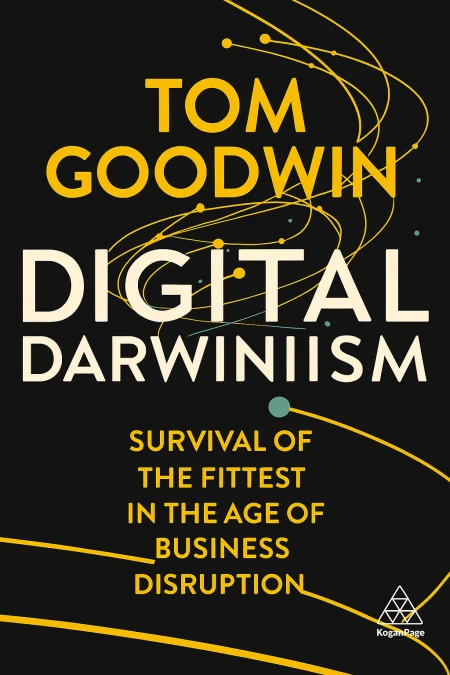
Digital Darwinism
Survival of the Fittest in the Age of Digital Disruption
Book Edition Details
Summary
In a world where the pace of change is a dizzying whirlwind, Tom Goodwin offers a lifeline for leaders navigating this chaos. "Digital Darwinism" dives into the heart of today's business survival—how to evolve when the rules are rewritten overnight. Goodwin decodes the secret to staying ahead, turning technological upheaval into opportunity and innovation. For CEOs and executives facing the relentless march of new data, disruptive technologies, and shifting consumer behaviors, this book is a beacon. It's not just a roadmap; it’s a call to action, urging leaders to reimagine their strategies with bold, transformative insights. As businesses teeter on the edge of obsolescence, the real question becomes: are you ready to adapt and thrive in the digital age's wild frontier?
Introduction
The modern business landscape resembles a battlefield where traditional companies face an existential crisis. While most organizations attempt incremental adaptations to digital technologies, they fundamentally misunderstand the magnitude of transformation required for survival. The conventional approach of adding digital elements to existing structures proves woefully inadequate when confronting companies that have been built from the ground up with digital thinking at their core. This analysis reveals why superficial technological adoption fails and why businesses must undergo radical reconstruction to thrive in an era of exponential change. The central argument challenges the prevailing wisdom that gradual digital transformation suffices. Instead, it demonstrates that successful adaptation requires dismantling foundational assumptions about how businesses operate, serve customers, and create value. Through examining historical precedents, contemporary market dynamics, and emerging technological paradigms, this exploration illuminates the critical distinction between digitizing existing processes and rebuilding enterprises around digital-native principles. The framework presented here guides readers through understanding not just what needs to change, but why conventional change management approaches remain insufficient for the scale of disruption facing modern enterprises.
The Digital Evolution Imperative: Why Incremental Change Fails
The fundamental flaw in contemporary business strategy lies in treating digital transformation as an enhancement rather than a complete reconstruction. Most organizations approach technological change through the lens of their existing operational frameworks, essentially attempting to force revolutionary capabilities into evolutionary containers. This misalignment creates what can be termed "digital disappointment" - the persistent gap between technological potential and actual business outcomes. Historical parallels illuminate this pattern of inadequate response to transformative technologies. The adoption of electricity in early industrial settings provides a compelling example. For decades, factories simply replaced steam engines with electric motors while maintaining the same linear production layouts, missing electricity's true potential to completely reimagine manufacturing processes. Only when entirely new facilities were designed around electrical power's capabilities did the transformative benefits materialize. Similarly, contemporary businesses that merely digitize existing workflows rather than reconceptualizing their fundamental operations find themselves perpetually lagging behind digitally native competitors. The evidence supporting radical over incremental change becomes apparent when examining market valuations. Companies built with digital principles at their core consistently outperform traditional enterprises that have attempted gradual modernization. These digital-first organizations don't simply execute familiar business models more efficiently; they operate under entirely different assumptions about customer relationships, value creation, and organizational structure. The competitive advantage stems not from superior technology implementation, but from architectural decisions made at the foundational level. The imperative for deep transformation extends beyond operational efficiency to encompass existential survival. In rapidly evolving markets, the companies most vulnerable to disruption are often those that have achieved moderate success with incremental improvements. This success creates a dangerous complacency, providing enough positive reinforcement to discourage the more dramatic changes necessary for long-term viability. The path forward requires acknowledging that existing organizational DNA may be fundamentally incompatible with future market realities.
Paradigm Shifts and Deep Transformation Strategies
True disruption emerges not from technological superiority alone, but from the willingness to abandon established paradigms entirely. The most successful market entrants typically possess no expertise in their chosen industries, allowing them to approach problems without the cognitive constraints that limit incumbents. This phenomenon explains why breakthrough innovations consistently originate from unexpected sources rather than established industry leaders. The concept of paradigm shifts reveals why expertise can become a liability. Industry knowledge creates mental models that define both possibilities and limitations. These frameworks, while useful for optimization within existing parameters, actively prevent the recognition of alternative approaches. Tesla's automotive success exemplifies this principle. Rather than attempting to build better combustion engines, the company reconceptualized transportation around entirely different technological and business assumptions. The result was not an improved car, but a fundamentally different category of vehicle that made traditional automotive expertise largely irrelevant. Paradigm shifts require abandoning local optimization in favor of global reimagining. Most improvement efforts focus on incrementally enhancing current solutions, creating what mathematicians call "local maxima" - points of optimization within limited constraint sets. However, revolutionary progress requires recognizing that optimal solutions may exist in completely different problem spaces. This recognition demands the intellectual courage to abandon proven approaches in favor of unproven alternatives. The strategic implications extend beyond product development to encompass entire business ecosystems. Companies pursuing paradigm shifts must simultaneously reimagine customer relationships, revenue models, operational processes, and competitive positioning. Apple's transformation from computer manufacturer to lifestyle ecosystem illustrates this comprehensive approach. The company didn't simply make better computers; it redefined computing's role in human experience and built an integrated ecosystem that transcends traditional product categories. This holistic transformation creates sustainable competitive advantages that prove difficult for traditional competitors to replicate.
Future Technologies and Human-Centered Design
The trajectory of technological development points toward increasing integration between digital capabilities and human experience, yet this integration must prioritize human needs over technological possibilities. The most successful implementations of emerging technologies consistently demonstrate deep understanding of human psychology, behavioral patterns, and emotional requirements rather than merely showcasing technical sophistication. Artificial intelligence and automation represent perhaps the most significant technological shifts on the horizon, but their impact will be determined by implementation philosophy rather than technical capabilities. Organizations that view these technologies as human replacement tools fundamentally misunderstand their transformative potential. More promising approaches treat AI as augmentation technology that enhances human capabilities rather than substituting for human judgment. This perspective requires designing systems that complement human strengths while compensating for human limitations. The concept of ambient computing suggests a future where technology becomes increasingly invisible while simultaneously more integral to daily experience. This evolution mirrors historical patterns where transformative technologies eventually fade into background infrastructure. Electricity transformed human society not by making electrical systems more prominent, but by making electrical power so reliable and ubiquitous that it became unnoticeable. Similarly, the most impactful implementations of emerging technologies will likely be those that enhance human capabilities without demanding conscious attention or behavioral modification. Privacy and data relationships represent critical considerations for future technological integration. Current approaches often treat personal data as a resource to be extracted rather than as an asset to be managed collaboratively. More sustainable models will likely emerge that recognize individuals as active participants in data ecosystems rather than passive sources of information. These approaches require developing new frameworks for consent, control, and value sharing that align technological capabilities with human autonomy and dignity. The organizations that successfully navigate these challenges will likely establish the foundations for long-term competitive advantage in an increasingly data-driven economy.
Implementing Digital Darwinism for Business Success
Successful transformation requires recognizing that organizational change operates at multiple levels simultaneously, from cultural assumptions to operational processes to customer interface design. The most critical decisions often involve determining what to preserve from existing organizational capabilities while identifying elements that must be completely reconstructed. This process demands diagnostic tools that can distinguish between valuable institutional knowledge and counterproductive legacy constraints. Leadership becomes paramount in transformation efforts because fundamental change inevitably generates resistance from multiple stakeholder groups. Employees fear job security, investors worry about short-term performance impacts, and customers may resist unfamiliar experiences. Effective transformation leadership requires building coalition support while maintaining clear vision about long-term objectives. This often means making decisions that appear suboptimal from traditional business perspectives but align with transformed organizational logic. The implementation process benefits from adopting startup methodologies while leveraging established organizational resources. This hybrid approach combines entrepreneurial agility with institutional stability, creating conditions where radical experimentation becomes possible without threatening organizational survival. Companies successfully navigating this balance often establish separate innovation units that operate under different rules while maintaining connection to core organizational capabilities. Measurement and feedback systems must evolve to support transformation objectives rather than reinforcing traditional performance metrics. Legacy measurement approaches often inadvertently discourage the experimentation and risk-taking necessary for breakthrough innovation. Organizations serious about transformation typically need to develop new assessment frameworks that reward learning velocity, customer insight generation, and market position building rather than short-term financial optimization. These measurement changes signal organizational commitment to transformation while providing practical guidance for tactical decision-making throughout the change process.
Summary
The fundamental insight emerging from this analysis concerns the inadequacy of incremental approaches to technological change in rapidly evolving business environments. Organizations that treat digital transformation as a series of technological upgrades rather than comprehensive reconstruction consistently underperform competitors built around digital-native principles from inception. The evidence suggests that sustainable competitive advantage in technology-driven markets requires abandoning optimization within existing paradigms in favor of discovering entirely new operational frameworks. This transformation demands not just new technologies or processes, but fundamentally different assumptions about value creation, customer relationships, and organizational purpose. The methodology presented here offers a framework for distinguishing between cosmetic modernization and genuine reinvention, providing practical guidance for leaders willing to undertake the profound changes necessary for long-term organizational survival and success.
Related Books
Download PDF & EPUB
To save this Black List summary for later, download the free PDF and EPUB. You can print it out, or read offline at your convenience.
By Tom Goodwin
