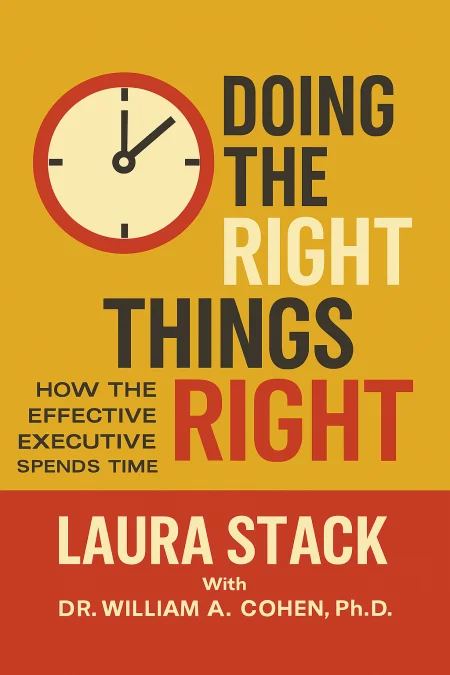
Doing the Right Things Right
How the Effective Executive Spends Time
byLaura Stack, William A. Cohen
Book Edition Details
Summary
In the bustling arena of modern leadership, Laura Stack emerges as a beacon for those seeking to master the art of doing the right things right. Inspired by the wisdom of Peter Drucker, Stack's "Doing the Right Things Right" is a must-have compass for navigating the intricate dance between effectiveness and efficiency. Imagine leading a team where every action aligns seamlessly with your organization’s goals, optimizing time, energy, and resources without a hitch. Stack's revolutionary 3T Leadership model—Strategic Thinking, Teamwork, and Tactics—delivers twelve actionable practices designed to catapult executives into the realm of unparalleled productivity. This is more than a guide; it’s a catalyst for leaders hungry for transformative results, ready to equip you with the tools to inspire confidence and drive success across your team.
Introduction
In today's rapidly evolving business landscape, leaders face an unprecedented challenge: how to navigate between effectiveness and efficiency while maintaining team productivity and personal well-being. The modern executive must juggle strategic thinking, team management, and tactical execution with precision and grace. This intersection of doing the right things and doing them right has become the defining characteristic of successful leadership in our connected, fast-paced world. The question isn't whether you can manage one aspect of leadership well, but whether you can master all three dimensions simultaneously. When you understand how to align strategic vision with team dynamics and tactical execution, you unlock the potential to transform not just your own productivity, but the entire culture of achievement around you.
Strategic Thinking: Align Goals and Drive Change
Strategic thinking represents the foundation of effective leadership, requiring you to maintain a bird's eye view while ensuring every team effort reinforces organizational objectives. At its core, strategic thinking means consistently asking yourself what the desired outcome should be, then working backward to create the pathway forward. This isn't about creating elaborate five-year plans that become obsolete within months, but about developing the mental agility to adapt quickly while keeping your ultimate destination in focus. Consider how Brenda Knowles, Vice President of Marketing at Shaw Industries, approaches strategic alignment. Rather than dictating solutions from above, she empowers her business areas to bring forth recommendations within a clear strategic framework. Her team understands the company's growth strategy and customer needs, which allows them to innovate while staying aligned with core objectives. This approach creates what she calls "empowerment and accountability," where team members feel ownership of both the process and the results. The transformation in Knowles' organization didn't happen overnight. By giving her team the big picture and clear guardrails, while relying on their strengths and insights, she created a culture where strategic thinking became everyone's responsibility, not just leadership's burden. Her teams now anticipate market forces and continuously improve products, processes, and services because they understand how their individual contributions connect to the larger vision. To implement strategic thinking effectively, start by establishing core values as your foundation. These values should guide every decision and serve as the measuring stick for all initiatives. Next, ensure your team understands not just what they're doing, but why their work matters and how it moves the organization forward. Create regular opportunities to step back and assess whether your current path aligns with your desired outcomes, and be willing to make course corrections quickly when circumstances change. Remember that strategic thinking isn't a solo activity. The most successful leaders actively involve their teams in the strategic process, leveraging diverse perspectives and front-line insights to create more robust and adaptive strategies. When everyone understands the strategy and feels empowered to execute it, you create a self-reinforcing cycle of alignment and achievement.
Team Focus: Build Culture and Performance Excellence
Team focus transforms individual contributors into a cohesive force capable of achieving extraordinary results. This goes far beyond simple collaboration; it's about creating an environment where people genuinely want to invest their discretionary effort because they feel valued, understood, and empowered to make a difference. Modern leadership requires you to be both a visionary and a facilitator, someone who clears obstacles while inspiring others to reach beyond their perceived limitations. Steve Gangwish from CSS Farms exemplifies this approach in his leadership philosophy. When his team members go to work in the morning and return home at night, they feel like it's their operation, their farm. This sense of ownership doesn't happen by accident. Gangwish deliberately fosters autonomy while maintaining clear communication channels, visiting sites regularly but trusting his farm managers to run their operations independently for the majority of the year. The results speak for themselves. CSS Farms has become a primary supplier for major companies like Frito-Lay because their team members think and act like business owners rather than just employees. When people feel genuine ownership of their work, they naturally become more creative, more committed, and more willing to go above and beyond expectations. This transformation from employee mindset to owner mindset represents one of the most powerful shifts a leader can facilitate. Building this kind of culture requires intentional daily actions. Start by making sure every team member understands how their role contributes to the bigger picture. Provide the tools, training, and authority they need to excel, then step back and let them own their responsibilities. When challenges arise, resist the urge to micromanage; instead, ask how you can remove obstacles and provide support. Create regular opportunities for recognition and celebration, but make sure your praise is specific and meaningful rather than generic. Most importantly, model the behavior you want to see by taking ownership of your own responsibilities and decisions, especially when things don't go according to plan.
Tactical Work: Master Time and Technology
Tactical work represents where strategy meets reality, where all your planning and team building either produces results or falls short. This dimension of leadership focuses on the practical execution of daily responsibilities, the systems and processes that enable consistent high performance, and the personal disciplines that sustain long-term effectiveness. Mastering tactical work means becoming exceptionally skilled at managing the intersection of time, technology, and human energy. Mike Howard, Chief Security Officer at Microsoft, demonstrates this mastery through his evolution from reactive crisis management to strategic oversight. Twelve years ago, he spent half his time responding to tactical issues, putting out fires and managing immediate crises. Through careful attention to talent development and systematic process improvement, he gradually shifted his tactical time to just fifteen to twenty percent, freeing himself to focus on strategic initiatives while building a team capable of handling operational challenges independently. This transformation didn't happen through delegation alone, but through deliberate system building. Howard invested significant time in training his team, documenting processes, and creating clear decision-making frameworks. He established communication rhythms that kept leadership informed without creating dependency, and he built enough redundancy in his systems that no single person became indispensable. The result is an operation that runs smoothly whether he's present or traveling internationally. To master tactical work yourself, start by conducting an honest assessment of how you currently spend your time. Identify which activities only you can do versus those that could be handled by others with proper training and authority. Create systems and documentation that allow your team to operate effectively in your absence, and gradually shift your focus from doing the work to enabling others to do the work excellently. Pay special attention to your relationship with technology. Use it as a tool to amplify your effectiveness, but don't let it control your schedule or attention. Establish clear boundaries around email, social media, and other digital communications to protect your focus during deep work periods. Finally, remember that tactical excellence isn't about perfection; it's about consistent, sustainable performance that supports your strategic objectives while maintaining your team's well-being.
Summary
The path to exceptional leadership lies in mastering the dynamic balance between strategic thinking, team focus, and tactical execution. As the business environment continues to accelerate and become more complex, your ability to operate effectively across all three dimensions becomes not just an advantage, but a necessity for survival and success. The leaders who thrive in this environment understand that effectiveness and efficiency aren't competing priorities but complementary forces that, when properly aligned, create extraordinary results. Remember that time is your most precious resource, and how you invest it across these three areas of leadership will ultimately determine both your impact and your fulfillment. Start today by choosing one area where you can immediately improve your approach, then systematically work to strengthen your capabilities across all three dimensions until operating at this level becomes second nature.
Related Books
Download PDF & EPUB
To save this Black List summary for later, download the free PDF and EPUB. You can print it out, or read offline at your convenience.
By Laura Stack
