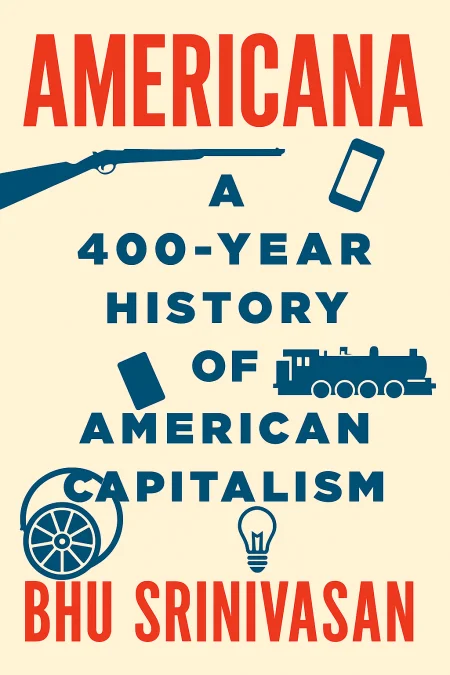
Americana
A 400-Year History of American Capitalism
Book Edition Details
Summary
In the vibrant tapestry of American history, Bhu Srinivasan stitches together a thrilling narrative of ambition and innovation with "Americana." From the telegraph's first clicks to the smartphone's ubiquitous presence, the pulse of capitalism beats at the heart of this sweeping chronicle. Here, pioneers and dreamers aren't just historical footnotes—they're the architects of a nation perpetually in motion. Discover how a telegraph boy named Andrew Carnegie redefined industry, or how the Mafia's shady dealings mirrored corporate consolidation. With a dash of intrigue and a sprinkle of revelation, Srinivasan reshapes our understanding of American enterprise, proving that the entrepreneurial spirit is as old as the country itself.
Introduction
Imagine standing on the docks of London in 1620, watching nervous investors hand over their life savings to fund a group of religious separatists sailing into the unknown. These merchants were essentially creating history's first venture capital deal, complete with equity stakes and profit-sharing agreements that would make modern Silicon Valley entrepreneurs nod in recognition. Fast-forward to 1973, when a young Bill Gates glimpsed the future of personal computing, or to 1994 when Jeff Bezos left his Wall Street job to sell books from his garage. The thread connecting these moments reveals something profound about the American economic story. This exploration unveils how America's rise wasn't simply about democratic ideals or military might, but about a unique economic system that emerged from the collision of European capital, indigenous knowledge, enslaved labor, and democratic aspirations. Through four centuries of boom and bust, innovation and disruption, the American economy has repeatedly reinvented itself while grappling with fundamental tensions between individual opportunity and collective welfare, between market freedom and democratic governance. Whether you're fascinated by entrepreneurship, curious about how technological revolutions reshape society, or seeking to understand the forces driving today's economic debates, this historical perspective offers crucial insights. The story of American capitalism is ultimately about human ingenuity, the power of creative destruction, and the ongoing struggle to balance prosperity with justice in an ever-changing world.
Colonial Ventures and Early Industrial Foundations (1620-1860)
The DNA of American capitalism was encoded in those first colonial ventures, where European merchants gambled fortunes on uncertain New World opportunities. The Virginia Company's tobacco profits and the Pilgrims' beaver fur trade established a pattern that would define American economic development: the willingness to take extraordinary risks for potentially revolutionary returns. These weren't just business deals but experiments in mobilizing capital across vast distances for projects with no guaranteed outcomes. The early colonial period revealed capitalism's capacity for both liberation and oppression. While tobacco plantations generated unprecedented wealth, they also embedded slavery into America's economic foundation. Northern colonies developed more diversified economies around trade and early manufacturing, creating regional differences that would eventually tear the nation apart. The Boston Tea Party wasn't merely about taxation but about who controlled the terms of trade in an emerging global economy. By the early 1800s, innovations like Eli Whitney's cotton gin and the Erie Canal demonstrated how technological breakthroughs could transform entire regions overnight. The canal connected the Great Lakes to the Atlantic, making New York City the commercial center of a continental economy. Samuel Morse's telegraph compressed time and space in ways that made modern business coordination possible for the first time in human history. These foundational decades established the infrastructure and institutions that would enable America's industrial takeoff. Patent systems protected inventors, corporations enabled large-scale investment, and relatively free markets created unprecedented opportunities for economic mobility. The stage was set for the dramatic transformations that would follow, though the fundamental contradiction between free and slave labor remained unresolved, threatening to destroy everything that had been built.
Gilded Age Titans and Corporate Consolidation (1860-1930)
The Civil War transformed American capitalism from a collection of regional markets into an integrated national powerhouse. The conflict itself became a massive industrial undertaking that demonstrated the Union's superior productive capacity. Railroad networks that had carried troops now carried goods across a reunited continent, while telegraph lines that had coordinated military operations now coordinated business transactions from coast to coast. This infrastructure enabled the rise of industrial titans like Andrew Carnegie and John D. Rockefeller, who understood that the new economy rewarded scale and systematic organization above all else. Carnegie's steel empire controlled every aspect of production from raw materials to final delivery, while Rockefeller's Standard Oil achieved dominance through superior logistics and strategic thinking. These men weren't just accumulating wealth but creating the organizational structures that would define modern corporate America. The era's contradictions were stark and profound. The same forces that built magnificent libraries and universities also produced dangerous working conditions, child labor, and environmental destruction. Labor unions emerged as workers sought their share of industrial prosperity, leading to violent confrontations that revealed fundamental tensions within the system. The Pullman Strike and other labor conflicts showed that prosperity wasn't automatically shared, requiring conscious effort and often bitter struggle. The 1920s seemed to vindicate capitalism's promise of broad-based prosperity. Henry Ford's assembly line made automobiles accessible to the workers who built them, while mass production techniques created the first true consumer economy. Yet the decade's speculative excesses revealed capitalism's inherent instability. The stock market crash of 1929 ended an era of unbounded faith in market mechanisms, forcing Americans to confront the need for new forms of economic governance and social protection.
Depression, War Economy, and Government Partnership (1930-1980)
The Great Depression shattered confidence in unregulated markets and forced a fundamental reconsideration of capitalism's role in American society. Franklin Roosevelt's New Deal didn't abandon market mechanisms but established government as capitalism's partner and occasional referee. Social Security, federal deposit insurance, and securities regulation created a safety net that actually strengthened capitalism by reducing systemic risks and maintaining consumer confidence during downturns. World War II demonstrated capitalism's extraordinary productive potential when directed toward national purposes. American factories that had struggled to find markets during the Depression suddenly produced aircraft, ships, and weapons at unprecedented scales. This wartime collaboration between public and private sectors created the template for postwar prosperity, proving that government investment could drive private innovation rather than stifle it. The postwar decades witnessed the creation of distinctly American mass prosperity, built on suburban development, consumer credit, and technological innovation. Government programs like the GI Bill and federal housing policies channeled market forces toward broadly shared prosperity. The same public investments that had produced radar and computers during wartime now funded the research that would eventually create the Internet and personal computing revolution. This period established what economists would later call the "mixed economy," where market forces operated within a framework of government regulation, social insurance, and public investment. The system proved remarkably successful at generating both growth and stability, creating the world's largest middle class while maintaining America's position as the global center of technological innovation. Yet by the 1970s, new challenges were emerging that would test this model's adaptability.
Digital Revolution and Global Market Dominance (1980-Present)
The rise of Silicon Valley in the 1980s and 1990s represented a new chapter in American capitalism, where venture capital, technological innovation, and global markets combined to create unprecedented wealth and influence. Entrepreneurs like Steve Jobs and Bill Gates transformed laboratory discoveries into mass-market products, while venture capitalists provided the patient capital necessary for long-term innovation. This ecosystem proved remarkably effective at translating scientific breakthroughs into commercial applications. The Internet revolution of the 1990s created the first truly global marketplace for information, entertainment, and commerce. Companies like Amazon and Google emerged from garages and dorm rooms to become some of the world's most valuable corporations, demonstrating capitalism's continued capacity for creative destruction. The dot-com boom and bust revealed that even sophisticated markets remained subject to speculation and irrationality, yet the underlying technological infrastructure continued transforming how people work and live. The 2008 financial crisis exposed new vulnerabilities in an increasingly complex and interconnected global economy. The same financial innovations that had democratized credit and homeownership also created systemic risks that threatened the entire system. Government intervention prevented complete collapse, but the crisis raised fundamental questions about inequality, regulation, and the social purposes of capitalism that remain unresolved. Today's digital economy presents both unprecedented opportunities and new challenges. Artificial intelligence, biotechnology, and renewable energy offer the potential for revolutionary improvements in human welfare, while platform monopolies and algorithmic decision-making raise concerns about concentration of power and democratic governance. The COVID-19 pandemic demonstrated both capitalism's fragility and its resilience, as supply chains collapsed and recovered while new business models emerged almost overnight.
Summary
The central thread running through four centuries of American capitalism is the constant tension between democratic ideals and market forces, between individual opportunity and collective welfare, between innovation and stability. This tension has never been resolved, yet it has generated extraordinary dynamism and adaptability. American capitalism succeeded not by eliminating this creative tension but by developing institutions that could channel it productively toward broadly beneficial outcomes. The historical record reveals that capitalism's greatest achievements have typically emerged from the combination of public and private resources rather than pure market forces alone. The transcontinental railroad, the Internet, and suburban prosperity all required government investment alongside private entrepreneurship. Similarly, capitalism's most destructive episodes have resulted from the unchecked pursuit of private profit without adequate regard for broader social consequences. Three crucial insights emerge for navigating contemporary challenges. First, successful capitalism requires strong public institutions capable of providing the infrastructure, education, and regulation that markets need to function effectively over the long term. Second, technological innovation alone cannot solve social problems but must be combined with conscious efforts to ensure that progress benefits are broadly shared across society. Finally, the American model remains a work in progress, requiring constant adaptation and reform to address new challenges while preserving the entrepreneurial energy that has driven centuries of innovation and broadly shared prosperity.
Related Books
Download PDF & EPUB
To save this Black List summary for later, download the free PDF and EPUB. You can print it out, or read offline at your convenience.
By Bhu Srinivasan
