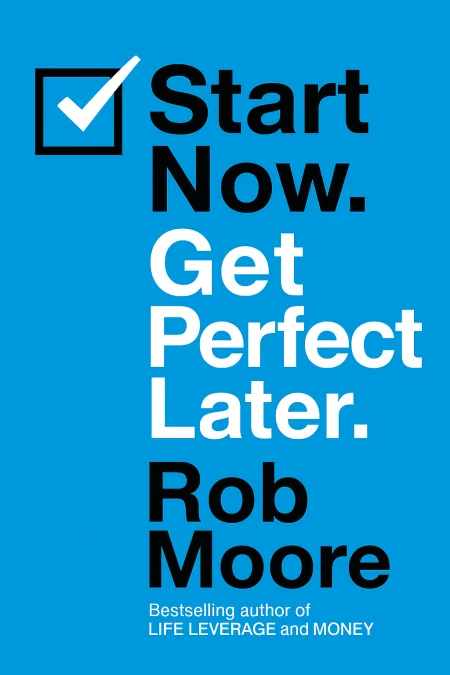
Start Now. Get Perfect Later.
Make Quick, Smart Decisions, and Overcome Procrastination
Book Edition Details
Summary
Staring at a blank page or endless to-do list, paralyzed by the quest for perfection? Rob Moore, acclaimed author of MONEY, dismantles the myth of flawless beginnings in "Start Now. Get Perfect Later." This invigorating guide propels you to leap into action, stripping away the chains of procrastination and self-doubt. Moore’s dynamic insights blend practical strategies with a motivational nudge, coaxing you to dive into ventures without waiting for the "perfect" moment. Learn to harness your intuition, master time management, and make decisive choices that propel you forward. Embrace the messiness of growth and let go of the fear of failure—the road to excellence starts with your first step today.
Introduction
How many times have you found yourself stuck in the endless loop of planning, preparing, and waiting for the perfect moment to begin something important? You know exactly what you need to do, yet somehow you keep finding reasons to delay. Whether it's starting that business, writing that book, having that difficult conversation, or making that life-changing decision, we all struggle with the gap between knowing and doing. The truth is, perfectionism isn't about excellence—it's about fear disguised as preparation. While you're busy getting your ducks in a row, life is passing you by. The most successful people aren't those who wait for perfect conditions; they're the ones who embrace imperfection as a starting point and refine as they go. This isn't about being reckless or unprepared—it's about understanding that action creates clarity, momentum builds confidence, and progress trumps perfection every single time.
Break the Procrastination Paradox
Procrastination isn't a character flaw or a sign of laziness—it's actually an ancient survival mechanism that once kept our ancestors alive. When facing a saber-toothed tiger, hesitation and careful consideration could mean the difference between life and death. Today, however, this same mechanism kicks in when we face modern challenges like public speaking, starting a business, or making important decisions, treating them as life-threatening situations when they're simply opportunities for growth. Consider the story of James, a talented engineer who spent three years researching the perfect business idea. He attended seminars, read countless books, and created elaborate business plans, all while remaining safely employed in his corporate job. James convinced himself he was being diligent and thorough, but in reality, he was stuck in what experts call "analysis paralysis." His brain was protecting him from the perceived danger of failure by keeping him in the comfortable zone of preparation. The breakthrough came when James realized that his extensive research was actually a form of sophisticated procrastination. He had enough knowledge to start ten businesses, yet he hadn't taken a single concrete step toward launching one. The moment he shifted his focus from perfect preparation to imperfect action, everything changed. He launched a simple consulting service within a week, learned more in his first month of operation than in three years of research, and built a six-figure business within eighteen months. To break your own procrastination paradox, start by recognizing that the urge to procrastinate often intensifies right before important breakthroughs. Set a "good enough" threshold—aim for 70% readiness rather than 100%. Create artificial deadlines with real consequences, such as announcing your project publicly or committing resources that would be wasted if you don't follow through. Most importantly, remember that taking imperfect action today is infinitely more valuable than perfect planning for tomorrow. The key to overcoming procrastination is understanding that you're not avoiding the task—you're avoiding the feeling you think the task will create. Once you start, you'll often find that the anticipation was far worse than the reality.
Make Smarter, Faster Decisions
Decision-making isn't about having perfect information—it's about having enough information to act responsibly while maintaining the courage to move forward despite uncertainty. The most successful people aren't those who make perfect decisions; they're those who make decisions quickly and then make them work through persistent action and course correction. Take Richard Branson's approach to launching Virgin Atlantic. When he was approached with the opportunity to start an airline, he didn't spend months analyzing market conditions or creating detailed business projections. Instead, he negotiated a simple deal with Boeing: if the airline failed, they would take the planes back. This single decision protected his downside risk while opening up unlimited upside potential. Within hours of that conversation, he had committed to launching an airline—a decision that would create billions in value. Branson's success came not from perfect foresight but from understanding the anatomy of smart decision-making: protect the downside, embrace the upside, and act quickly when you have enough information to move forward responsibly. He didn't wait for certainty; he created conditions where uncertainty became manageable. The airline succeeded not because the initial decision was perfect, but because he was committed to making it work through continuous adjustment and improvement. To make smarter, faster decisions in your own life, limit the time you spend on any single decision to what's proportional to its importance. For most decisions, set a deadline of 24-48 hours maximum. Gather information actively but don't wait for complete certainty—it doesn't exist. Focus on protecting your downside through contracts, partnerships, or other risk mitigation strategies, then commit fully to making your decision work. Remember that there are no perfect decisions, only decisions that you make perfect through committed action and intelligent course correction.
Build Your Decision Muscle
Like physical strength, decision-making ability grows stronger with regular exercise and progressive challenges. Every decision you make—whether it turns out well or poorly—adds to your experience bank and improves your intuitive judgment for future choices. The goal isn't to avoid mistakes but to make them quickly, learn from them completely, and carry that wisdom forward. Consider the journey of Sara Blakely, founder of Spanx. She made hundreds of small decisions that seemed insignificant at the time but collectively built her decision-making muscle. When she couldn't find the right undergarment for white pants, she decided to cut the feet off her pantyhose. When that worked, she decided to research the hosiery industry. When she discovered an opportunity, she decided to invest her $5,000 savings. Each decision built confidence for the next, larger decision. By the time she was making million-dollar choices about manufacturing and distribution, her decision muscle was strong enough to handle the weight. The transformation didn't happen overnight. Blakely's early decisions were often wrong—she was rejected by manufacturer after manufacturer, made mistakes in product development, and initially struggled with marketing. But each "wrong" decision taught her something valuable that informed better decisions later. She discovered that her decision-making muscle grew strongest not when everything went perfectly, but when she had to adapt and problem-solve in real time. To build your own decision muscle, start with smaller, lower-stakes decisions and practice making them quickly and confidently. Keep a decision journal where you record not just what you decided but why you decided it and what you learned from the outcome. Seek out mentors and advisors who can help you stress-test important decisions, but don't let their input paralyze you—use it to make better decisions, not to avoid making decisions altogether. Most importantly, celebrate both your successful decisions and your learning experiences. Every decision you make, regardless of outcome, is practice for the bigger decisions that will shape your future.
Create Your Results Routine
Consistent results don't come from occasional bursts of inspiration or perfect conditions—they come from intentionally designed routines that automate good decisions and minimize the energy required for daily choices. When you create systems that support your goals, success becomes less about willpower and more about workflow. Look at the daily routine of someone like Tim Cook, CEO of Apple. He doesn't wake up each morning wondering when to exercise, what to eat for breakfast, or how to structure his day. These decisions are pre-made through routine, which frees his mental energy for the complex decisions that actually move the company forward. His routine includes waking at 3:45 AM, reading customer emails, exercising at the gym, and starting work by 6 AM—not because these times are magical, but because the consistency eliminates decision fatigue and creates space for focused work. The power in Cook's routine isn't the specific timing but the systematic approach to energy management. By automating low-value decisions through routine, he preserves his mental bandwidth for high-value choices. When a crisis hits or an opportunity emerges, he has the cognitive resources to respond effectively rather than being depleted by a thousand small decisions throughout the day. Your results routine should be built around your natural energy rhythms and most important priorities. Start by tracking your energy levels throughout the day for two weeks, noting when you feel most creative, most focused, and most depleted. Then design your routine to place your highest-value activities in your highest-energy time slots. Batch similar activities together to minimize switching costs, and create specific triggers that automatically initiate important behaviors. Build flexibility into your routine by creating "minimum viable" versions for difficult days and "optimal" versions for when you're firing on all cylinders. The key is consistency over perfection—a routine you can maintain 80% of the time is infinitely more valuable than a perfect routine you abandon after a few weeks.
Summary
The bridge between knowing what to do and actually doing it isn't built from perfect plans or ideal conditions—it's constructed from decisive action and continuous refinement. As the evidence shows throughout countless success stories, "you can't connect the dots moving forwards, you only can when you're looking backwards." The clarity you seek will come through action, not contemplation. The confidence you need will develop through experience, not preparation. The perfect moment you're waiting for will emerge from the imperfect moments you create by starting now. Your next step is simple but not easy: choose one important decision you've been postponing and commit to taking the first concrete action within the next 24 hours. Not the perfect action, not the complete action, just the next action. Trust that your ability to handle whatever comes next will expand to meet the challenge, because it always has and it always will.
Related Books
Download PDF & EPUB
To save this Black List summary for later, download the free PDF and EPUB. You can print it out, or read offline at your convenience.
By Rob Moore
