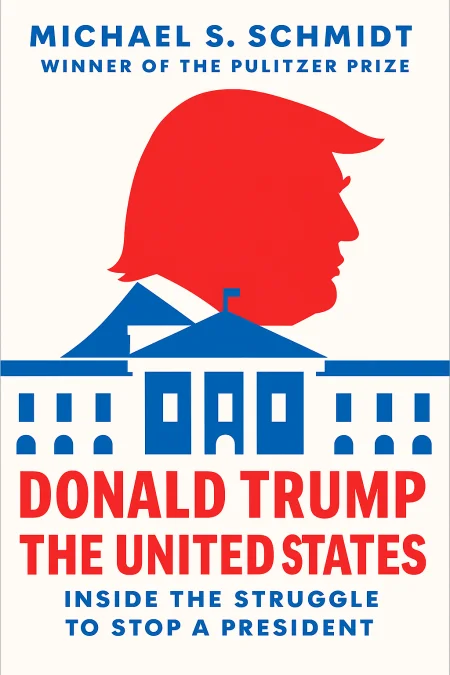
Donald Trump v. The United States
Inside the Struggle to Stop a President
Book Edition Details
Summary
In the crucible of unprecedented political turmoil, Michael S. Schmidt unveils a narrative crackling with tension and intrigue. With the Oval Office as its stage, "Donald Trump v. The United States" plunges readers into a world where the guardians of democracy grapple with a president testing the limits of his power. As lines blur between duty and defiance, Schmidt chronicles the clandestine maneuvers and moral dilemmas faced by those who swore allegiance not just to a leader, but to the nation. This is no ordinary chronicle; it’s a riveting exposé of a fragile democracy's battle for its very soul, told through the eyes of those who stood at its defense. With unprecedented access to secret documents and insider accounts, Schmidt crafts a narrative that is as illuminating as it is unsettling, capturing a saga of loyalty, power, and the unyielding quest for truth.
Introduction
In the summer of 2016, as America prepared to choose its next president, few could have predicted the constitutional earthquake that would soon shake the foundations of American democracy. What began as routine investigations into email servers and foreign interference would evolve into an unprecedented clash between the presidency and the rule of law, testing the very guardrails that protect democratic institutions from authoritarian impulses. This extraordinary period reveals how individual decisions by key figures can alter the course of history in ways they never intended. The story illuminates three critical questions that define modern democracy: How do career officials respond when presidential power threatens institutional independence? What happens when traditional norms of executive deference collide with constitutional duty? And perhaps most importantly, can democratic institutions survive when the president himself becomes their primary threat? At the heart of this crisis stood figures whose actions would define this tumultuous era: FBI Director James Comey, who believed transparency could protect his institution's credibility; White House Counsel Don McGahn, torn between loyalty to his client and his oath to the Constitution; and Special Counsel Robert Mueller, whose methodical investigation would document the most serious challenge to presidential accountability since Watergate. Their story offers essential insights for anyone seeking to understand how democracies can be tested from within and why the rule of law remains democracy's most precious and vulnerable asset.
The Seeds of Crisis: Comey's Decisions and Russian Interference (2016-2017)
The constitutional crisis that would define the Trump presidency began with two parallel investigations that converged in ways no one anticipated. In July 2015, FBI Director James Comey faced an extraordinary dilemma as his bureau investigated Hillary Clinton's use of a private email server while simultaneously uncovering evidence of Russian interference in the presidential election. These investigations would demonstrate how law enforcement inevitably becomes entangled with electoral politics, often with catastrophic unintended consequences. Comey's approach to the Clinton email investigation shattered decades of Justice Department precedent. Convinced that the toxic political climate demanded unprecedented transparency, he held a press conference on July 5, 2016, spending thirteen minutes detailing Clinton's "extremely careless" handling of classified information before concluding that no reasonable prosecutor would bring charges. This decision injected the FBI director directly into a presidential election while attempting to thread an impossible needle between law and politics. When Anthony Weiner's laptop revealed potentially new Clinton emails in late October, Comey felt compelled by his earlier promise of transparency to notify Congress, effectively reopening the investigation just eleven days before the election. Meanwhile, Russian interference was materializing as an unprecedented attack on American democracy that intelligence agencies failed to detect until it was too late. Beginning in 2014, Vladimir Putin's operatives launched a sophisticated campaign combining cyberwarfare with massive disinformation efforts designed to exploit America's deepest social divisions. From a nondescript building in St. Petersburg, the Internet Research Agency orchestrated a comprehensive assault on American political discourse while Russian intelligence services systematically hacked Democratic Party communications and government agencies. The collision between Russian interference and Trump's victory created a situation no democracy had ever faced: the FBI investigating a presidential campaign while that campaign's candidate won the election. Trump's own behavior during this period, including his public request for Russia to find Clinton's missing emails and his consistent praise for Putin, raised profound questions that would haunt his presidency. As Trump prepared to take office, the intelligence community's assessment that Putin had personally directed the interference campaign to help Trump win cast a shadow of illegitimacy over the incoming presidency that would define the next four years.
Presidential Obstruction: Trump vs. the Justice System (2017-2018)
Trump's presidency began with a constitutional collision that exposed the fundamental incompatibility between his transactional worldview and the rule of law. Within days of taking office, the administration faced its first major crisis when National Security Advisor Michael Flynn was caught lying to the FBI about his contacts with Russian Ambassador Sergey Kislyak. The White House's response revealed a pattern that would persist throughout Trump's tenure: prioritizing political considerations over institutional norms and national security concerns. Despite being warned by Acting Attorney General Sally Yates that Flynn had likely lied to Vice President Pence and could be compromised by Russian blackmail, the administration allowed Flynn to remain in his position for eighteen days. When Flynn was finally forced to resign, Trump's subsequent attempts to control the Russia investigation demonstrated a president who viewed the Justice Department as his personal law firm rather than an independent institution. His private dinner with Comey, where he demanded "loyalty," and his Oval Office request that Comey "let Flynn go" crossed clear lines of propriety and potentially constituted obstruction of justice. The Comey firing in May 2017 marked a point of no return that would trigger the appointment of Special Counsel Robert Mueller. Rather than ending the Russia investigation as Trump hoped, his decision to fire the FBI director intensified scrutiny and raised new questions about obstruction of justice. The president's own words to NBC's Lester Holt, acknowledging that the Russia investigation factored into his decision, provided prosecutors with potential evidence of corrupt intent that would become central to the case against him. Trump's immediate reaction to Mueller's appointment revealed both his understanding of the threat it posed and his willingness to abuse presidential power to protect himself. His demand that White House Counsel Don McGahn fire Mueller, delivered during a weekend phone call while the president was at his golf club, demonstrated how Trump viewed government institutions as extensions of his personal interests. McGahn's refusal to carry out this order, and his threat to resign rather than participate in what he recognized as potential obstruction of justice, showed how individual conscience and institutional knowledge could serve as crucial guardrails against presidential overreach.
Institutional Resistance: McGahn, Mueller, and the Constitutional Test (2017-2019)
The Trump presidency's most lasting impact may be its stress test of American democratic institutions and the individuals who chose to defend them against unprecedented pressure. Don McGahn emerged as an unlikely constitutional hero, a conservative lawyer who found himself repeatedly standing between Trump and actions that would have shattered democratic norms and potentially ended his presidency. McGahn's position was uniquely precarious, serving as both White House counsel and unwitting witness to the president's potentially criminal conduct. The revelation of Trump's attempt to fire Mueller, first reported in January 2018, marked a new phase in the constitutional crisis as the president began actively pressuring witnesses to change their testimony. Trump's demand that McGahn create a false record denying the firing attempt represented a clear escalation from obstruction to witness tampering, demonstrating how the investigation itself was generating new criminal conduct. When McGahn refused to "correct" the record, Trump's threat to fire him unless he complied illustrated the lengths to which the president would go to protect himself. McGahn's extensive cooperation with Mueller's investigation, providing nearly thirty hours of testimony and access to thousands of pages of contemporaneous notes, gave prosecutors an unprecedented window into Trump's attempts to obstruct justice. Through his lawyer Bill Burck, McGahn effectively served as a real-time witness against the president, creating an extraordinary situation where the president's own legal counsel was documenting his potentially criminal conduct for federal prosecutors. This cooperation would provide the foundation for Mueller's detailed obstruction case. Mueller's methodical approach to building the case demonstrated the power of institutional processes to constrain even presidential misconduct. By documenting Trump's actions through witness testimony, contemporaneous notes, and electronic communications, the investigation created a comprehensive record that would outlast any single administration. The special counsel's decision to present the evidence without making a prosecutorial judgment reflected both the constitutional complexity of charging a sitting president and the investigation's ultimate purpose of preserving the historical record for future accountability.
Democratic Guardrails Hold: Lessons from America's Constitutional Crisis
The constitutional crisis of 2016-2019 ultimately became a test of whether American democratic institutions could constrain a president determined to use his power for personal protection. The response revealed both the strength and limitations of the constitutional system, as career officials, political appointees, and institutional norms all played crucial roles in maintaining the rule of law under extreme pressure. The system held, but barely, and at enormous cost to public trust and institutional integrity. The investigation's most significant finding may have been its documentation of how individual character and institutional loyalty determined the system's response to presidential overreach. Officials like McGahn, Deputy Attorney General Rod Rosenstein, and career prosecutors chose institutional integrity over personal advancement, while others enabled the president's most destructive impulses. These individual choices, multiplied across the government, ultimately determined whether democratic norms would survive the crisis intact. The broader implications became clear as the crisis evolved: America's constitutional system had been stress-tested to its breaking point. The precedents set during this period, from the politicization of the Justice Department to the expansion of executive privilege claims, would outlast any single administration. While immediate catastrophe was averted, the institutional damage and the lessons learned about democratic fragility would shape American politics for generations to come. The crisis also revealed the critical importance of having principled individuals in key positions during moments of constitutional stress. McGahn's refusal to fire Mueller, Rosenstein's appointment of the special counsel despite political pressure, and career prosecutors' methodical pursuit of evidence all demonstrated how the system's survival depends on individuals willing to prioritize constitutional duty over personal convenience. These actions preserved democratic norms for future generations while establishing precedents for how similar crises might be navigated.
Summary
The constitutional crisis of the Trump presidency represents a defining moment in American democratic history, revealing how institutions respond when confronted with unprecedented challenges to the rule of law. The central tension throughout this period was between a president who viewed government as an extension of his personal interests and a system designed to constrain such impulses through institutional checks and individual conscience. While American democracy ultimately survived this test, it did so primarily through the courage of career officials who chose constitutional duty over political convenience. The historical record demonstrates that democratic institutions are only as strong as the people who staff them and the public support they receive. The system's preservation depended on individuals like Don McGahn, James Comey, and Robert Mueller, who were willing to sacrifice their careers and reputations for democratic principles. However, this reliance on personal heroism also exposed dangerous vulnerabilities in America's institutional framework that future authoritarian-minded leaders might exploit more effectively. For citizens and leaders today, this history offers essential guidance for protecting democratic institutions. We must recognize that constitutional government requires active defense, not passive assumption that norms will self-enforce. We should demand transparency and accountability from our leaders while supporting the independence of law enforcement and judicial institutions. Most importantly, we must understand that democracy's survival depends not just on laws and procedures, but on citizens who are willing to defend constitutional principles even when doing so comes at personal cost. The Trump presidency proved that American democracy can survive authoritarian challenges, but only if enough people are prepared to stand up when the moment demands courage over convenience.
Related Books
Download PDF & EPUB
To save this Black List summary for later, download the free PDF and EPUB. You can print it out, or read offline at your convenience.
By Michael S. Schmidt
