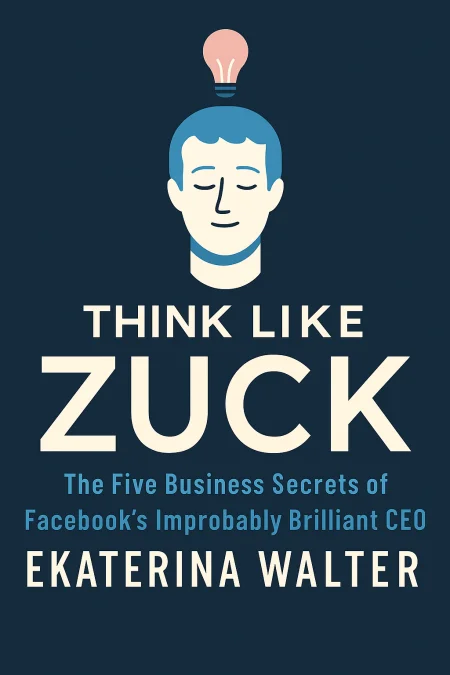
Think Like Zuck
The Five Business Secrets of Facebook’s Improbably Brilliant CEO
Book Edition Details
Summary
In a universe where social media reshapes human interaction, one audacious visionary stands at the helm: Mark Zuckerberg. "Think Like Zuck" is your portal into the mind of the prodigious Facebook founder, uncovering the quintet of groundbreaking principles that catapulted his platform to global dominance. Delve into the art of cultivating an impassioned mission, crafting a lucid vision, assembling a powerhouse team, and navigating the ever-evolving business landscape with agility. Through riveting insights and real-world examples from tech titans, this book distills the essence of entrepreneurial success, offering a blueprint for leaders eager to leave an indelible mark on the world stage. Whether you're a startup dreamer or an established mogul, these lessons transcend mere business tactics, offering a paradigm shift in leadership and innovation.
Introduction
In February 2004, a nineteen-year-old Harvard sophomore launched what would become one of the most transformative platforms in human history. What started as a simple college networking site in a dorm room would eventually connect over a billion people worldwide, fundamentally altering how we communicate, share information, and build relationships. This remarkable journey raises profound questions about leadership, innovation, and the nature of success itself. The story of Facebook's meteoric rise offers insights into the mind of a young visionary who dared to challenge conventional wisdom about business, technology, and human connection. Through examining Mark Zuckerberg's approach to building and scaling his company, we discover five fundamental principles that drove Facebook from a college project to a global empire. These principles reveal not just how a social network grew, but how transformative ideas take root and flourish in the modern world. This exploration is particularly valuable for entrepreneurs, business leaders, and anyone seeking to understand how vision, persistence, and strategic thinking can create lasting impact. The lessons embedded in Facebook's evolution transcend the technology industry, offering timeless wisdom about building meaningful enterprises that serve genuine human needs while navigating the complex challenges of rapid growth and global influence.
From Dorm Room to Harvard Phenomenon (2004-2005)
The genesis of Facebook emerged from Mark Zuckerberg's deep fascination with human psychology and social connections. Unlike typical computer science students who focused solely on technical problems, Zuckerberg pursued a dual major in computer science and psychology, driven by an intense curiosity about how people interact and form relationships. This unique perspective would prove instrumental in creating a platform that felt intuitive and natural to users. Zuckerberg's early experiments revealed his talent for building social applications. His controversial Facemash project, despite landing him in trouble with Harvard administrators, demonstrated something crucial: students craved digital tools that reflected their real-world social dynamics. The overwhelming response to Facemash, with over 22,000 photo comparisons in just hours, showed the pent-up demand for authentic online social interaction. Rather than viewing the disciplinary action as failure, Zuckerberg saw it as validation of his core insight about human nature. The launch of Facebook in February 2004 represented a profound shift from existing social networks. While competitors like Friendster focused on dating and MySpace embraced anonymous personas, Zuckerberg insisted on authentic identity. Users had to register with their college email addresses and represent themselves honestly. This requirement for authenticity wasn't just a technical decision; it reflected Zuckerberg's philosophical belief that meaningful connections required trust and transparency. As he would later explain, having multiple identities online represented "a lack of integrity." The explosive growth within Harvard, reaching over 6,000 users in three weeks, revealed something remarkable about human psychology in the digital age. Students weren't just creating profiles; they were bringing their entire social world online. They formed study groups, organized events, and maintained friendships through the platform. Facebook wasn't merely a website; it was becoming a utility as essential as email or the telephone, setting the stage for its expansion beyond campus walls.
Building the Platform and Going Global (2006-2008)
The introduction of the News Feed in September 2006 marked perhaps the most controversial yet transformative moment in Facebook's evolution. Initially met with fierce resistance from users who felt their privacy was being violated, the feature actually reflected Zuckerberg's deeper understanding of human social behavior. People naturally wanted to know what their friends were doing; they were already visiting profile after profile manually. The News Feed simply made this process more efficient and engaging. Zuckerberg's unwavering commitment to his vision during the News Feed backlash revealed his emerging leadership philosophy. Despite protests from users and internal pressure to retreat, he remained convinced that transparency and openness would ultimately benefit society. His response demonstrated a crucial entrepreneurial principle: true innovators often face resistance when introducing concepts that challenge existing norms. The data supported his conviction, showing that despite their complaints, users were spending significantly more time on the platform. The decision to open Facebook beyond colleges and schools represented another calculated risk that transformed the company's trajectory. Critics worried that expanding the user base would alienate the core college demographic, but Zuckerberg understood that social networks derive value from scale and diversity. When registration opened to everyone in September 2006, growth exploded to 50,000 new users daily, validating his belief that the desire to connect transcended demographic boundaries. The launch of the Facebook Platform in 2007 showcased Zuckerberg's strategic brilliance and long-term thinking. By allowing external developers to build applications within Facebook, he created an ecosystem that enriched the user experience while accelerating innovation. This move transformed Facebook from a simple social network into a comprehensive platform, establishing the foundation for sustained competitive advantage and demonstrating how successful companies can harness external creativity to fuel internal growth.
The Billion-User Empire and IPO Era (2009-2012)
The period from 2009 to 2012 witnessed Facebook's transformation from a promising startup to a global phenomenon with unprecedented reach and influence. Reaching 200 million users by 2009, the platform had become the world's dominant social network, surpassing MySpace and establishing itself as an essential communication tool across diverse cultures and demographics. This scale brought both tremendous opportunities and complex new challenges. Zuckerberg's decision to bring Sheryl Sandberg aboard as Chief Operating Officer in 2008 exemplified his growing maturity as a leader. Recognizing his own limitations in business operations and management, he sought a partner who could complement his product vision with operational excellence. Sandberg's arrival transformed Facebook's business model, systematizing advertising operations and scaling revenue from $150 million to nearly $4 billion during her tenure, while allowing Zuckerberg to focus on product development and long-term strategy. The company's approach to monetization revealed Zuckerberg's commitment to user experience over short-term profits. Unlike many internet companies that aggressively pursued advertising revenue, Facebook prioritized user engagement and platform quality. This philosophy, encapsulated in the IPO letter's declaration that "we don't build services to make money; we make money to build better services," reflected a fundamental belief that sustainable business success required genuine value creation rather than mere profit extraction. The May 2012 initial public offering, raising $16 billion and valuing the company at $104 billion, marked Facebook's entry into a new phase of accountability and scrutiny. Despite initial stock price volatility and criticism from short-term investors, Zuckerberg maintained control through a dual-class share structure, ensuring his long-term vision wouldn't be compromised by quarterly earnings pressures. This decision reflected lessons learned from other technology companies that had lost their innovative edge after going public.
Strategic Partnerships and Long-term Vision
Zuckerberg's ability to forge strategic partnerships while maintaining Facebook's core identity demonstrated sophisticated business acumen that belied his youth. The relationship with Sheryl Sandberg exemplified the power of complementary leadership, where visionary creativity paired with operational discipline created exponential value. Their partnership became a model for technology companies, showing how founders could scale their organizations without surrendering their essential mission and values. The company's approach to acquisitions revealed Zuckerberg's strategic thinking about talent and technology. Rather than simply buying companies for their products, Facebook often pursued "acqui-hires" to bring exceptional teams into the organization. This strategy recognized that in a rapidly evolving technology landscape, human capital often represented more value than existing products or services, and that innovation required continuously attracting and retaining the world's best minds. Facebook's international expansion strategy demonstrated Zuckerberg's understanding of cultural nuances while maintaining platform consistency. Rather than imposing a purely American perspective globally, the company adapted to local languages, customs, and communication patterns while preserving the core principles of authentic identity and meaningful connection. This approach enabled Facebook to achieve dominant positions in markets worldwide, often displacing local competitors through superior execution and resources. The development of the "hacker way" culture represented perhaps Zuckerberg's most important contribution to modern management philosophy. By encouraging rapid experimentation, embracing failure as learning, and prioritizing impact over hierarchy, Facebook created an environment where innovation flourished at scale. This culture attracted exceptional talent who might otherwise have started their own companies, essentially allowing Facebook to capture entrepreneurial energy within a large organization structure.
Summary
The transformation of Facebook from dormitory project to global communications infrastructure reveals timeless principles about vision, execution, and human nature. At its core, this story demonstrates how understanding fundamental human needs, combined with relentless focus and strategic thinking, can create value that transcends immediate commercial success to reshape society itself. Three key insights emerge from Facebook's journey that remain relevant for any ambitious endeavor. First, authentic innovation often requires challenging conventional wisdom and persisting through initial resistance; the most transformative ideas frequently appear threatening to existing norms. Second, sustainable growth demands balancing visionary leadership with operational excellence, suggesting that the most successful ventures combine inspirational purpose with disciplined execution. Third, creating lasting impact requires maintaining long-term perspective amid short-term pressures, whether from competitors, investors, or critics who may not share or understand the underlying vision. These lessons extend far beyond technology or business, offering guidance for anyone seeking to create meaningful change in their field or community. The Facebook story ultimately suggests that extraordinary outcomes often result from ordinary individuals who possess extraordinary clarity about their purpose, coupled with the courage and persistence to pursue that purpose despite obstacles and uncertainty.
Related Books
Download PDF & EPUB
To save this Black List summary for later, download the free PDF and EPUB. You can print it out, or read offline at your convenience.
By Ekaterina Walter
