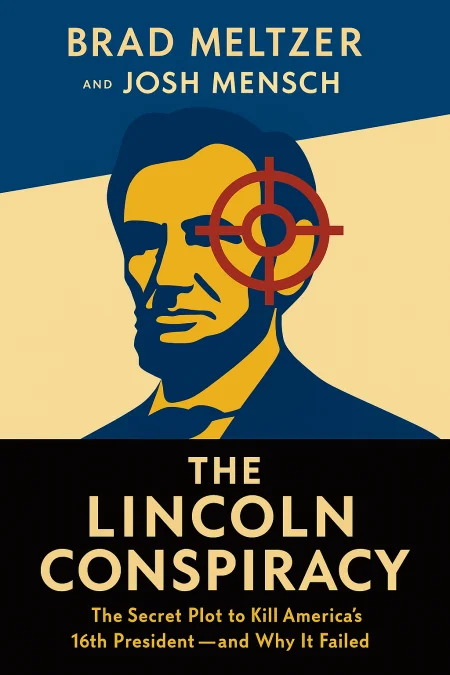
The Lincoln Conspiracy
The Secret Plot to Kill America's 16th President – and Why It Failed
Book Edition Details
Summary
In the shadows of history lies a plot that could have unraveled the fabric of a nation. Before the well-known tragedy of 1865, a clandestine conspiracy aimed to eliminate Abraham Lincoln before he even took office. In 1861, as Lincoln journeyed to his inaugural ceremony, a covert alliance of Southern loyalists hatched a deadly plan in Baltimore. Their goal: to silence the voice of abolition before it reached the White House. With stakes sky-high, detective Allan Pinkerton and the trailblazing Kate Warne—the first female detective in America—wove through a web of deceit, risking all to safeguard the future president. "The Lincoln Conspiracy" masterfully unearths this gripping prelude to history, a tale of intrigue, courage, and the fragile threads upon which destiny hangs.
Introduction
In the frigid winter of 1861, as Abraham Lincoln prepared for his inaugural journey to Washington, a sinister conspiracy was brewing in the shadows of Baltimore that would test American democracy before it could even be fully born. This was not merely another political disagreement in a nation already fracturing over slavery—this was America's first organized attempt to assassinate a President-elect before he could take office, orchestrated by secret societies and militant groups who viewed Lincoln's election as an existential threat to their way of life. The Baltimore Plot illuminates three profound questions that echo through history: How do democratic societies survive when faced with violent extremism from within their own borders? What happens when political rhetoric escalates beyond debate into deadly conspiracy? And how do ordinary individuals—private detectives, pioneering women, railroad executives—find themselves thrust into roles that determine the fate of nations? This gripping tale reveals how the preservation of democratic institutions often depends not on grand military victories but on the quiet courage of unexpected heroes working behind the scenes. For anyone seeking to understand how America nearly lost its greatest President before he could serve a single day, or how the institution of slavery poisoned every aspect of political discourse, this story offers both a riveting thriller and profound insights into the fragility of democratic governance. It serves as a stark reminder that the peaceful transfer of power we often take for granted has sometimes hung by the thinnest of threads, preserved only by the vigilance and bravery of those willing to risk everything for the survival of the republic.
From Rail-Splitter to President-Elect: Lincoln's Rise Amid National Crisis (1809-1860)
The journey to the presidency began in the harsh wilderness of Kentucky and Indiana, where young Abraham Lincoln learned life's cruelest lessons through grinding poverty and profound loss. When his beloved sister Sarah died in childbirth in 1828, eighteen-year-old Lincoln sat behind a smokehouse with tears rolling through his fingers, experiencing the deep grief that would shadow him throughout his life. Born into circumstances that offered little hope of advancement, Lincoln's childhood was marked by backbreaking labor, minimal formal education, and the constant presence of death that claimed his mother, infant brother, and sister. Yet from these harsh beginnings emerged something extraordinary. Lincoln's relentless self-education through borrowed books, his unusual empathy that extended even to animals, and his iron determination to transcend his circumstances forged a character of remarkable depth and moral clarity. By the 1850s, this tall, awkward lawyer from Illinois had developed into one of the most compelling voices against slavery's expansion, articulating the fundamental contradiction between human bondage and American ideals with a precision that cut through decades of political compromise. The deeper currents of this period revealed a nation increasingly polarized over its founding sin. The violence that erupted on the Senate floor when Preston Brooks nearly beat Charles Sumner to death demonstrated how completely civil discourse had broken down between North and South. Southern society had constructed an entire worldview around white supremacy and the economic necessity of enslaved labor, while Northern opposition to slavery was hardening into political action that threatened the very foundations of the plantation system. Lincoln's unexpected nomination at the 1860 Republican Convention reflected the party's recognition that they needed someone who could unite rather than divide, someone who represented authentic American values without the radical baggage of more established politicians. This choice would prove prescient in the coming crisis, but it also made Lincoln a target for those who saw his election as the death knell of their civilization, setting the stage for the deadly conspiracy that would soon unfold in Baltimore's shadowy streets.
Conspiracy in Baltimore: The Assassination Plot Against Democracy (February 1861)
Lincoln's election victory triggered an immediate and catastrophic response that revealed how completely the nation had fractured along ideological lines. Within days of his victory, South Carolina declared his election a "hostile act" and called for secession, while six other states quickly followed suit. The speed of this reaction demonstrated that Southern extremists had been preparing for this moment, viewing any Republican victory as justification for destroying the Union rather than accepting the results of a democratic election. Baltimore had become the epicenter of this resistance, a city where wealthy slave traders, secret societies, and paramilitary organizations converged in their hatred of the President-elect. At the heart of this web of conspiracy stood Cypriano Ferrandini, a charismatic Corsican-born barber whose establishment beneath Barnum's Hotel had become an informal headquarters for plotting Lincoln's demise. Ferrandini possessed the dangerous combination of genuine fanaticism and organizational skill, rallying fellow conspirators with passionate speeches about Southern rights while methodically planning the most audacious political assassination in American history. The conspiracy revealed the sophisticated nature of the threat Lincoln faced, involving multiple secret societies like the Knights of the Golden Circle, militia groups such as the National Volunteers, and wealthy financiers who provided resources and coordination. The plot centered on Baltimore because geography made it unavoidable—any rail journey from the North to Washington required passing through this hostile city, where Lincoln would be forced to change trains and travel through public streets in an open carriage, vulnerable to attack from the crowds that would inevitably gather. The conspirators' plan was elegantly simple and terrifyingly effective: create a disturbance during Lincoln's passage through Baltimore, using the chaos as cover for assassination by multiple attackers who would then escape in the confusion. Their confidence was chilling—they spoke openly of preventing Lincoln's inauguration through violence, convinced that his death would somehow restore the old order and prevent the coming war. This represented something unprecedented in American history: the first serious attempt to overthrow democratic governance through the murder of an elected leader.
The Midnight Journey: Pinkerton's Mission to Save Lincoln (February 22-23, 1861)
The discovery and prevention of the Baltimore plot required the combined efforts of several remarkable individuals, chief among them Allan Pinkerton, America's first private detective, whose investigation would establish precedents for presidential security that endure to this day. Initially hired by railroad executive Samuel Felton to investigate threats against railroad infrastructure, Pinkerton quickly realized that the danger extended far beyond property damage to encompass a direct threat to the President-elect's life and the survival of democratic government itself. Pinkerton's secret weapon was Kate Warne, the nation's first female detective, whose gender allowed her to infiltrate social circles that remained completely closed to male operatives. Posing as a Southern sympathizer from Alabama, Warne gathered crucial intelligence about the conspirators' plans, timeline, and level of organization, providing detailed evidence that convinced even skeptical Republican officials of the plot's reality. Her groundbreaking work, combined with that of other Pinkerton agents operating undercover in Baltimore's secessionist circles, revealed the shocking scope of the conspiracy and the imminent danger Lincoln faced. The challenge of getting Lincoln safely to Washington required unprecedented coordination, secrecy, and split-second timing. Pinkerton worked with Norman Judd, Lincoln's trusted advisor, to devise an alternative route that would bring the President-elect through Baltimore nearly ten hours ahead of schedule and under cover of darkness. The elaborate plan involved multiple deceptions: cutting telegraph lines to prevent communication about Lincoln's movements, using coded messages between railroad officials, and employing disguises to conceal Lincoln's distinctive appearance during the dangerous passage. On the night of February 22-23, 1861, Lincoln secretly departed from a reception in Harrisburg, Pennsylvania, and traveled by special train to Philadelphia, where he boarded the regular overnight service to Baltimore. Accompanied only by Pinkerton and bodyguard Ward Hill Lamon, with Kate Warne posing as his invalid sister, Lincoln passed through the heart of enemy territory while his would-be assassins slept peacefully in their beds, unaware that their target was traveling within blocks of their meeting places. The successful mission demonstrated how professional intelligence work, careful planning, and individual courage could triumph over even the most determined enemies of democratic governance.
From Baltimore to Civil War: Lincoln's Legacy and Democracy's Survival (1861-1865)
Lincoln's safe arrival in Washington marked not the end of his trials but the beginning of the greatest test any American president has ever faced, as the nation plunged into a civil war that would claim more lives than all other American conflicts combined. The man who had narrowly escaped assassination in Baltimore now found himself leading a divided country through its darkest hour, forced to use unprecedented executive power to preserve the Union and confront the institution of slavery that had motivated his would-be killers. The Civil War transformed Lincoln from a cautious prairie lawyer into a revolutionary leader willing to shatter constitutional precedents to save the Constitution itself. His Emancipation Proclamation of 1863 fulfilled the worst fears of the Baltimore conspirators, freeing millions of enslaved people and fundamentally altering the character of American society. This decision required immense moral and political courage, as Lincoln knew it would intensify Southern resistance, potentially prolong the war, and possibly cost him reelection in 1864. Throughout the war years, Lincoln maintained his relationship with Allan Pinkerton, who served as head of the Union's military intelligence service, while Kate Warne and other agents conducted dangerous undercover missions behind Confederate lines. Their work demonstrated how the skills and networks developed in thwarting the Baltimore plot could be adapted to serve the broader cause of preserving democratic government against armed rebellion. The same attention to detail, professional competence, and personal courage that had saved Lincoln's life in 1861 now helped save the Union itself. The ultimate tragedy of Lincoln's story is that while he escaped the Baltimore assassins through careful planning and professional protection, he could not escape his fate forever. On April 14, 1865, just days after Confederate surrender at Appomattox, John Wilkes Booth succeeded where Ferrandini had failed, shooting Lincoln at Ford's Theatre. Yet by then, Lincoln had accomplished his greatest work—preserving the Union, ending slavery, and proving that democratic government could survive its most severe challenges through the dedication of ordinary citizens willing to perform extraordinary acts of service and sacrifice.
Summary
The Baltimore Plot reveals the central paradox that has defined American democracy from its founding: a nation conceived in liberty that simultaneously embraced the institution of slavery, creating contradictions so fundamental that they poisoned every aspect of political life and made violence virtually inevitable. This conspiracy emerged from the same toxic combination of fear, economic interest, and racial ideology that drove secession and civil war, demonstrating how quickly political disagreement can escalate into existential threats to democratic governance when compromise becomes impossible and extremist voices gain influence. The successful thwarting of this assassination plot offers both hope and practical lessons for defending democracy in any era, showing the crucial importance of professional law enforcement, the value of diverse perspectives in intelligence gathering, and the absolute necessity of individuals willing to put institutional loyalty above partisan advantage. The story demonstrates that democratic institutions, while fragile, possess the resilience necessary to survive their greatest challenges when ordinary citizens—a Scottish immigrant detective, a pioneering woman breaking gender barriers, a railroad executive concerned about his country—rise to meet extraordinary circumstances with competence, courage, and unwavering commitment to constitutional principles. For our own time, the Baltimore Plot serves as both warning and inspiration, reminding us that the peaceful transfer of power we often take for granted requires constant vigilance against those who would use violence to overturn democratic results. It teaches us that preserving democracy demands not just grand gestures but careful attention to detail, professional competence in law enforcement and intelligence work, and the moral courage to act decisively when foundational principles come under attack. Most importantly, it proves that the survival of democratic institutions often depends on the quiet heroism of those willing to work in darkness to ensure that the light of freedom continues to shine for all.
Related Books
Download PDF & EPUB
To save this Black List summary for later, download the free PDF and EPUB. You can print it out, or read offline at your convenience.
By Brad Meltzer
