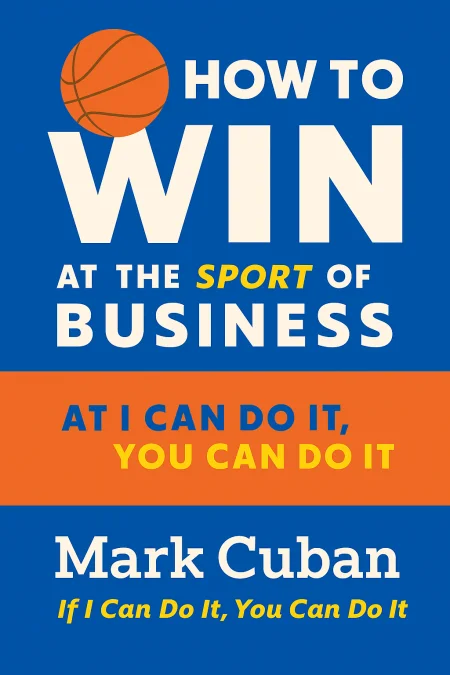
How to Win at the Sport of Business
If I Can Do It, You Can Do It
Book Edition Details
Summary
Amidst the relentless grind of entrepreneurship, where the arena is as fierce as any sport, Mark Cuban's How to Win at the Sport of Business offers an unfiltered playbook for those daring enough to rewrite their own rules. Drawing from the raw insights of his Blog Maverick, Cuban crafts a narrative that is part memoir, part guide, distilling the essence of his meteoric rise from penniless dreamer to billionaire maverick. This isn't just a tale of triumph; it's a call to arms for every would-be entrepreneur eager to defy convention and carve a unique path to success. With each page, Cuban challenges the status quo, arming readers with the unconventional strategies and audacious mindset needed to outmaneuver the competition and claim victory in the business world.
Introduction
Mark Cuban's story begins with a simple truth that would define his entire career: success isn't about being the smartest person in the room, it's about outworking everyone else in it. From sleeping on floors in a cramped Dallas apartment to owning professional sports teams and building billion-dollar companies, Cuban embodies the relentless pursuit of the American dream. His journey from bartender to billionaire wasn't paved with privilege or connections, but rather with an insatiable appetite for learning, an unshakeable work ethic, and the courage to take calculated risks when others hesitated. What makes Cuban's story particularly compelling is his willingness to fail publicly and learn from those failures, turning each setback into a stepping stone toward greater success. Through his experiences, readers will discover the fundamental principles of entrepreneurial thinking, the importance of treating business as the ultimate competitive sport, and the mindset required to transform obstacles into opportunities. His philosophy challenges conventional wisdom about business success, proving that with enough determination and smart execution, anyone can rewrite their own story.
The Making of an Entrepreneur: Early Struggles and First Ventures
Cuban's entrepreneurial journey began not with grand visions, but with necessity and a willingness to embrace uncertainty. After graduating from Indiana University, he found himself in Pittsburgh working for a bank, learning about computer systems while secretly questioning whether this was his path. The early years were defined by constant movement and experimentation. He bounced from job to job, including a stint trying to franchise TV repair shops, each position teaching him valuable lessons about business operations, customer service, and the importance of understanding technology. The pivotal moment came when Cuban made the decision to leave everything familiar behind and drive to Dallas in a beat-up Fiat with a hole in the floorboard. With no job prospects and barely any money, he crashed on friends' couches and survived on happy hour appetizers. This wasn't the glamorous startup story often portrayed in media, but rather the gritty reality of someone willing to sacrifice comfort for the chance at something greater. During this period, Cuban developed his philosophy of "getting paid to learn," viewing each job not just as a means of survival, but as an education in business fundamentals. His first real breakthrough came through persistence and preparation. Landing a job at Your Business Software, the first retail software store in Dallas, Cuban compensated for his lack of experience by reading every software manual he could get his hands on. While others relied on surface-level knowledge, he dove deep into the technical details, earning customers' trust through genuine expertise rather than smooth talking. The defining moment of his early career came when he was fired for choosing to close a sale rather than open the store. Rather than seeing this as a setback, Cuban recognized it as liberation. Getting fired forced him to confront a fundamental truth about himself: he was a terrible employee because he was meant to be an entrepreneur. This realization didn't come with fanfare or celebration, but with the quiet determination to never again put his future in someone else's hands.
Building MicroSolutions: Learning to Compete in the Business Arena
The birth of MicroSolutions represented Cuban's first real test as an entrepreneur, and it nearly broke him before it made him. Starting the company required him to transform relationships with former clients into business opportunities, convincing them to trust not just his expertise, but his ability to deliver as a one-man operation. The early days were characterized by hustle and resourcefulness. Cuban operated from borrowed office space, had no computer of his own, and relied on handshake deals and personal guarantees to secure his first customers. The company's growth was neither smooth nor predictable. Cuban learned to balance technical expertise with business acumen, often working 18-hour days to master new technologies while simultaneously managing client relationships and company finances. His partnership with Martin Woodall proved crucial during this period. Where Cuban was impulsive and growth-focused, Woodall was methodical and detail-oriented. Their partnership, though often contentious, created a dynamic that pushed the company forward while maintaining operational integrity. The most challenging lesson came when Cuban discovered that their trusted secretary had embezzled $83,000 of the company's $85,000 in savings. Rather than wallowing in anger or seeking revenge, Cuban made a decision that would define his approach to crisis management throughout his career. He focused entirely on moving forward, recognizing that energy spent on blame and recrimination was energy not spent on rebuilding and growing the business. This crisis taught him the importance of systems, checks and balances, and the reality that in business, trust must be balanced with verification. MicroSolutions grew steadily over seven years, eventually becoming successful enough to attract acquisition interest from CompuServe. The sale of the company for several million dollars validated Cuban's belief that with enough persistence and smart execution, even someone with limited resources could build something valuable. More importantly, it provided him with the capital and confidence to pursue bigger opportunities, setting the stage for his next venture into the emerging world of internet broadcasting.
The Rules of Success: Cuban's Philosophy for Winning at Business
Cuban's approach to business success is built on fundamental principles that prioritize execution over theorizing and results over excuses. His first and most important rule centers on the concept of sweat equity being the best startup capital. Unlike many entrepreneurs who believe that raising money is the key to success, Cuban argues that external investment often creates more problems than it solves. When entrepreneurs take outside money, they immediately shift from playing their own game to playing the investor's game, often losing control of their vision and destiny in the process. The philosophy of "getting paid to learn" permeates Cuban's thinking about career development and business strategy. He believes that every job, regardless of how menial or temporary, provides valuable education if approached with the right mindset. This perspective allowed him to extract lessons from bartending, software sales, and even failed ventures, building a knowledge base that would prove invaluable in later business decisions. Cuban emphasizes that the information needed to succeed is publicly available to anyone willing to invest the time to learn it, but most people simply won't put in the effort to gain that knowledge advantage. Cuban's concept of business as sport resonates throughout his philosophy. He views competition not as something to be feared, but as the ultimate test of preparation, execution, and mental toughness. This sporting mentality drives his belief that success requires treating every day as game day, maintaining constant vigilance against competitors who might be working harder or smarter. The sporting analogy extends to his view on failure, which he sees as an essential part of the learning process rather than something to be avoided. Perhaps most importantly, Cuban emphasizes that effort is the only thing truly within an entrepreneur's control. Market conditions, competitors' actions, and economic circumstances are external factors that must be navigated but cannot be controlled. However, the amount of effort invested in learning, preparing, and executing is entirely within individual control. This philosophy creates a framework where success becomes a matter of personal responsibility rather than external circumstances, empowering entrepreneurs to focus on what they can influence rather than what they cannot.
Beyond Money: Creating Value and Controlling Your Destiny
Cuban's evolution from entrepreneur to investor and team owner reflects a sophisticated understanding of value creation that extends far beyond simple profit maximization. His acquisition of the Dallas Mavericks wasn't merely a trophy purchase, but a strategic decision to control an entertainment asset that could be improved through better management, customer experience, and operational excellence. This move demonstrated his belief that the principles of successful entrepreneurship apply across industries, whether selling software or entertaining basketball fans. His media ventures, including HDNet and various film projects, illustrate Cuban's approach to identifying market inefficiencies and creating solutions. Rather than following traditional industry models, he pioneered day-and-date release strategies that acknowledged changing consumer preferences and technology capabilities. These ventures weren't just about making money, but about proving that established industries could be disrupted through innovative thinking and willingness to challenge conventional wisdom. Cuban's investment philosophy on shows like Shark Tank reflects his core beliefs about entrepreneurship. He consistently emphasizes the importance of sales capability, market understanding, and operational competence over elaborate business plans or theoretical projections. His investment decisions often favor entrepreneurs who demonstrate grit, learning ability, and customer focus over those who present polished presentations but lack execution experience. This approach stems from his own journey, where success came from doing rather than planning. The concept of controlling one's destiny appears throughout Cuban's various business ventures. Whether in sports, media, or technology investments, he seeks opportunities where superior execution can create competitive advantages that are difficult for others to replicate. This philosophy extends to his personal brand, where he maintains direct communication with customers and fans through email and social media, refusing to let intermediaries filter his message or customer feedback. For Cuban, true success means building businesses and assets that generate value while providing the freedom to make decisions based on personal values rather than external pressures.
Summary
Mark Cuban's journey from sleeping on apartment floors to building billion-dollar companies proves that extraordinary success often begins with ordinary circumstances transformed by extraordinary effort. His story demonstrates that the path to entrepreneurial success isn't about having the perfect idea or the most funding, but about developing an unshakeable work ethic, learning from every experience, and maintaining the courage to act when opportunities arise. Cuban's philosophy that "you only have to be right once" offers hope to anyone facing setbacks or uncertainty, reminding us that persistence and continuous learning can overcome almost any obstacle. His emphasis on treating business as sport, controlling what can be controlled, and always focusing on customer value provides a practical framework for building successful ventures in any industry. For aspiring entrepreneurs, career changers, and anyone seeking to take greater control of their professional destiny, Cuban's example offers both inspiration and a concrete roadmap for turning dreams into reality through disciplined execution and relentless determination.
Related Books
Download PDF & EPUB
To save this Black List summary for later, download the free PDF and EPUB. You can print it out, or read offline at your convenience.
By Mark Cuban
