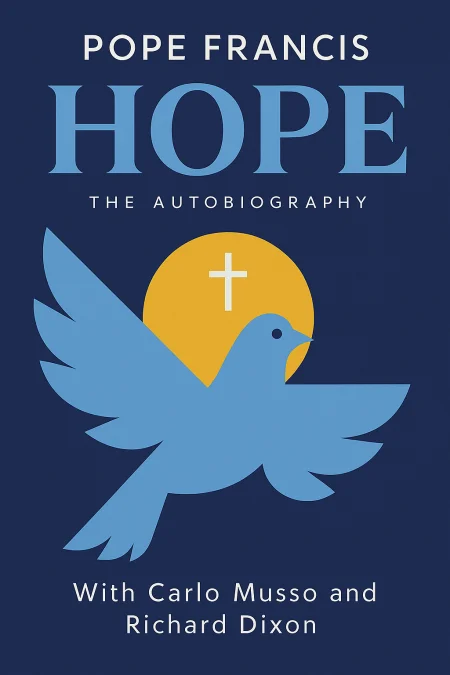
Hope
The Autobiography
byPope Francis, Carlo Musso, Richard Dixon
Book Edition Details
Summary
In a groundbreaking testament of faith and resilience, "Hope" reveals the extraordinary journey of Pope Francis, the first pontiff to pen an autobiography. Against the vibrant backdrop of 20th-century Argentina, Jorge Mario Bergoglio's tale unfolds, from his Italian roots to his rise as a global spiritual leader. With candid reflections on pivotal moments of his papacy, the Pope addresses pressing global issues—war, migration, climate change, and more—with unflinching honesty and compassion. This narrative is not just a memoir but a beacon for humanity, blending personal anecdotes with profound insights. Enhanced by rare photographs, "Hope" is a legacy of wisdom, humor, and unwavering optimism, destined to inspire readers across generations.
Introduction
In the sweltering summer of 1936, as Europe teetered on the brink of another devastating war, a child was born in the bustling immigrant neighborhood of Flores, Buenos Aires. His Italian grandparents had arrived with little more than hope and determination, fleeing economic hardship for the promise of a new world. Few could have imagined that this boy would one day return to Europe not as a migrant seeking opportunity, but as the spiritual leader of over one billion Catholics worldwide. This extraordinary journey illuminates three profound historical currents that shaped the modern world. First, it reveals how the great waves of twentieth-century migration created new forms of identity that transcended national boundaries, forging leaders who understood both displacement and belonging. Second, it demonstrates how individuals navigated the brutal political upheavals that swept across Latin America, where military dictatorships and social revolution tested the limits of moral courage. Finally, it shows how ancient institutions can undergo radical transformation while maintaining their essential mission, offering lessons for anyone seeking to understand how meaningful change occurs in complex organizations. This story speaks to those curious about the intersection of personal conviction and public leadership, the dynamics of institutional reform, and the ongoing tension between tradition and progress. It offers insights for anyone wondering how ordinary experiences can forge extraordinary leaders, and how historical trauma can become a source of moral clarity rather than cynicism.
Immigrant Roots and Formation: Buenos Aires Foundations (1929-1969)
The Argentina that welcomed the Bergoglio family was a nation still defining itself, built by successive waves of European immigrants who brought their traditions while creating something entirely new. Giovanni and Rosa Bergoglio arrived from Piedmont carrying their life savings sewn into coat linings, joining the vibrant Italian community in Flores where multiple languages mixed on street corners and Old World customs adapted to New World realities. The economic collapse of the early 1930s struck the family hard, wiping out their small business and forcing them to rebuild from nothing. Yet this experience of vulnerability planted seeds of social consciousness that would later bloom into a distinctive understanding of poverty and solidarity. Rosa Bergoglio's fierce independence and her son Mario's quiet determination embodied the immigrant virtues of resilience and mutual aid that characterized this generation of displaced Europeans. Young Jorge's path to priesthood was neither straight nor predictable. He first trained as a chemical technician, learning the value of precision and methodical thinking in Buenos Aires laboratories. His calling came not through mystical visions but during a routine confession at age seventeen, when he experienced what he would later describe as a profound encounter with divine mercy. This moment of quiet certainty would become the cornerstone of his theological understanding. His seminary formation coincided with the revolutionary changes of the Second Vatican Council, when the Catholic Church opened its windows to the modern world and embraced a more engaged social conscience. These formative experiences shaped his conviction that authentic faith must be lived in the world, not apart from it. His ordination as a Jesuit priest in 1969 marked not just personal fulfillment but preparation for the tumultuous decades ahead, when his convictions would face their severest tests in the crucible of Argentine history.
Dark Years and Moral Testing: Dictatorship Era (1970s-1980s)
The military coup of March 1976 plunged Argentina into its darkest chapter, as armed forces launched a systematic campaign of terror against suspected subversives that would claim an estimated thirty thousand lives. The young Jesuit Provincial found himself navigating treacherous waters where any association with social justice could be construed as subversion, and where silence might mean survival while speaking out could mean death. The disappearance of Esther Ballestrino, his former chemistry supervisor who had taught him to think critically about social issues, personalized the horror of state terrorism. Despite his desperate efforts to locate her and other disappeared activists, they were tortured and murdered, their bodies thrown into the sea. These experiences taught him that sometimes the most important Christian witness involves quiet acts of rescue rather than public denunciation, and that moral leadership often requires working within flawed systems to protect the vulnerable. The Catholic Church itself was deeply divided during this period, with some bishops supporting the military regime while others, like the martyred Enrique Angelelli, paid with their lives for defending the poor. This division forced a generation of Latin American Catholics to grapple with fundamental questions about the relationship between faith and politics, between institutional survival and prophetic witness. The young provincial learned that power could corrupt even religious institutions, and that moral authority required constant vigilance against the temptations of compromise. The gradual return to democracy in the 1980s brought new challenges as Argentine society struggled to reckon with the trauma of the disappeared and the complicity of various institutions. The experience of living through this transition from authoritarianism to democracy would later inform approaches to reconciliation and healing that transcended national boundaries. The disappeared of Argentina became a permanent presence in his consciousness, a reminder that human dignity transcends political calculations and that justice delayed often becomes justice denied.
Episcopal Leadership Through Crisis: Democratic Transition (1992-2013)
As Argentina rebuilt its democratic institutions, Bergoglio's rise through Church hierarchy coincided with a period of national soul-searching about the past and uncertainty about the future. His appointment as auxiliary bishop, then Archbishop of Buenos Aires, and finally Cardinal, revealed a pastor more comfortable in the slums than in ecclesiastical palaces, more concerned with serving the marginalized than maintaining institutional privileges. His transformation of the Buenos Aires archdiocese into a "Church of the peripheries" was both literal and symbolic. He established new parishes in the sprawling shantytowns surrounding the capital, traveled by subway rather than official car, and maintained the simple lifestyle that had characterized his earlier priesthood. This wasn't mere symbolism but reflected a theological conviction that the Church's credibility depended on its proximity to those whom society had forgotten. The economic collapse of 2001-2002 provided a laboratory for testing these convictions in practice. When currency devaluation and mass unemployment suddenly impoverished Argentina's middle class, Cardinal Bergoglio emerged as a moral voice calling for solidarity and systemic change. His criticism of policies that enriched the few while impoverishing the many established him as a champion of social justice rooted in Catholic social teaching rather than partisan politics. His approach to leadership emphasized what he called "theology of the people," recognizing the wisdom and faith found among ordinary believers rather than academic theologians. This pastoral philosophy, combined with his reputation for personal integrity and social concern, positioned him as a significant figure in Latin American Catholicism. His experience of guiding the Church through Argentina's democratic transition, economic crisis, and social transformation would prove invaluable preparation for the global challenges that awaited him in Rome.
Papal Revolution: Global Reform and Modern Challenges (2013-Present)
The election of Jorge Mario Bergoglio as Pope Francis in March 2013 marked a historic shift for the Catholic Church, bringing the first Latin American, first Jesuit, and first pope to take the name of Saint Francis to the Chair of Peter. His papacy began with symbolic gestures that signaled profound changes ahead: refusing the papal apartment for simpler quarters, washing the feet of prisoners and refugees, and calling for "a poor Church for the poor." Francis's reform agenda has touched every aspect of Church life, from financial transparency to environmental stewardship to clerical accountability. His encyclical "Laudato Si'" positioned the Catholic Church as a leading voice in addressing climate change, while "Amoris Laetitia" opened new pastoral approaches to family life. Most significantly, he has confronted the clerical sexual abuse crisis with unprecedented transparency, insisting that "covering up is adding shame to shame" and prioritizing victims over institutional reputation. His approach to global diplomacy has embodied his message that the Church must go to the peripheries of human experience. From facilitating dialogue between the United States and Cuba to advocating for peace in conflict zones, his visits to refugee camps and marginalized communities worldwide have demonstrated how moral authority can influence international relations. His reforms of Vatican finances and establishment of new oversight bodies have begun restoring credibility to Church leadership. The Francis papacy has fundamentally altered how the Catholic Church engages with modernity, proving that ancient institutions can adapt to contemporary challenges while maintaining their essential mission. His emphasis on mercy over judgment, inclusion over exclusion, and service over power has resonated far beyond Catholic circles, offering a model for institutional leadership in an era of declining trust in traditional authorities. As his papacy continues, Francis has shown that authentic reform requires leaders who understand both the weight of tradition and the urgency of contemporary challenges.
Summary
The journey from Buenos Aires to Rome illuminates a central tension of our time: how traditional institutions can maintain moral authority while adapting to rapidly changing social realities. Through one man's extraordinary life story, we witness how personal experience of injustice and marginalization can forge leaders capable of institutional transformation without abandoning core principles. This historical arc reveals that authentic reform requires leaders who understand both the weight of tradition and the urgency of contemporary challenges. Francis's papacy demonstrates that credible moral leadership in the modern era demands three essential qualities: proximity to those who suffer, transparency in addressing institutional failures, and courage to challenge systems that perpetuate inequality. His approach suggests that lasting change comes not through revolutionary rupture but through patient, persistent reform grounded in fundamental values. For contemporary leaders in any field, this story offers crucial insights about the nature of transformational leadership. First, moral authority derives from lived experience with those one claims to serve, not from abstract principles or institutional position. Second, credibility requires acknowledging and addressing past failures honestly, even when such transparency initially damages reputation. Finally, meaningful reform must balance respect for tradition with responsiveness to present needs, recognizing that institutions survive by adapting their methods while preserving their mission. The path from Argentine streets to Vatican halls reminds us that the most profound transformations often begin in the most ordinary circumstances, guided by individuals who refuse to accept injustice as inevitable.
Related Books
Download PDF & EPUB
To save this Black List summary for later, download the free PDF and EPUB. You can print it out, or read offline at your convenience.
By Pope Francis
