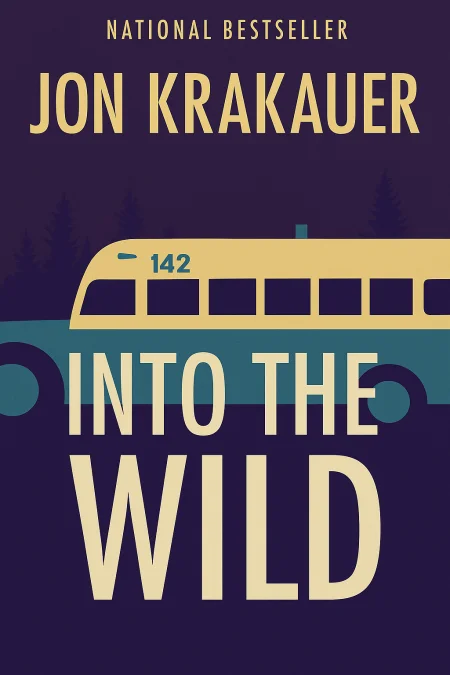
Into the Wild
An unflinching account of the extraordinary life and death of Christopher McCandless
Book Edition Details
Summary
In the haunting echoes of the Alaskan wild, a young man's quest for authenticity spirals into a mesmerizing enigma. Christopher McCandless, a recent college graduate with a heart full of wanderlust, shunned his privileged roots for a raw, uncharted life. Armed with nothing but sheer will, he wandered through the untamed American West, seeking the truth within nature's unforgiving embrace. Jon Krakauer masterfully unravels this tragic odyssey, capturing the restless spirit that drove McCandless to shed his identity and embrace the wilderness as Alexander Supertramp. As McCandless's idealistic dreams clash with harsh reality, Krakauer offers an unflinching exploration of ambition, folly, and the poignant ties of family. "Into the Wild" blazes with insight and emotion, transforming a young man's doomed adventure into a profound meditation on the human condition.
Introduction
In the spring of 1992, a young man walked into the Alaskan wilderness with little more than a backpack, a rifle, and an unwavering belief in the transformative power of solitude. Christopher McCandless was twenty-four years old, a recent college graduate from a comfortable Virginia suburb, yet he chose to abandon the conventional path that lay before him. His journey into the wild would become one of the most compelling and controversial stories of modern American adventure, raising profound questions about the relationship between idealism and reality, freedom and responsibility. McCandless represented a distinctly American archetype: the seeker who turns his back on material comfort to pursue authentic experience. His story resonates because it speaks to something many people feel but few act upon—the desire to strip away the complexities of modern life and discover what truly matters. Through his brief but intense odyssey, we encounter the power of uncompromising idealism, the allure and dangers of absolute independence, and the complex dynamics between parents and children when fundamental values collide. His tale forces us to examine our own assumptions about success, happiness, and what constitutes a life well-lived.
The Making of an Idealist
Christopher McCandless was shaped by contradictions from his earliest years. Born into an affluent family in suburban Virginia, he grew up surrounded by the trappings of success that his aerospace engineer father Walt had worked tirelessly to achieve. Yet even as a child, Chris displayed an almost allergic reaction to privilege and materialism. He would disappear into books by Tolstoy and Thoreau, absorbing their critiques of wealth and their calls for moral purity with the intensity that other children reserved for comic books or video games. His parents, Walt and Billie McCandless, had built their American dream through hard work and sacrifice, but Chris saw their achievements differently. He was embarrassed by the family's comfortable lifestyle and deeply troubled by what he perceived as the moral compromises inherent in conventional success. This tension was exacerbated when Chris discovered, during a cross-country trip after high school, the painful details of his father's complex personal history—secrets that had been kept from him and that he interpreted as fundamental hypocrisy. The discovery of his father's hidden past became a watershed moment in Chris's development. Rather than confronting his parents directly, he internalized his anger and disappointment, allowing it to fuel his growing conviction that authentic living required a complete rejection of mainstream society. His academic excellence and athletic achievements masked a deepening alienation from the world his parents inhabited. He began to see their expectations and values not as expressions of love, but as attempts to imprison him in a life that felt morally bankrupt. By the time Chris graduated from Emory University, his idealism had crystallized into something approaching religious fervor. He donated his college savings to charity, changed his name to Alexander Supertramp, and set out to live according to principles he had derived from his literary heroes. His transformation from promising young graduate to wandering ascetic represented both a rejection of his upbringing and a quest for the kind of pure, unmediated experience that he believed could only be found far from civilization's corrupting influence.
Journey to Alaska
After two years of wandering across the American West, living hand to mouth and embracing the life of a vagabond, McCandless finally set his sights on Alaska—the last great wilderness, the place where he believed he could test himself against nature in its purest form. His journey to the far north in the spring of 1992 was both the culmination of his wanderings and the beginning of his ultimate adventure. He hitchhiked from South Dakota to Fairbanks, carrying little more than a small-caliber rifle, a bag of rice, and the kind of naive confidence that comes from never having truly failed at anything important. The Alaska that McCandless encountered was both magnificent and indifferent. He found his way to an abandoned bus on the Stampede Trail, about twenty miles from the nearest road, and established it as his base camp. The bus, left over from a 1960s road construction project, became his wilderness home—a rusty sanctuary where he could live out his vision of self-reliant existence. For the first few weeks, everything seemed to validate his beliefs about the possibility of living free from society's constraints. McCandless threw himself into the daily challenges of survival with characteristic intensity. He hunted small game, foraged for edible plants, and documented his experiences in a spare, almost telegraphic journal style that reflected his practical focus on the immediate demands of staying alive. His photographs from this period show a young man who appears genuinely happy, grinning widely as he holds up his hunting prizes or poses beside the bus that had become his unlikely home. Yet even as McCandless reveled in his newfound freedom, the harsh realities of the Alaska wilderness began to assert themselves. Game was scarcer than he had anticipated, and his lack of local knowledge about seasonal patterns and food sources gradually became apparent. When he killed a moose in June—a triumph that should have provided weeks of sustenance—his inexperience with preservation techniques led to most of the meat spoiling, an outcome that devastated him both practically and emotionally. The incident marked the beginning of a subtle shift in his journal entries, from confident declarations to more tentative observations about his circumstances.
Death in the Wilderness
By early July, McCandless had made the decision to return to civilization, but when he reached the Teklanika River, he found his path blocked by spring floodwaters. The same stream he had easily crossed in April had become a churning torrent, impossible to ford safely. This moment represented a crucial turning point—had he possessed a detailed topographic map, he might have found alternative crossing points or discovered the hand-operated cable tram located just a mile downstream. Instead, his deliberate choice to travel without proper maps, part of his desire for a pure wilderness experience, now trapped him on the wrong side of the river. Forced to return to the bus, McCandless faced his predicament with characteristic stoicism, but his situation was more precarious than he initially realized. His body weight had dropped significantly during his months in the bush, and his margin for error was shrinking. In late July, he made a fatal mistake—consuming seeds from a plant he believed to be safe based on his field guide. The seeds likely contained alkaloids that, while not immediately toxic, prevented his weakened body from properly metabolizing the limited food he was able to find. As his strength ebbed, McCandless's journal entries became increasingly sparse and desperate. He posted an SOS note on the bus, hoping against hope that someone might find him, but the remote location made rescue unlikely. His final weeks were marked by a gradual acceptance of his fate, combined with a spiritual clarity that seemed to transcend his physical suffering. He continued to photograph himself, documenting his decline with the same methodical attention he had brought to recording his hunting successes. In his final days, McCandless appeared to find a kind of peace that had perhaps eluded him during his restless years of searching. His last message, scrawled on a page torn from a book, thanked the Lord for a happy life and bid goodbye to the world with what appears to be genuine serenity. When hunters discovered his body in September, they found a young man who had died alone but not, it seemed, in despair—his final photograph shows him smiling and waving, as if welcoming whatever came next.
Understanding McCandless
Christopher McCandless embodied both the nobility and the tragedy of American individualism taken to its logical extreme. His story has sparked intense debate because it forces us to confront uncomfortable questions about the relationship between idealism and practicality, between the desire for authentic experience and the responsibilities we owe to those who love us. Critics have dismissed him as a reckless dreamer whose death was the predictable result of his own arrogance and inexperience, while admirers see him as a courageous seeker who paid the ultimate price for living according to his deepest convictions. Perhaps the most striking aspect of McCandless's character was his absolute refusal to compromise his principles, even when such compromise might have saved his life. His rejection of detailed maps, his insistence on minimal equipment, his choice to venture into the wilderness alone—all of these decisions reflected his belief that authentic experience could only emerge from genuine risk and uncertainty. He understood that safety nets and backup plans might preserve his physical well-being, but they would also diminish the spiritual value of his quest. McCandless's relationship with his family reveals the complex emotional landscape that drove his journey. His anger toward his parents, particularly his father, was rooted not simply in their material success but in his perception that they had compromised their integrity in achieving it. Yet his letters and journal entries also reveal a young man struggling to reconcile his love for his family with his need to reject everything they represented. His inability to bridge this gap may have been his greatest tragedy, more profound even than his death in the wilderness. The enduring fascination with McCandless's story suggests that his quest speaks to something deeper than mere adventure-seeking. In an age of increasing materialism and technological dependency, his radical embrace of simplicity and self-reliance offers both inspiration and warning. He represents the possibility of living according to one's deepest values, regardless of social expectations or practical consequences, but also demonstrates the potential cost of such uncompromising idealism.
Summary
Christopher McCandless died pursuing a vision of authentic living that was both profoundly American and deeply personal—the belief that truth could only be found by stripping away the comfortable illusions of modern life and confronting existence in its rawest form. His story endures because it embodies the tension between our desire for meaning and our need for safety, between the call of the wild and the bonds of civilization. Though his journey ended in tragedy, McCandless succeeded in living according to his deepest convictions, choosing authenticity over security and experience over comfort. For those who feel constrained by conventional expectations or trapped by material pursuits, McCandless's example offers both inspiration and caution. His willingness to sacrifice everything for his ideals reminds us that true fulfillment often requires difficult choices and genuine risks. Yet his fate also warns against the dangers of absolutism and the importance of balancing personal quests with responsibilities to others. Perhaps the wisest lesson from his brief but intense life is that the search for authenticity need not require complete isolation from human connection—that the most meaningful adventures might be those we can eventually share with the people who matter most to us.
Related Books
Download PDF & EPUB
To save this Black List summary for later, download the free PDF and EPUB. You can print it out, or read offline at your convenience.
By Jon Krakauer
