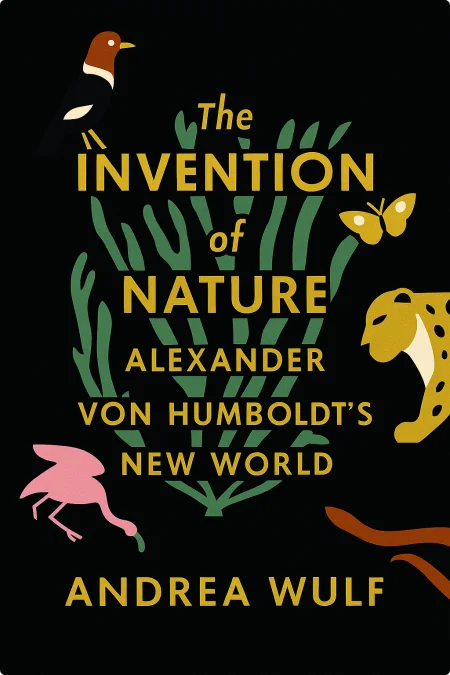
The Invention of Nature
Alexander von Humboldt’s New World
Book Edition Details
Summary
In an age when science was yet to understand the intricate web of life, Alexander von Humboldt emerged as a visionary whose insights transcended the boundaries of his time. This biography by Andrea Wulf resurrects the legacy of a man whose name has echoed across the landscapes of North America yet whose story faded into obscurity. Humboldt foresaw the dawn of human-induced climate change and embarked on fearless adventures from the peaks of South America to the Siberian steppes. His profound connections with luminaries such as Simón Bolívar and Thomas Jefferson, and the indelible mark he left on minds like Darwin and Thoreau, are captured in this riveting narrative. "The Invention of Nature" invites readers to rediscover Humboldt’s revolutionary view of nature as a harmonious force, a perspective that resonates powerfully in today’s environmental discourse.
Introduction
On a windswept ridge nearly four miles above sea level, gasping for breath in the thin Andean air, Alexander von Humboldt experienced a moment of revelation that would forever change how humanity understands the natural world. It was June 1802, and the thirty-two-year-old Prussian naturalist was attempting to climb Chimborazo, then believed to be Earth's highest peak. Though a massive crevasse would ultimately block his path to the summit, what Humboldt observed during that perilous ascent proved far more valuable than reaching the top. As he carefully documented how plant life changed with altitude, he suddenly grasped a profound truth: nature was not a collection of separate phenomena but a single, interconnected web where everything influenced everything else. Born into the intellectual ferment of Enlightenment Prussia, Humboldt would become the most celebrated scientist of his age, a man whose revolutionary ideas about environmental interconnection preceded Darwin's evolutionary theory by decades. His five-year expedition through Latin America at the dawn of the nineteenth century produced observations that would reshape entire fields of knowledge, from geography and botany to climatology and ecology. More than just an intrepid explorer, Humboldt was a visionary who recognized that human activities could alter the planet's climate, making him arguably the first scientist to articulate what we now call environmental crisis. Through Humboldt's extraordinary journey from restless aristocrat to global intellectual celebrity, we discover how one person's insatiable curiosity and holistic vision can transform human understanding. His story reveals the power of seeing connections where others perceive only isolated facts, the importance of combining rigorous observation with poetic sensibility, and the profound responsibility that comes with scientific knowledge. Most importantly, Humboldt's legacy demonstrates how individual passion for discovery, when guided by humanitarian values and environmental consciousness, can illuminate truths that remain urgently relevant to our interconnected world today.
The Making of a Revolutionary Naturalist
Alexander von Humboldt's transformation from melancholy aristocrat to revolutionary scientist began in the most unlikely of circumstances: the suffocating drawing rooms of late eighteenth-century Prussian society. Born in 1769 into minor nobility, young Alexander grew up at Tegel Castle outside Berlin, surrounded by wealth and privilege yet starved of the intellectual stimulation his restless mind craved. His mother, Marie Elisabeth, was a woman of rigid propriety who viewed her younger son's passionate interest in collecting plants, insects, and minerals with barely concealed disapproval. While his older brother Wilhelm excelled in classical studies and seemed destined for diplomatic greatness, Alexander appeared to be what his family dismissively called "the little apothecary." The boy's salvation came through his tutor, Gottlob Johann Christian Kunth, who recognized the spark of genius beneath Alexander's apparent academic struggles. Kunth introduced his charge to the revolutionary ideas sweeping through European intellectual circles, from Linnaeus's systematic classification of nature to Immanuel Kant's philosophical inquiries into the limits of human knowledge. Under this enlightened guidance, Alexander's natural curiosity began to find focus and direction. He devoured travel accounts by Captain Cook and other explorers, memorized the names of exotic species, and dreamed of distant lands where unknown creatures lived beneath foreign stars. When Alexander finally escaped to university, first at Frankfurt an der Oder and later at the prestigious University of Göttingen, he encountered the full flowering of German intellectual life during its golden age. Here he met Georg Forster, the renowned naturalist who had sailed with Captain Cook to the South Pacific, and whose vivid descriptions of tropical islands and undiscovered species set Alexander's imagination ablaze. Forster became both mentor and inspiration, showing the young man that science could be both rigorous and romantic, that the pursuit of knowledge could be an adventure as thrilling as any novel. Under Forster's influence, Alexander began to envision his destiny not in the comfortable confines of academic life, but in the unknown territories that lay beyond the horizon. The final stage of Alexander's intellectual formation occurred at the Freiberg Mining Academy, where he studied the practical sciences of geology and mineralogy under Abraham Werner, the leading earth scientist of his day. In the depths of Saxon mines, he learned to observe with precision, measure with accuracy, and think with the systematic rigor that would characterize all his later work. Yet even as he mastered these technical skills, Alexander never lost sight of the larger questions that had first drawn him to science. He began conducting experiments on everything from plant physiology to animal electricity, driven by an intuition that all natural phenomena were somehow connected in ways that conventional scientific specialization failed to recognize.
Epic Journey Through the Americas
The expedition that would establish Humboldt's scientific reputation and revolutionize natural history began with a stroke of diplomatic fortune in 1799. After years of frustrated attempts to join various scientific voyages, the thirty-year-old naturalist found himself in Madrid with his French companion Aimé Bonpland, armed with unprecedented royal permits to explore Spain's vast American colonies. What followed was a five-year odyssey through landscapes so magnificent and biologically diverse that they would provide material for a lifetime of scientific work and literary creation. From the moment their ship touched Venezuelan shores, Humboldt was overwhelmed by the sheer abundance of tropical life, where a single tree might host more species than existed in all of northern Europe. Humboldt's approach to exploration was revolutionary in its comprehensiveness and systematic methodology. While previous naturalists had focused primarily on collecting specimens and cataloging new species, he sought to understand the relationships between all aspects of the natural world. He measured everything with obsessive precision: temperature, humidity, atmospheric pressure, magnetic declination, the height of mountains, the depth of rivers, the distribution of plants and animals across different elevations and climates. His instruments were the finest available, and his observations were recorded with meticulous care. Yet alongside these quantitative measurements, he maintained detailed journals filled with poetic descriptions of landscapes and phenomena that moved him to wonder and scientific insight. The expedition's most transformative moment came during the ascent of Chimborazo in Ecuador, then believed to be the world's highest peak. As Humboldt and his companions climbed through the mountain's distinct vegetation zones, he experienced a profound revelation about the fundamental unity of nature. He observed that plants growing at different altitudes corresponded precisely to those found at different latitudes around the globe, from tropical species at the base to Arctic lichens near the summit. This insight led to his revolutionary concept of plant geography, demonstrating that vegetation is distributed across Earth according to climate and elevation in predictable, universal patterns. The mountain became a living laboratory, a microcosm of the entire planet where the laws governing life could be observed and understood. Throughout their travels, covering over six thousand miles through rainforests, across mountain ranges, and down mighty rivers, Humboldt demonstrated an extraordinary ability to synthesize observations from multiple disciplines into coherent theories about natural processes. He was among the first scientists to recognize the ecological functions of forests, noting how deforestation around Lake Valencia in Venezuela was already causing water levels to drop and local climates to change. He documented the devastating effects of colonial agriculture on both natural environments and indigenous peoples, making connections between economic systems, social justice, and environmental degradation that would not be widely accepted for another century. When he finally returned to Europe in 1804, he brought with him not just thousands of specimens but a revolutionary new understanding of Earth as a single, interconnected system.
Scientific Vision and Global Impact
Upon returning to Europe as the most celebrated explorer since Columbus, Humboldt faced the monumental challenge of organizing and communicating the vast amount of revolutionary data he had collected. He settled in Paris, then the scientific capital of the world, where he spent the next two decades producing a series of magnificent works that would establish his reputation as the greatest scientific author of his age. His thirty-four-volume account of the American expedition, lavishly illustrated with maps, diagrams, and artistic renderings, presented not merely collections of facts but integrated visions of natural phenomena that revealed the underlying unity of all natural processes. These works became international bestsellers, inspiring countless readers to see nature with entirely new eyes. Humboldt's scientific innovations were both methodological and profoundly conceptual. He pioneered the use of isotherms, lines connecting points of equal temperature across the globe, which revealed worldwide climate patterns for the first time in human history. His plant geography demonstrated how species distribution was governed not just by local conditions but by broad climatic and geological patterns that operated across continents and oceans. Perhaps most remarkably for his era, he was among the first scientists to recognize that human activities could fundamentally alter Earth's climate, observing how colonial deforestation and agriculture were already changing weather patterns and water cycles across vast regions of the Americas. The intellectual impact of Humboldt's holistic vision rippled through the nineteenth-century world with extraordinary force and lasting consequence. Charles Darwin carried Humboldt's "Personal Narrative" on the Beagle voyage and later wrote that it had shaped his entire scientific career, calling Humboldt "the greatest scientific traveler who ever lived." The young Darwin found in Humboldt's work not just scientific methodology but a way of seeing nature that would prove crucial to developing evolutionary theory. American transcendentalists like Ralph Waldo Emerson and Henry David Thoreau discovered in Humboldt's writings a scientific foundation for their philosophical belief in the unity of nature and humanity, while John Muir explicitly credited Humboldt with inspiring his lifelong mission to protect wilderness areas. Humboldt's influence extended far beyond the English-speaking world, reaching scientists, artists, and political leaders across the globe. His works were translated into dozens of languages, and he maintained correspondence with intellectuals on every continent. He advised governments on everything from mining techniques to agricultural policy, always emphasizing the critical need to understand natural systems before attempting to exploit them. His concept of nature as an interconnected web provided the intellectual framework for ecology's emergence as a scientific discipline, while his prescient warnings about human environmental impact prefigured modern concerns about climate change, biodiversity loss, and sustainable development that define our current environmental crisis.
Environmental Pioneer and Lasting Legacy
Alexander von Humboldt's most profound and enduring contribution to human knowledge lies not in any single discovery but in his revolutionary reconceptualization of humanity's relationship with the natural world, a vision that anticipated and helped shape modern environmental consciousness. His recognition that nature operates as a unified, interconnected system where changes in one element inevitably affect all others provided the essential intellectual foundation for ecology and environmental science. More prophetically, his detailed observations about human impact on climate and ecosystems made him arguably the first scientist to articulate what we now understand as the environmental crisis facing our planet. Humboldt's influence on conservation thinking and environmental policy cannot be overstated. His meticulous documentation of how human activities, particularly deforestation, mining, and colonial agriculture, could alter local and regional climates provided early scientific evidence for what would later be recognized as anthropogenic climate change. His warnings about the environmental costs of unchecked exploitation resonated powerfully with later conservationists who found in his work scientific justification for protecting wilderness areas and natural systems. The establishment of national parks, beginning with Yellowstone in 1872, drew directly on Humboldtian ideas about the intrinsic value of natural systems and the urgent need to preserve them for both scientific study and human inspiration. The modern environmental movement continues to draw on Humboldt's insights in ways both explicit and implicit, finding in his work a scientific and philosophical foundation for contemporary ecological thinking. His concept of nature as a web of interconnections underlies current understanding of ecosystem dynamics, biodiversity conservation, and the complex relationships between human societies and natural systems. His recognition that local environmental changes could have global consequences directly prefigured modern climate science and our understanding of planetary-scale environmental processes. His integration of rigorous scientific observation with aesthetic appreciation and ethical concern provided an influential model for environmental writers from John Muir to Rachel Carson, who combined precise scientific knowledge with poetic vision to inspire public environmental action. Perhaps most importantly for our current environmental challenges, Humboldt's example demonstrates how scientific understanding and environmental consciousness can emerge from a fundamental sense of wonder and connection with the natural world. His ability to perceive both minute ecological details and grand planetary patterns, to combine precise measurement with poetic vision, offers a compelling model for how we might approach the complex environmental problems of our own time. In an age of increasing scientific specialization and environmental fragmentation, Humboldt's holistic vision reminds us that the most profound insights often come from seeing the connections that others miss, and that true understanding of our environmental situation requires both rigorous scientific analysis and imaginative sympathy with the living systems that sustain all life on Earth.
Summary
Alexander von Humboldt's extraordinary life demonstrates that the most transformative scientific insights emerge not from narrow specialization but from the intellectual courage to perceive connections across disciplines, scales, and seemingly separate phenomena, ultimately revealing nature as the unified, interconnected system we now know it to be. His pioneering recognition that human activities could fundamentally alter Earth's climate, combined with his revolutionary vision of nature as a living web where every element affects every other, established him as the founding father of environmental science and ecological thinking. From his breathless ascent of Chimborazo to his patient mapping of global climate patterns, from his warnings about deforestation to his integration of scientific rigor with poetic appreciation of natural beauty, Humboldt showed that understanding our place in the world requires both precise observation and imaginative synthesis. For anyone seeking to understand how individual curiosity and determination can reshape human knowledge and environmental consciousness, Humboldt's example offers profound and practical inspiration. His willingness to risk everything in pursuit of understanding, combined with his remarkable ability to synthesize vast amounts of information into coherent insights about planetary systems, demonstrates how transformative thinking emerges from the intersection of careful observation, broad learning, and imaginative connection-making. In our current age of environmental crisis and climate change, Humboldt's integration of scientific rigor with environmental consciousness provides an essential model for approaching the complex, interconnected challenges facing our planet, reminding us that the solutions to our most pressing problems will require us to think as broadly, connectedly, and holistically as nature itself operates.
Related Books
Download PDF & EPUB
To save this Black List summary for later, download the free PDF and EPUB. You can print it out, or read offline at your convenience.
By Andrea Wulf
