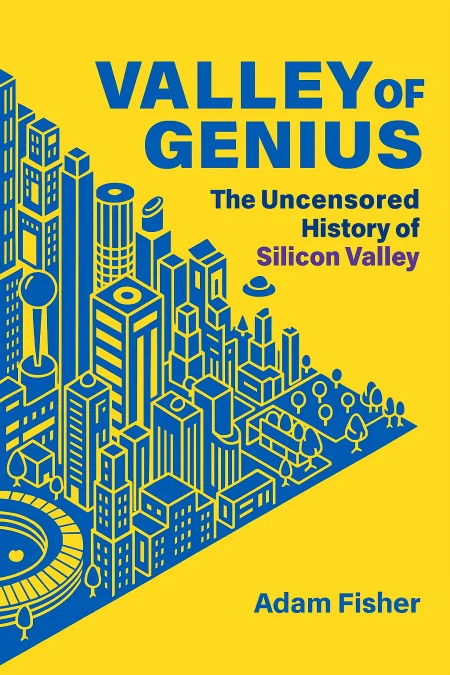
Valley of Genius
The Uncensored History of Silicon Valley (As Told by the Hackers, Founders, and Freaks Who Made It Boom)
Book Edition Details
Summary
Silicon Valley's story unfolds like a high-stakes game of chance, where genius intersects with serendipity and ambition fuels an insatiable hunger for innovation. "Valley of Genius" chronicles the magnetic rise of this digital empire, tracing its roots from the wild days of Atari and Apple to the tech titans of Google and Facebook. Through a tapestry woven from over two hundred firsthand accounts, this vivid oral history reveals the tumultuous dance of creation and chaos that defines the Valley's DNA. Here, fortunes are made overnight, betrayals lurk in the shadows, and the only constant is change itself. It's a saga of pioneers and mavericks, where the unimaginable becomes reality, casting a spotlight on the stories insiders whisper, yet are astonishingly true.
Introduction
In the summer of 1968, a Stanford researcher named Doug Engelbart stood before a packed auditorium and demonstrated something that seemed like pure science fiction: a computer that responded to a small device he called a "mouse," displaying windows of information that could be manipulated with simple clicks and drags. The audience watched in stunned silence as Engelbart collaborated in real-time with a colleague hundreds of miles away, editing documents together through what he called "hypertext." This moment, now known as "The Mother of All Demos," marked the beginning of a revolution that would transform not just computing, but the very fabric of human society. What makes this story particularly fascinating is how it reveals the unexpected origins of our digital world. The technologies that now dominate our daily lives didn't emerge from corporate boardrooms or government laboratories, but from a unique collision of counterculture idealism and engineering brilliance in a small region south of San Francisco. The same peninsula that once grew prunes and apricots became the birthplace of personal computers, video games, the internet, and social media—each innovation building upon the last in an accelerating cascade of change. This transformation raises profound questions that remain relevant today: How did a small group of rebels and misfits manage to overthrow entire industries and create new ones from scratch? What role did the unique cultural moment of the 1960s and 70s play in shaping technologies that would eventually connect billions of people? And perhaps most importantly, what can we learn from this remarkable period about the relationship between technological innovation and social change? Understanding these dynamics isn't just fascinating history—it's essential knowledge for anyone seeking to navigate our rapidly evolving digital future and the ongoing tensions between technology's liberating potential and its capacity for control.
Foundations: Counterculture Meets Computing (1960s-1980s)
The seeds of Silicon Valley's transformation were planted during the turbulent 1960s, when an unlikely alliance formed between hippie idealists and computer engineers. While the East Coast computing establishment focused on building massive mainframes for corporations and government agencies, California's technologists were dreaming of something radically different: computers that could empower individuals rather than institutions. This wasn't mere coincidence—it reflected the profound influence of counterculture values on the region's approach to technology. Doug Engelbart's pioneering work at Stanford Research Institute embodied this philosophy perfectly. His vision of computers as tools for "augmenting human intellect" drew inspiration from both rigorous engineering and the era's consciousness-expansion movement. Meanwhile, just miles away, figures like Stewart Brand were bridging the gap between technology and counterculture through publications like the Whole Earth Catalog, which promoted both advanced computing concepts and back-to-the-land idealism. Brand's famous declaration that "information wants to be free" would become a rallying cry for generations of Silicon Valley entrepreneurs. The region's unique legal environment proved equally crucial to its development. Unlike other states, California prohibited non-compete agreements, allowing engineers to freely move between companies and share ideas. This created a fluid ecosystem where innovation could spread rapidly, and where talented individuals weren't trapped by corporate loyalty agreements. When combined with the area's anti-establishment ethos, this legal framework fostered an unprecedented culture of collaboration and knowledge sharing. The culmination of this foundational period came with the emergence of Apple Computer, founded by Steve Jobs and Steve Wozniak in a suburban garage. Their Apple II wasn't just a technical achievement—it was a cultural statement that computing power should be accessible, beautiful, and personally empowering. The machine's success proved that the counterculture's idealistic vision could be transformed into profitable reality, establishing the template for Silicon Valley entrepreneurship that would define the region for decades to come. This fusion of idealism and commercialism would create both tremendous opportunities and enduring tensions as the technology industry matured.
The Internet Breakthrough and Dot-Com Boom (1990s-2000s)
The 1990s witnessed Silicon Valley's transformation from a regional technology cluster into the command center of a global digital revolution. The development of the World Wide Web suddenly made the internet accessible to ordinary users, creating unprecedented opportunities for entrepreneurs who could envision how networked computing might reshape commerce, communication, and culture. Marc Andreessen's Netscape browser became the gateway to this new world, sparking an investment frenzy that would define the decade. The dot-com boom revealed both the Valley's greatest strengths and its most dangerous tendencies. Venture capital flowed freely to anyone with a compelling vision of digital disruption, creating paper millionaires overnight and attracting global attention to the region's innovation model. Companies like eBay and Amazon demonstrated how internet platforms could create entirely new forms of economic activity, while early search engines like Google began organizing the world's information in ways previously unimaginable. The prevailing belief was that traditional business rules no longer applied in the digital realm. However, this period also marked the beginning of Silicon Valley's complicated relationship with its own success. The same technologies that promised to democratize information and empower individuals also enabled unprecedented corporate control over personal data and social discourse. The utopian dreams of early internet pioneers—who envisioned a decentralized network of equals—began colliding with the harsh realities of winner-take-all platform economics and surveillance capitalism. The inevitable crash in 2000-2001 was devastating but ultimately purifying. As venture funding dried up and thousands of companies failed, only the most resilient entrepreneurs and viable business models survived. This brutal selection process eliminated the speculators and tourists, leaving behind a core group of true believers who understood that building lasting companies required more than just hype and venture capital. The survivors emerged with hard-won wisdom about the difference between genuine innovation and mere speculation, setting the stage for the next wave of technological transformation that would prove even more profound than what came before.
Social Networks and Mobile Dominance (2000s-2010s)
From the ashes of the dot-com crash emerged a new generation of entrepreneurs who understood that the internet's true power lay not in simply digitizing existing commerce, but in fundamentally reimagining human connection and communication. Mark Zuckerberg's Facebook began as a simple college directory but evolved into a platform that would reshape global politics, commerce, and social interaction. The company's rapid growth from a Harvard dormitory project to a billion-user platform demonstrated how quickly digital networks could achieve unprecedented scale and influence. The simultaneous development of mobile technology created the perfect conditions for social media's explosive growth. Steve Jobs's introduction of the iPhone in 2007 represented a fundamental shift in computing philosophy, transforming phones from simple communication devices into powerful pocket computers. The device's intuitive touchscreen interface and constant internet connectivity created possibilities that no single company could have achieved alone, enabling a new ecosystem of applications and services that would reshape daily life for billions of people. Twitter's emergence from the failed podcasting company Odeo illustrated Silicon Valley's remarkable ability to pivot and adapt when initial strategies proved unsuccessful. The platform's 140-character limit seemed like a constraint, but it actually encouraged a new form of public discourse that would eventually influence everything from journalism to politics. These social platforms didn't just digitize existing forms of communication—they created entirely new modes of human interaction with profound implications for democracy, privacy, and social cohesion. This period marked Silicon Valley's evolution from a hardware-focused industry to one increasingly concerned with human behavior, psychology, and social dynamics. The region's entrepreneurs discovered that the most valuable technologies weren't necessarily the most technically sophisticated, but rather those that best understood and influenced human nature. As these platforms achieved global dominance, they began grappling with unprecedented responsibilities for moderating discourse, protecting privacy, and managing their enormous influence over public opinion. The tension between Silicon Valley's libertarian roots and its growing power over social and political life would become one of the defining challenges of the digital age.
Summary
The history of Silicon Valley reveals a fundamental paradox at the heart of technological progress: the same innovations that promise to liberate human creativity and democratize access to information also tend to concentrate unprecedented power in the hands of a few dominant platforms and their creators. From Doug Engelbart's vision of computers as tools for augmenting human intelligence to today's social media algorithms that shape public discourse, we see how identical technologies can serve radically different purposes depending on their cultural context and economic incentives. This transformation offers three crucial lessons for navigating our digital future. First, the most significant technological breakthroughs often emerge from communities that combine technical expertise with broader cultural vision, suggesting that innovation requires more than just engineering skill—it demands deep understanding of human needs and social dynamics. Second, the gap between technological possibility and beneficial social implementation can span decades, requiring patience and persistence from those who would change the world for the better. The personal computer took nearly two decades to fulfill its democratizing promise, while the internet's potential for connecting humanity has been partially undermined by its capacity for surveillance and manipulation. Finally, and perhaps most importantly, the ultimate impact of any technology depends not on its technical capabilities alone, but on the values and intentions of the communities that develop and deploy it. As we face new frontiers in artificial intelligence, biotechnology, and virtual reality, Silicon Valley's history reminds us that technological progress is not inevitable or predetermined. The choices made by today's innovators, entrepreneurs, and citizens will shape tomorrow's world just as profoundly as the decisions made by Engelbart, Jobs, and their contemporaries shaped ours. Understanding this legacy empowers us to demand better from our technological systems and to actively participate in creating the digital future we want to inhabit, rather than simply accepting whatever emerges from the intersection of brilliant engineering and market forces.
Related Books
Download PDF & EPUB
To save this Black List summary for later, download the free PDF and EPUB. You can print it out, or read offline at your convenience.
By Adam Fisher
