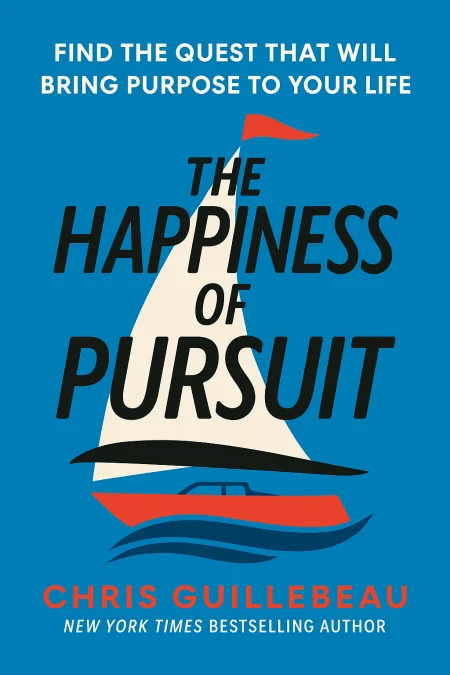
The Happiness of Pursuit
Find the Quest that Will Bring Purpose to Your Life
Book Edition Details
Summary
Amid the humdrum rhythm of everyday life lies a daring invitation: redefine your existence through the power of a quest. In "The Happiness of Pursuit," Chris Guillebeau, celebrated author and global adventurer, unearths the transformative magic of pursuing audacious goals. This isn't just about globe-trotting feats like Guillebeau’s own journey to every country by 35; it’s about any endeavor that ignites your spirit and shatters the mundane. Drawing on insights from thousands of modern-day adventurers, Guillebeau reveals how these quests unravel self-discovery, resilience, and life-changing fulfillment. Whether it's creating art, starting a movement, or simply mastering a new skill, your quest is the key to a life imbued with purpose and passion.
Introduction
The airport terminal in Dakar buzzed with late-night energy as travelers from across West Africa converged on connecting flights. Among them sat a weary adventurer, propped against plastic chairs, clutching a laptop bag and watching mosquitoes circle overhead. What drove someone to spend uncomfortable nights in foreign terminals, pursuing a goal that seemed both impossible and oddly compelling? This scene captures something profound about human nature: our deep need to chase something meaningful, even when the path forward appears unclear. We live in an age of unprecedented opportunity yet widespread dissatisfaction. Despite having access to comfort, education, and possibilities our ancestors could never imagine, many of us feel adrift. We scroll through social media, comparing our ordinary moments to others' highlight reels, wondering if there's something more. The answer isn't found in another self-help formula or life hack. Instead, it lies in understanding how ordinary people transform their lives by embracing something extraordinary: the pursuit of a quest. A quest differs from a simple goal. While goals can be checked off lists, quests reshape who we become. They demand sacrifice, courage, and persistence through monotonous middle miles. They connect us to something larger than ourselves and reveal capabilities we never knew we possessed. Through stories of individuals who walked across continents, lived in trees for environmental causes, cooked meals from every nation, and pursued dreams that others called impossible, we discover that the path to fulfillment isn't about finding ourselves—it's about creating ourselves through purposeful action.
The Calling to Adventure: Stories of Discontent and Discovery
The notification email arrived on an ordinary Tuesday morning, but its message would shatter everything Sandi Wheaton thought she knew about her future. After twelve years of dependable service at General Motors, she and six colleagues were summoned to a hotel meeting room and delivered the news: their positions were eliminated. While her coworkers immediately began polishing resumes and networking frantically, Sandi felt something unexpected stirring within her. The layoff wasn't just an ending—it might be the beginning she'd been secretly craving. For years, Sandi had harbored a dream of photographing America's iconic Route 66, capturing the essence of small-town life through her lens. The corporate job had provided security but consumed her most creative hours. Now, faced with the choice between scrambling for another position or pursuing her long-dormant vision, she made a decision that would reshape everything. She bought a camper, mapped out her route, and set off to document America in slow motion, one photograph at a time. Meanwhile, across the Atlantic, Tom Allen faced his own moment of reckoning. Fresh from university with a promising job offer in hand, he should have felt triumphant. Instead, he experienced a profound unease when the interviewer emphasized long-term commitment and company loyalty. Something within him recoiled at the thought of his life's trajectory being predetermined. When he declined the position to cycle around the world instead, he knew he was choosing uncertainty over security—but he also knew he couldn't live with the regret of not trying. These moments of awakening reveal a fundamental truth about human nature: beneath our carefully constructed routines lies a yearning for something more authentic and meaningful. The spark of discontent, rather than being something to suppress, often signals our deepest wisdom calling us toward our true path. When we learn to listen to that inner voice and respond with courage, we discover that our greatest adventures often begin with our willingness to leave familiar shores behind.
The Journey Within: Independence, Courage, and Daily Progress
Laura Dekker knew the feeling of wind-filled sails before she could walk properly on land. Born aboard a yacht and raised on the water, she possessed an intuitive understanding of navigation and weather patterns. But when she announced her intention to become the youngest person to circumnavigate the globe solo, the Dutch government intervened, placing her under state guardianship and deeming her plan too dangerous. Rather than accepting defeat, Laura pursued legal action against her own country, fighting for the right to pursue her dream. Her victory in court marked only the beginning of a different kind of challenge. Alone on the vast ocean, Laura discovered that the greatest obstacles weren't the storms or mechanical failures she'd trained for—they were the voices of doubt and criticism that followed her across the waves. People questioned her motives, her parents' judgment, and her mental state. Yet in the solitude of her journey, she found something more valuable than public approval: absolute confidence in her own capabilities. The daily rhythm of solo sailing created its own form of meditation. Each morning brought decisions about weather, route, and equipment. Each sunset provided an opportunity for reflection and planning. Laura wasn't just crossing oceans; she was building an unshakeable foundation of self-reliance. When critics suggested she was simply seeking attention, she responded with characteristic directness: "I didn't want to be famous. I wasn't trying to become a celebrity. I just loved the sea and wanted to do this for myself." Across different pursuits, this pattern emerges repeatedly: those who undertake significant quests discover that external validation, while pleasant, pales in comparison to the deep satisfaction of proving something to themselves. The teenager who trains her own guide dog despite experts insisting it's impossible, the software engineer who continues working on his project even after being laid off—they all share this common thread. True confidence isn't borrowed from others' opinions; it's earned through daily acts of persistence, through choosing forward motion when retreat would be easier, and through trusting our inner compass even when the destination remains uncertain.
Community and Struggle: Finding Support on the Long Road
When John Francis decided to stop using motorized vehicles after witnessing an oil spill, friends initially supported his environmental stance. But when he added a vow of silence to his protest, lasting seventeen years, many relationships shifted dramatically. His father flew across the country to convince him to abandon what seemed like self-imposed isolation. "What kind of job are you going to get?" his father pleaded. "You have to talk." Yet John discovered that his unusual choices, while alienating some people, attracted others who shared his values and commitment to environmental action. The challenge of maintaining relationships during extended quests reveals both the loneliness and unexpected connections that define transformative journeys. Tom Allen, cycling from England toward Iran, experienced this tension acutely when he fell in love with Tenny in Armenia. Suddenly, his solitary adventure became complicated by deep emotional attachment. The first time he left to continue his journey, he immediately regretted the decision and turned back. Later, when they parted again, he had learned an important distinction: while love could be shared, dreams ultimately belong to their creators. Similarly, the Vogel family—parents Nancy and John with their twin ten-year-old boys—discovered that their three-year cycling journey from Alaska to Argentina tested family bonds in unexpected ways. Nancy reached her breaking point multiple times, particularly during the humid jungles of Central America and the challenging terrain of Peru. Yet the boys adapted fastest to life on the road, motivated by the simple rule of "twenty miles per cookie" and the excitement of setting a world record as the youngest continental cyclists. What emerges from these stories is a paradox: pursuing a deeply personal quest can simultaneously isolate you from those who don't understand while connecting you more authentically with those who do. The key lies not in expecting universal support, but in finding the right balance between solitude and community, between independence and interdependence, and between honoring your own vision while remaining open to the unexpected relationships that enrich the journey along the way.
Transformation and Return: What Comes After the Quest
The final approach to Oslo airport marked the end of a ten-year odyssey to visit every country in the world. Yet stepping off the plane felt surprisingly anticlimactic—no fanfare, no photographers, just an immigration officer who barely looked up while scanning the passport. After a decade of complex visa applications, missed connections, and nights spent sleeping in remote terminals, the completion of such an ambitious goal arrived with whispered simplicity rather than thunderous conclusion. This understated ending reflects a deeper truth about transformative journeys: they change us so gradually and thoroughly that we often struggle to articulate their impact. Meghan Hicks, after completing her fourth Marathon des Sables race across the Sahara Desert, found herself fumbling when friends asked, "What was it like?" The question seemed to demand a sound bite for an experience that had rewired her understanding of endurance, solitude, and personal capability. How do you compress months of struggle, breakthrough, and self-discovery into casual conversation? The more profound challenge comes in integrating these hard-won insights into everyday life. Howard Weaver, after successfully dismantling Alaska's establishment newspaper through years of principled journalism, discovered that victory brought its own form of disorientation. "A large part of how I'd defined myself simply was no longer there," he reflected. Without the familiar enemy to fight against, he struggled to define his next chapter. Many quest-completers describe similar experiences: the very achievement of their goal creates a vacuum that must be filled with new purpose. Yet this disorientation signals growth rather than loss. Those who undertake significant quests return with expanded vision and capabilities. What began as individual goals often evolve into broader missions of service. The woman who cooked meals from every country becomes an advocate for cultural understanding. The man who walked across continents starts inspiring others to embrace their own adventures. The teenager who sailed solo around the world models courage for the next generation. They discover that completion isn't an ending but a commencement—the beginning of a life informed by the knowledge that seemingly impossible things become achievable through persistent, purposeful action.
Summary
The stories woven throughout these pages reveal a fundamental truth about human flourishing: we are most alive when pursuing something that challenges and transforms us. Whether walking across continents, protesting environmental destruction by living in trees, or mastering crafts through deliberate practice, the individuals in these accounts share common threads of dissatisfaction with ordinary life, willingness to embrace uncertainty, and commitment to persistent action despite obstacles and criticism. The quest structure itself—with clear goals, measurable progress, and willingness to sacrifice comfort for meaning—provides a framework for creating lives of intention rather than accident. These are not stories of superhuman individuals with special advantages, but of ordinary people who chose extraordinary commitment to their vision. They remind us that our greatest regrets typically stem not from attempting difficult things and failing, but from failing to attempt the difficult things that call to our deepest selves. Perhaps most importantly, these accounts demonstrate that the pursuit itself, rather than the achievement, provides the greatest rewards. The confidence gained from daily progress, the relationships forged through shared struggle, and the expanded sense of what's possible create lasting transformation that extends far beyond any specific goal. The call to adventure isn't reserved for a chosen few—it whispers to all of us, waiting for the moment we decide to listen and respond with courage. Your quest may not involve visiting every country or sailing solo across oceans, but it beckons nonetheless, offering the possibility of a life that matters deeply to you and contributes meaningfully to the world.
Related Books
Download PDF & EPUB
To save this Black List summary for later, download the free PDF and EPUB. You can print it out, or read offline at your convenience.
By Chris Guillebeau
