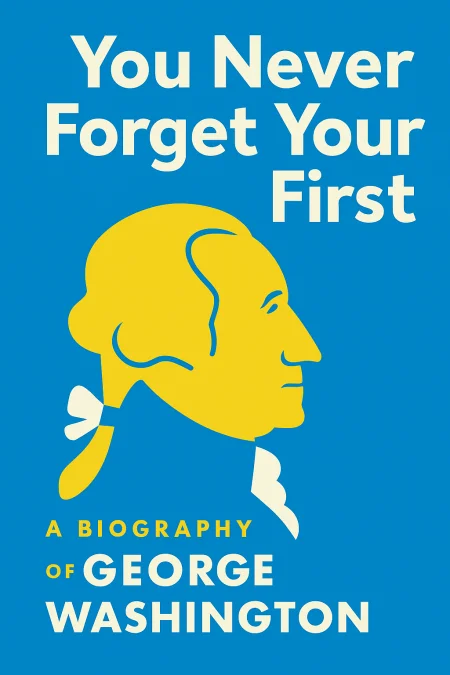
You Never Forget Your First
A Biography of George Washington
Book Edition Details
Summary
In Alexis Coe's refreshingly audacious take on America's most mythologized figure, George Washington emerges not as the marble deity of legend, but as a flesh-and-blood man grappling with the chaos of his own making. Here is a Washington who sidesteps conventional heroism to reveal a life teetering between personal ambition and the collective ideals of a fledgling nation. Before he was a reluctant icon, he was a man who danced with scandal, navigated war with equal measures of luck and tenacity, and contended with the moral quagmire of slavery. Coe, the first woman in decades to tackle his biography, dismantles the pedestal, unveiling a narrative rich with espionage, heartbreak, and the heavy crown of unwanted power. In this playful yet incisive portrait, Washington is reborn—not as a distant hero, but as a complex character with triumphs and flaws familiar to all who dare to lead.
Introduction
Picture a young George Washington, barely twenty-two, inadvertently sparking what would become the world's first global war through a diplomatic miscalculation in the Pennsylvania wilderness. This moment captures the essence of America's most mythologized founder—a man whose greatness emerged not from perfection, but from his very human struggles with ambition, contradictions, and moral compromise. For too long, Washington has been trapped in marble—portrayed as either a flawless saint or reduced to wooden teeth and cherry tree fables. This fresh examination cuts through centuries of myth-making to reveal a complex figure whose personal battles with slavery, political enemies, and his own limitations shaped the very foundations of American democracy. We encounter a Washington who was simultaneously the liberator of a nation and the enslaver of hundreds, a champion of unity who became increasingly partisan, a reluctant leader who craved recognition. This nuanced portrait illuminates three crucial questions that resonate today: How do we reconcile the noble ideals of our founders with their profound moral failures? What can Washington's evolution from colonial upstart to reluctant statesman teach us about leadership in times of deep division? And how did the personal contradictions of one man become embedded in the DNA of American democracy itself? Anyone seeking to understand the paradoxes at the heart of American identity will find essential insights in Washington's remarkably human story.
From Colonial Upstart to Revolutionary Commander (1732-1775)
George Washington's rise began not with greatness, but with loss and limitation. Born into Virginia's minor gentry in 1732, his world collapsed when his father Augustine died in 1743, leaving eleven-year-old George under the care of his formidable mother, Mary Ball Washington. Unlike his older half-brothers who received English educations, Washington's formal schooling ended early, forcing him to forge his own path in colonial society. The young Washington channeled his ambitions into land surveying and military service, desperately seeking the recognition that birth had denied him. His early career reads like a cautionary tale of colonial overreach—at twenty-one, he accidentally triggered the French and Indian War by killing French diplomat Jumonville in 1754, an act that "set the world on fire," as one British observer noted. Yet even his failures became stepping stones, as his published account of frontier hardships transformed military defeat into literary celebrity. Washington's hunger for advancement reflected deeper colonial frustrations with British imperial limits. Despite his loyalty and service, the crown consistently treated colonial officers as second-class, denying them equal rank, pay, and respect. This personal humiliation mirrored the broader colonial experience of being valued yet constrained, useful yet never truly equal. When Washington finally resigned his commission in 1758, it marked not just a personal turning point, but a preview of colonial disillusionment. The transformation of this ambitious young officer into a revolutionary leader required more than military disappointment—it demanded the cultivation of different values through domestic life. His 1759 marriage to the wealthy widow Martha Custis provided both financial security and emotional grounding, allowing Washington to mature from a glory-seeking soldier into a thoughtful planter and stepfather. This personal evolution would prove essential when the colonies again called him to arms, this time not for empire, but against it.
Wartime Leadership and the Price of Independence (1775-1783)
When the Continental Congress unanimously chose Washington to command their makeshift army in 1775, they selected not the colonies' best general, but their most politically astute one. Washington understood that winning independence required more than battlefield victories—it demanded maintaining colonial unity, international credibility, and his own moral authority against the world's greatest military power. Washington's genius lay in recognizing that he was fighting a war of endurance rather than conquest. While losing more battles than he won, he kept his army intact and the revolutionary cause alive through eight grueling years. His strategic retreats, tactical withdrawals, and patient rebuilding of forces frustrated British attempts to deliver a decisive blow. The famous Delaware crossing and subsequent victories at Trenton and Princeton in late 1776 exemplified his approach—dramatic enough to restore morale, limited enough to preserve his forces for the longer struggle ahead. Perhaps more importantly, Washington pioneered a new form of warfare that combined military action with sophisticated propaganda, espionage, and diplomacy. He carefully documented British atrocities, cultivated relationships with European allies, and ran extensive spy networks while maintaining the moral high ground. His restraint in victory and dignity in defeat convinced international observers that Americans could govern themselves responsibly—a crucial factor in securing French alliance and ultimate victory. The personal cost of this extended conflict was enormous. Washington spent eight years away from Mount Vernon, watching from afar as family members died, his estates deteriorated, and his finances crumbled. His enslaved manservant Billy Lee accompanied him throughout the war, a constant reminder of the contradiction between fighting for liberty while holding others in bondage. When Washington finally resigned his commission in 1783, his voluntary surrender of power shocked a world accustomed to military strongmen, establishing a precedent that would define American democracy.
Presidential Precedents and Political Divisions (1789-1797)
Washington approached the presidency with the same strategic thinking that had won the war—understanding that his primary task was not governing a nation but creating the very idea of what American governance could become. Every decision, from how to address the president to establishing a cabinet system, set precedents that would outlast his lifetime. His reluctant acceptance of a second term demonstrated his commitment to institutionalizing democratic transitions rather than personal rule. The great challenge of Washington's presidency was managing the emergence of partisan divisions that threatened to tear apart the union he had fought to create. The fierce rivalry between Alexander Hamilton and Thomas Jefferson over federal power, economic policy, and foreign relations forced Washington to navigate between competing visions of America's future. His attempts to remain above party politics became increasingly difficult as both sides claimed his authority while attacking his policies through partisan newspapers. Washington's handling of domestic crises revealed both his strengths and limitations as a leader. The Whiskey Rebellion of 1794 saw him march federal troops against his own citizens—the only president ever to do so—demonstrating his determination to uphold federal authority. Yet his response was disproportionate to the threat, suggesting how the pressures of office had worn away some of his legendary self-control. His foreign policy of studied neutrality during European wars established America's early isolationist tradition while protecting the young nation's fragile independence. The presidency's greatest toll was personal, transforming Washington from a unifying national symbol into a partisan figure. By 1797, half the country viewed him as a monarchist tool of Hamilton's financial interests, while the other half saw him as their only bulwark against democratic chaos. His Farewell Address warned against the "baneful effects" of party spirit and foreign entanglements, but these very divisions had emerged under his watch, embedded in the constitutional system he had helped establish.
Final Contradictions: Slavery, Legacy, and Death (1797-1799)
Washington's final retirement to Mount Vernon was shadowed by the unresolved contradictions that had defined his public life. Now in his mid-sixties and increasingly concerned with his historical legacy, he confronted the moral weight of owning over three hundred human beings while being celebrated as the champion of human liberty. His private correspondence reveals a man intellectually opposed to slavery yet financially dependent on it, speaking of gradual emancipation while taking active steps to prevent his enslaved workers from claiming their freedom. The former president's pursuit of his runaway slaves, Ona Judge and Hercules, during this period exposed the gap between his public rhetoric and private actions. Judge had fled rather than become a wedding gift to Washington's granddaughter, while Hercules disappeared on Washington's birthday in 1797 after being relegated from chef to field laborer. Washington's use of federal resources and the Fugitive Slave Act to reclaim his "property" demonstrated how deeply the institution of slavery was woven into the fabric of the early republic. Washington's final years were marked by increasing political isolation as the partisan divisions he had warned against consumed the nation. His support for Federalist military preparations during the Quasi-War with France, his criticism of Republican opponents, and his public feuds with former allies like Jefferson revealed a man whose commitment to unity had given way to factional loyalty. The transcendent figure of the Revolution had become an aging partisan, respected but no longer revered. When Washington died in December 1799, his will provided for the eventual emancipation of his slaves—but only after Martha's death, and with provisions that protected his economic interests to the end. Martha, fearing for her safety, freed them a year later, but the enslaved families were separated, sold, and scattered across multiple states. Even in death, Washington's legacy embodied the fundamental American contradiction between the promise of freedom and the reality of bondage, a tension that would ultimately require civil war to resolve.
Summary
George Washington's life reveals the central paradox of American democracy: a nation founded on liberty by men who practiced slavery, dedicated to equality by those who embraced hierarchy, and committed to unity by leaders whose conflicts nearly destroyed it before it began. His evolution from ambitious colonial officer to reluctant revolutionary to partisan ex-president mirrors America's own struggle between idealism and pragmatism, principle and power. The enduring lesson of Washington's career lies not in his perfection but in his capacity for growth under pressure. His willingness to surrender power, accept criticism, and adapt to changing circumstances established precedents that have allowed American democracy to survive far greater challenges than those faced by his generation. Yet his failure to resolve the slavery question and his inability to transcend partisan divisions also demonstrate the limits of individual leadership in addressing structural inequalities and systemic conflicts. For contemporary leaders, Washington's example suggests three essential principles: first, that moral authority requires acknowledging and grappling with personal contradictions rather than hiding behind mythic perfection; second, that democratic institutions matter more than individual greatness, and must be consciously built and maintained; and third, that the price of unity is constant vigilance against the forces of division and the temptations of power. Understanding Washington as a flawed human being rather than a marble monument makes his achievements more remarkable and his lessons more relevant to our own struggles with democracy's enduring tensions.
Related Books
Download PDF & EPUB
To save this Black List summary for later, download the free PDF and EPUB. You can print it out, or read offline at your convenience.
By Alexis Coe
