
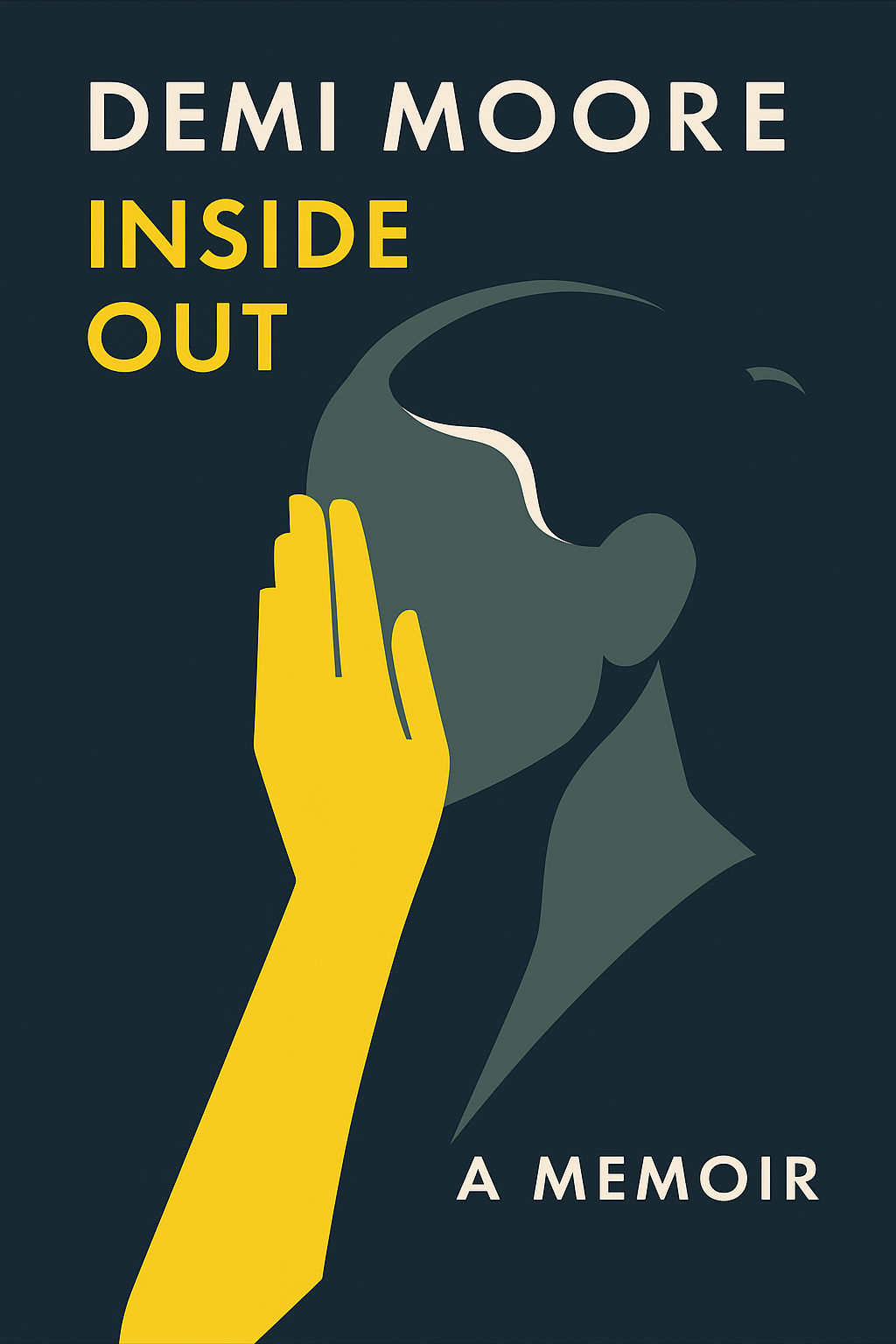
Inside Out
A Memoir
Book Edition Details
Summary
Under the spotlight's relentless glare, Demi Moore's life unfolded like a drama more gripping than any Hollywood script. In "Inside Out," Moore bares her soul, recounting a journey marked by stark contrasts: the glittering heights of stardom against the shadows of addiction and trauma. As a child of chaos who ascended to become Hollywood's highest-paid actress, Demi invites readers into her world—a place where fame dances with insecurity, and public triumphs mask private battles. From her tumultuous childhood through marriages to Bruce Willis and Ashton Kutcher, Moore's memoir is an unvarnished tale of resilience and vulnerability. With piercing honesty, she unveils her battles with self-worth and the relentless quest for acceptance, both in Hollywood and within herself. "Inside Out" isn't just a celebrity tell-all; it's a raw, human story of survival, reflection, and ultimately, redemption.
Introduction
From the neon-lit stages of Hollywood to the quiet mountains of Idaho, Demi Moore's life reads like a masterclass in resilience against impossible odds. Born into chaos and uncertainty, she transformed herself from a wounded child into one of the most recognizable faces in cinema, commanding unprecedented salaries and redefining what it meant to be a leading woman in Hollywood. Yet beneath the glossy magazine covers and red carpet appearances lay a deeper story of survival, one that began long before the cameras started rolling. Moore's journey offers readers a rare glimpse into three profound dimensions of human experience. First, her extraordinary rise from poverty and neglect to becoming the highest-paid actress of her era reveals the complex machinery of ambition, talent, and sheer determination. Second, her candid exploration of love, motherhood, and the price of fame illuminates the often hidden costs of success, particularly for women navigating public scrutiny while trying to maintain authentic relationships. Finally, her ultimate surrender to vulnerability and self-acceptance provides a roadmap for anyone seeking to break free from the patterns that no longer serve them, showing how our deepest wounds can become our greatest sources of wisdom and strength.
Breaking Through: From Childhood Trauma to Hollywood Dreams
Demi Moore's childhood was a masterclass in survival, though no child should have to earn such an education. Born into a world where stability was a foreign concept, she learned to read the emotional weather of any room before she could properly read books. Her parents, Danny and Ginny, were themselves barely more than children when they started their tumultuous dance of love, betrayal, and self-destruction. Danny, with his lazy eye and gambler's charm, and Ginny, a beauty queen trapped in poverty, created a home where the only constant was change itself. The family moved with relentless frequency, sometimes several times a year, as they fled from debts, affairs, or simply the consequences of their own poor choices. For young Demi, each new school, each new town, became a puzzle to solve: who did she need to become to fit in this time? This constant adaptation, born of necessity, would later become her greatest asset as an actress, but at the time it was simply a survival mechanism. She learned to study people like a detective, reading their desires and expectations, then shape-shifting to meet them. The darkness in her childhood ran deeper than mere instability. When Demi discovered her father wasn't her biological parent, it shattered her sense of identity at its core. Later, the betrayal by her mother, who essentially sold her daughter's safety for five hundred dollars, would leave wounds that took decades to heal. Yet even in these moments of profound violation, young Demi was developing the steel spine that would carry her through Hollywood's treacherous waters. She learned that she could endure anything, that survival was not just possible but inevitable if she stayed alert and adaptable. By the time she left home at sixteen, Demi had already lived several lifetimes worth of experience. She carried with her a desperate hunger for safety and belonging, but also an unshakeable belief in her own resilience. These qualities would prove both her salvation and her curse as she navigated the entertainment industry, where her ability to reinvent herself would make her a star, but her deep-seated insecurities would nearly destroy her.
Rising Star: Career Heights and Personal Struggles
The transformation from survival mode to stardom happened with breathtaking speed, but success brought its own unique forms of suffering. When Demi landed her role on General Hospital, she finally had something she'd never experienced: financial security. The simple ability to pay rent without anxiety was revolutionary, yet it also exposed the deeper hungers that money couldn't satisfy. Fame, she discovered, was a double-edged sword that could validate your worth one moment and obliterate it the next. Her breakthrough role in Ghost catapulted her into the stratosphere of Hollywood royalty, but with it came pressures she hadn't anticipated. The famous Vanity Fair cover, where she posed nude and pregnant, became a cultural lightning rod that both empowered and vilified her. She had intended simply to celebrate the beauty of pregnancy, but the reaction revealed society's complex relationship with female sexuality and motherhood. The image became iconic, yet the accompanying article painted her as a demanding diva, creating a narrative that would follow her for years. The intense scrutiny of her personal life, particularly her marriage to Bruce Willis, created a fishbowl existence where every gesture was analyzed and every relationship was fair game for speculation. Their romance had begun like a fairy tale, but the reality of building a marriage under the harsh glare of public attention proved far more challenging than either had anticipated. Bruce's ambivalence about commitment, combined with Demi's deep need for security, created a dynamic that was both passionate and unstable. Perhaps most painfully, her professional choices were consistently viewed through a lens of sexuality rather than artistry. Whether she was taking her clothes off in Striptease or building muscle for G.I. Jane, critics seemed more interested in her body than her performance. The unprecedented salary she commanded for these films made her a target for accusations of greed, as if wanting to be paid fairly for her work was somehow unfeminine or inappropriate. These experiences taught her that success for women in Hollywood came with a unique set of penalties that men rarely faced.
The Fall and Rise: Loss, Recovery, and Finding Herself
The unraveling began slowly, then accelerated with devastating speed. Her relationship with Ashton Kutcher had seemed like a second chance at love, a opportunity to experience the carefree romance she'd never had in her youth. Twenty-five to her forty, he brought an energy and optimism that made her feel reborn. Yet beneath the surface joy lay the same patterns that had always governed her relationships: the desperate need to please, the willingness to contort herself into whatever shape her partner desired, the terror of abandonment that drove her to compromise her own needs. The loss of their unborn daughter, Chaplin, marked the beginning of Demi's descent into a darkness she'd never before experienced. Grief, she discovered, was a beast that couldn't be tamed through sheer willpower or positive thinking. The repeated failures of their attempts to conceive through IVF felt like cosmic punishment, each negative result reinforcing her deepest fear that she was fundamentally flawed and undeserving of happiness. She began to self-medicate, first with alcohol, then with prescription pills, seeking any refuge from the pain that seemed to be consuming her from within. The end came with brutal swiftness: Ashton's betrayal, followed by the complete estrangement from her daughters, stripped away every identity she'd ever claimed. No longer a wife, no longer actively a mother, no longer in demand as an actress, she was forced to confront the most terrifying question of all: who was she when all the roles fell away? The seizure that brought paramedics to her door was merely the physical manifestation of a spiritual collapse that had been building for years. Yet in losing everything, she found the key to her own freedom. The forced isolation, painful as it was, became a crucible for transformation. Without the constant demands of others to distract her, she finally had to face the trauma she'd been carrying since childhood, the beliefs about her own worthlessness that had shaped every major decision of her life. Through therapy, spiritual practice, and the simple act of learning to be alone with herself, she began to understand that her value didn't depend on her usefulness to others or her ability to meet their expectations.
Summary
Demi Moore's story ultimately teaches us that true strength lies not in the ability to endure suffering silently, but in the courage to examine why we suffer and to demand better for ourselves. Her journey from a discarded child to a Hollywood icon to a woman who finally learned to value herself reveals that our greatest wounds, when properly tended, can become our most profound sources of wisdom. The same adaptability that helped her survive a chaotic childhood and navigate the treacherous waters of fame eventually taught her the most important lesson of all: that she was worthy of love and respect simply by virtue of being human, not because of what she could do or provide for others. For anyone who has ever felt trapped by their past or overwhelmed by others' expectations, Moore's story offers a powerful reminder that it's never too late to reclaim your own life and write a different ending to your story.
Related Books
Download PDF & EPUB
To save this Black List summary for later, download the free PDF and EPUB. You can print it out, or read offline at your convenience.
By Demi Moore
