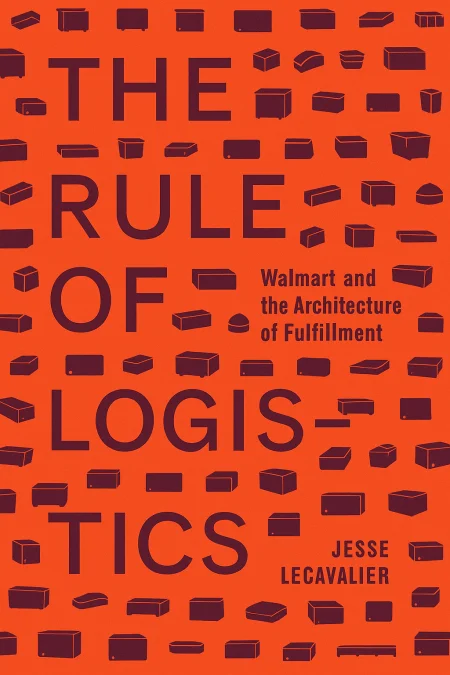
The Rule of Logistics
Walmart and the Architecture of Fulfillment
Book Edition Details
Summary
In the bustling heart of consumerism lies a labyrinthine world of precision and power—Walmart's logistical empire. "The Rule of Logistics" invites you into a realm where every barcode scanned and every aisle traversed is part of a grand design, a symphony of efficiency that extends far beyond retail. Jesse LeCavalier masterfully unveils how this retail giant's architectural footprint reshapes cities and influences our daily lives. From its humble beginnings in 1962 to its status as a global titan, discover the intricate dance of military strategies, cutting-edge technology, and unexpected cultural intersections that underpin Walmart’s operations. This compelling narrative doesn’t just chronicle the rise of a retail behemoth; it redefines how we perceive space and commerce in the modern world, challenging us to envision the future of architecture in an era dominated by logistics.
Introduction
In the summer of 1987, a remarkable scene unfolded in the skies above rural America. Below, a small aircraft traced lazy circles over cornfields and shopping centers, its pilot scanning the landscape with the practiced eye of a military strategist. This was Sam Walton, founder of a growing discount chain, conducting aerial reconnaissance to identify the next targets for his retail empire. What appeared to be simple business scouting was actually something far more profound: the birth of a new form of territorial control that would reshape the American landscape. This transformation reveals how the mundane science of moving goods efficiently has become one of the most powerful forces organizing modern life. The story illuminates three crucial historical developments: how military logistics evolved into corporate strategy, fundamentally altering the relationship between business and territory; how information technology enabled unprecedented coordination across vast distances, creating new forms of economic power; and how the pursuit of efficiency transformed both built environments and human work in ways that continue to reverberate today. Understanding this evolution is essential for business leaders seeking to comprehend competitive dynamics in the digital age, urban planners grappling with the spatial implications of e-commerce, architects designing for automated systems, and citizens wondering how invisible networks of coordination shape their daily lives. The lessons extend far beyond retail, offering insights into how technological innovation, spatial strategy, and organizational design intersect to create new forms of power in the contemporary world.
From Military Strategy to Corporate Power: The Evolution of Logistics (1940s-1960s)
The transformation of logistics from battlefield necessity to commercial advantage began during World War II, when military planners discovered that victory depended as much on supply chains as on fighting forces. The war's unprecedented scale demanded new approaches to coordination, leading to innovations in standardization, communication, and systematic planning that would prove equally revolutionary in civilian contexts. Military theorists like Antoine-Henri Jomini had long understood that strategy determines where to act, but logistics brings the means to the point of action—a principle that would soon migrate from war rooms to boardrooms. The post-war economic boom created perfect conditions for this migration, as returning veterans brought military organizational methods to rapidly expanding corporations. The development of shipping containers, early computer systems, and improved communications infrastructure provided the technological foundation for coordination at unprecedented scales. Companies began to realize that competitive advantage lay not just in manufacturing superior products, but in moving goods more efficiently than rivals could manage. This shift coincided with broader changes in American retail, particularly the rise of discount stores and self-service shopping. Traditional retailers had relied on personal relationships and local knowledge, but the new discount model demanded systematic approaches to inventory management, supplier coordination, and cost control. The companies that thrived were those that recognized logistics as a core competency rather than merely a support function. The implications extended far beyond operational efficiency. As logistics became central to business strategy, it began to reshape physical space itself. The efficient movement of goods required new forms of architecture, new patterns of settlement, and new relationships between buildings and infrastructure. What had begun as a military discipline was evolving into a comprehensive system for organizing territory, setting the stage for transformations that would reshape the American landscape over the following decades.
Building the Network: Walmart's Territorial Expansion and Technological Integration (1962-1990s)
Sam Walton's genius lay in recognizing that retail success depended less on individual store performance than on the systematic coordination of entire networks. Beginning with his first Walmart store in 1962, Walton developed a territorial strategy that deliberately avoided direct competition with established retailers, instead focusing on smaller towns and rural areas where his company could establish market dominance. Each distribution center functioned as a strategic hub controlling a hundred-mile radius, creating overlapping zones of influence that gradually covered vast regions. This territorial approach required sophisticated information systems that could treat merchandise as data to be processed rather than simply objects to be stored. The adoption of Universal Product Codes transformed every item into a source of information, while computerized inventory management systems enabled real-time coordination between stores, distribution centers, and suppliers. Walmart's decision to launch its own satellite network in the 1980s created a private communications system more advanced than many government agencies possessed, allowing unprecedented coordination across the expanding retail empire. The architectural implications were equally revolutionary. Walmart developed three primary building types—stores, distribution centers, and data centers—each representing a different relationship between form, function, and information flow. Unlike traditional retail buildings designed as destinations in their own right, these structures functioned as components in a vast machine for moving goods. The buildings could be standardized and replicated across different locations while maintaining operational consistency, creating a new form of corporate architecture optimized for efficiency rather than local character. The success of this integrated approach fundamentally altered the competitive landscape of American retail. By the 1990s, Walmart had demonstrated that superior logistics could overcome traditional advantages like prime locations or established customer relationships. The company's ability to offer lower prices through operational efficiency forced competitors to adopt similar approaches or face extinction, spreading logistical thinking throughout the retail industry and beyond.
The Human-Machine Hybrid: Workers and Automation in Distribution Centers (1990s-2000s)
The evolution of distribution centers into building-sized computers created unprecedented challenges for human workers, who found themselves operating within environments designed primarily for machines rather than people. The introduction of technologies like voice-directed picking systems and wearable scanners represented more than simple automation—they constituted a fundamental reimagining of the relationship between human bodies and technological systems. Workers became hybrid entities, part human and part machine, navigating spaces that were increasingly illegible without technological augmentation. The development of systems like voice-directed picking software revealed the extent to which human workers had become components in larger computational systems. Rather than using tools to extend their capabilities, workers found themselves serving as organic extensions of digital networks, following algorithmic instructions delivered through earpieces and confirming their actions through voice recognition systems. This reversal of the traditional human-machine relationship—where computers did the thinking and humans performed the physical labor—represented a new form of industrial organization adapted to the demands of information-intensive logistics. The spatial implications of these human-machine assemblages were profound. Distribution centers became environments where workers moved through three-dimensional grids following paths determined by software optimization rather than human logic. The architecture itself became a kind of interface, with conveyor systems, storage racks, and picking stations arranged to facilitate algorithmic rather than intuitive navigation. Workers equipped with wearable computers could access database information about inventory locations, but they simultaneously became visible to management systems that tracked their every movement and action. These developments in logistics work environments prefigured broader transformations in the relationship between humans and automated systems. As distribution centers became testing grounds for new forms of human-machine integration, they revealed both the possibilities and the challenges of organizing work around information processing rather than material production. The result was a new kind of industrial space that demanded new forms of literacy and adaptation from its human inhabitants while subordinating their needs to the demands of algorithmic efficiency.
Corporate Geography: Bentonville and the New American Spatial Order (2000s-Present)
The transformation of Bentonville, Arkansas, from a sleepy county seat to a global command center illustrates how logistics creates entirely new forms of urban development. Unlike traditional cities that grew around natural resources, transportation hubs, or manufacturing centers, Bentonville represents something unprecedented: a metropolitan region organized around the management of distant commercial networks. This evolution demonstrates how corporate logistics can reshape not just business operations, but entire regional geographies. Walmart's decision to remain rooted in its unlikely hometown, initially driven by founder Sam Walton's personal preferences, evolved into a sophisticated strategy for corporate control. By concentrating management functions in a remote location, the company could attract suppliers and partners while maintaining tight control over corporate culture and decision-making processes. Thousands of vendor representatives established offices in the region, creating a peculiar form of urbanism that combines global connectivity with local insularity. The result is a landscape of corporate domesticity where international commerce unfolds in buildings designed to look like suburban homes, while massive private investments in cultural institutions and infrastructure attempt to create urban sophistication without urban complexity. The Crystal Bridges Museum, the regional airport expansion, and various lifestyle amenities represent attempts to build a world-class metropolitan region through private rather than public investment, creating new models for territorial development. This transformation represents a broader shift toward privatized regional development, where corporate interests rather than democratic processes shape territorial organization. The Northwest Arkansas metropolitan region functions as a testing ground for new forms of governance that operate through market mechanisms rather than political institutions. The success of this experiment suggests that the future of American urbanism may belong not to traditional cities, but to corporate territories organized around logistical efficiency rather than civic life, raising profound questions about democracy, community, and the public interest in an age of corporate territorial control.
Summary
The logistics revolution reveals a fundamental transformation in how power operates in contemporary society, where the efficient movement of goods and information has become more important than their production or consumption. What began as military innovation evolved into a comprehensive system for organizing space, time, and human activity around the imperatives of efficiency and coordination. This transformation operates largely below the threshold of political awareness, reshaping landscapes and communities through the seemingly neutral language of optimization and technological progress. The central tension running through this history lies between the promise of technological liberation and the reality of systemic control. Logistics technologies offer genuine benefits including lower prices, greater convenience, and access to global markets, yet these same systems concentrate unprecedented power in the hands of those who control the networks while reducing workers, communities, and consumers to data points in vast computational systems. The human cost of efficiency becomes visible in the hybrid work environments of distribution centers and the corporate territories that prioritize logistical performance over democratic participation. Understanding this transformation provides essential insights for navigating our increasingly automated world. First, we must recognize that efficiency is never neutral but always serves particular interests and values, requiring careful consideration of whose needs are prioritized in system design. Second, we need new forms of democratic engagement that can address the political implications of seemingly technical decisions about infrastructure and technology. Finally, we must imagine alternative futures that harness the genuine benefits of coordination and connectivity while preserving space for human agency, community self-determination, and the messy vitality that makes places worth inhabiting rather than merely efficient to operate.
Related Books
Download PDF & EPUB
To save this Black List summary for later, download the free PDF and EPUB. You can print it out, or read offline at your convenience.
By Jesse LeCavalier
