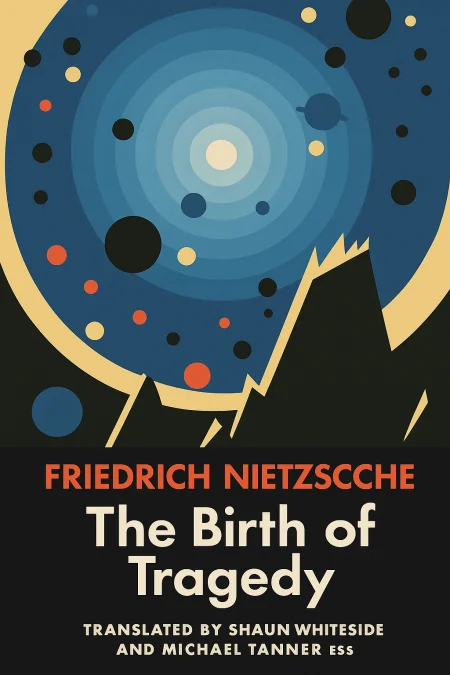
The Birth of Tragedy
Discover Art's Role in Unmasking Reality
byFriedrich Nietzsche, Shaun Whiteside, Michael Tanner
Book Edition Details
Summary
In the vibrant tapestry of philosophical thought, Friedrich Nietzsche's "The Birth of Tragedy" weaves a profound exploration of art's primal essence. This seminal work, ignited by Nietzsche's fervor for Greek drama and the profound influences of Schopenhauer's philosophy and Wagner's music, delves into the duality of human nature. The interplay of the Apolline—symbolizing order and harmony—and the Dionysiac—a wild, unrestrained ecstasy—forms the heart of this discourse. Nietzsche contends that the fusion of these forces births the pinnacle of artistic expression, offering both a mirror to life's inherent suffering and a salve for its wounds. A cornerstone of cultural critique, this passionate manifesto challenges the era's burgeoning rationalism, advocating instead for the timeless resurgence of tragic beauty.
Introduction
In the smoky ruins of the Franco-Prussian War, a young German scholar wrestled with a question that would shake the foundations of Western thought: Why did the ancient Greeks, those masters of beauty and wisdom, create an art form dedicated to suffering and destruction? Friedrich Nietzsche's groundbreaking exploration reveals that beneath the marble perfection of classical civilization lay a profound understanding of life's fundamental tragedy, and that this understanding held the key to cultural renewal. This work illuminates three transformative insights about the rise and fall of civilizations. First, it demonstrates how the greatest artistic achievements emerge not from naive optimism, but from the courage to confront life's deepest contradictions. Second, it traces how the triumph of rational analysis over mythic wisdom leads inevitably to cultural sterility and spiritual emptiness. Finally, it suggests that genuine cultural rebirth requires not the accumulation of knowledge, but the recovery of our capacity for transformative experience through art and myth. These revelations speak directly to anyone grappling with the apparent meaninglessness of modern existence, the hollowness of purely intellectual approaches to life's great questions, or the search for authentic sources of cultural and spiritual renewal in an age of fragmentation.
Ancient Greek Tragedy: The Golden Age of Apollonian-Dionysian Unity
In the sun-drenched amphitheaters of fifth-century Athens, something unprecedented unfolded before the gathered citizens. Here, in the space of a few extraordinary decades, Greek tragedy achieved a synthesis that would never again be equaled in Western civilization. This was no mere entertainment, but a profound religious and artistic experience that held an entire culture in its transformative grip. The secret of Greek tragedy lay in its fusion of two opposing but complementary forces that Nietzsche identified as the Apollonian and Dionysian principles. Apollo, the god of light, form, and individual identity, provided the sculptural beauty and measured clarity that made tragic heroes visible and comprehensible. But beneath this luminous surface churned the darker wisdom of Dionysus, god of wine, ecstasy, and the dissolution of individual boundaries. In the tragic chorus, audiences experienced a collective intoxication that shattered their everyday consciousness and revealed the underlying unity of all existence. This synthesis created what Nietzsche called "metaphysical consolation." Even as spectators witnessed the destruction of noble heroes like Oedipus or Prometheus, they simultaneously experienced the indestructible vitality of life itself. The individual might perish, but the eternal creative force that produced both suffering and joy remained triumphant. Through this paradoxical insight, Greek tragedy transformed the horror of existence into a source of the highest aesthetic pleasure. The tragic age represented the pinnacle of what a culture could achieve when it possessed both the formal mastery to create beauty and the spiritual depth to confront ultimate questions without flinching. In these works, myth served not as primitive superstition but as the most profound vehicle for expressing truths that rational discourse could never capture. The Greeks had discovered how to make suffering itself serve the cause of human flourishing.
Socratic Rationalism and the Death of Tragic Culture
The arrival of Socrates in Athens marked a turning point as decisive as any military conquest. This seemingly modest figure, with his endless questions and demands for logical clarity, represented a new type of human being that would fundamentally alter the trajectory of Western civilization. Where the tragic poets had embraced paradox and celebrated the marriage of beauty with terror, Socrates insisted that nothing could be truly valuable unless it could be rationally understood and systematically explained. The philosopher's famous declaration that "the unexamined life is not worth living" contained within it the seeds of tragedy's destruction. For Socrates, the mysterious wisdom embodied in mythic narratives and choral experiences was merely ignorance dressed up in appealing forms. True knowledge required the patient work of logical analysis, the careful definition of terms, and the exposure of contradictions in traditional beliefs. What had once been accepted as profound religious insight was now dismissed as confused thinking. Euripides, the last of the great tragedians, became Socrates' unwitting ally in this cultural transformation. Under the influence of the new rational spirit, Euripides sought to make tragedy more psychologically realistic and logically coherent. He reduced the role of the chorus, eliminated much of the mythic grandeur, and created characters who could explain their motivations in clear, everyday language. The mysterious presence of divine forces gave way to all-too-human psychological conflicts and social commentary. This rationalization of tragedy marked the end of an entire way of experiencing reality. The Socratic demand that everything be explicable and useful gradually eroded the cultural foundations that had made tragic wisdom possible. In place of the profound synthesis of opposing forces, Greek culture began to prize only clarity, consistency, and practical benefit. The stage was set for the emergence of a fundamentally different type of civilization, one that would value knowledge over experience and analysis over transformation.
Modern Alexandrian Culture: The Triumph of Theoretical Man
In the great library of Alexandria, surrounded by countless scrolls and treatises, the theoretical man found his natural habitat. This new type of human being, born from the Socratic revolution, represented a dramatic departure from the tragic wisdom of earlier ages. Where the Greeks of the fifth century had created immortal works of art from their wrestling with ultimate questions, the Alexandrian scholars devoted themselves to cataloguing, analyzing, and explaining the achievements of the past. The theoretical man operates under a fundamental delusion: the belief that rational inquiry can penetrate to the essence of reality and solve all significant human problems. Armed with the tools of logic and systematic investigation, he approaches existence with boundless optimism, convinced that each question answered brings humanity closer to complete understanding and perfect happiness. Yet this very confidence in reason's power betrays a profound misunderstanding of life's essential character. Alexandrian culture, with its emphasis on scholarship, historical research, and scientific method, produces individuals who know vast amounts about human experience but remain fundamentally alienated from its transformative depths. They can analyze tragedy with exquisite precision but cannot create it; they can explain the mechanics of artistic creation but cannot participate in its magic. Like museum curators surrounded by masterpieces they cannot truly comprehend, they mistake information about life for life itself. This cultural type reaches its fullest development in the modern academic and scientific establishments that Nietzsche observed in his own time. Here, in universities and research institutions, the theoretical man pursues his dream of complete knowledge while remaining oblivious to the spiritual emptiness that such pursuits ultimately generate. The very success of rational inquiry in certain limited domains blinds him to the vast territories of human experience that remain forever beyond its reach, territories that only art and myth can illuminate.
Wagner and the Rebirth of Dionysian Spirit in German Culture
As the nineteenth century reached its midpoint, signs of exhaustion appeared throughout European intellectual life. The confident rationalism that had promised to unlock all mysteries was revealing its limitations, and sensitive spirits began to hunger for forms of experience that purely analytical approaches could never provide. Into this cultural moment stepped Richard Wagner, whose revolutionary operas seemed to herald the return of tragic wisdom to the modern world. Wagner's achievement lay in his rediscovery of music's power to express what conceptual thought could never capture. In works like Tristan and Isolde, he created sonic landscapes that dissolved the boundaries between self and world, individual desire and cosmic process. Through innovative harmonic techniques and the masterful use of dissonance, Wagner found ways to make audible the fundamental contradictions that rational discourse could only describe abstractly. His music became a vehicle for the return of Dionysian experience to a culture that had forgotten its transformative power. The composer's integration of music with mythic narrative offered a path beyond the sterile alternations between dry scholarship and superficial entertainment that characterized contemporary cultural life. In the Ring cycle, ancient Germanic legends were reborn as vehicles for exploring the deepest tensions of modern existence. These were not museum pieces or historical curiosities, but living myths that could once again serve as vessels for collective transformation and spiritual renewal. Wagner's example suggested that German culture might succeed where others had failed in recovering the secret of tragic art. Just as the ancient Greeks had synthesized Apollonian form with Dionysian insight, modern Germany might create new forms of artistic expression that could heal the split between reason and experience that had plagued Western civilization since the time of Socrates. The possibility emerged that the age of mere scholarship and analysis might give way to a new tragic age, one that could embrace both intellectual sophistication and spiritual depth.
Summary
The central tension running through this cultural analysis reveals itself as the conflict between two fundamentally different approaches to existence: the drive toward rational mastery and control versus the acceptance of life's essential mystery and tragedy. The Greeks achieved their cultural supremacy by holding these opposing forces in creative tension, but the triumph of Socratic rationalism shattered this synthesis and inaugurated an age of spiritual impoverishment disguised as intellectual progress. This historical pattern offers profound insights for contemporary cultural and personal development. First, genuine cultural vitality requires not the elimination of contradiction and suffering, but their transformation into sources of meaning and beauty through artistic creation. Second, purely analytical approaches to existence, however sophisticated, inevitably lead to spiritual emptiness unless balanced by forms of experience that engage the whole human being. Finally, cultural renewal cannot be achieved through the accumulation of knowledge or the refinement of critical techniques, but only through the recovery of our capacity for transformative encounter with reality through myth, art, and communal ritual. The path forward lies not in rejecting rational inquiry but in subordinating it to deeper forms of wisdom that honor both the beauty and terror of human existence.
Related Books
Download PDF & EPUB
To save this Black List summary for later, download the free PDF and EPUB. You can print it out, or read offline at your convenience.
By Friedrich Nietzsche
