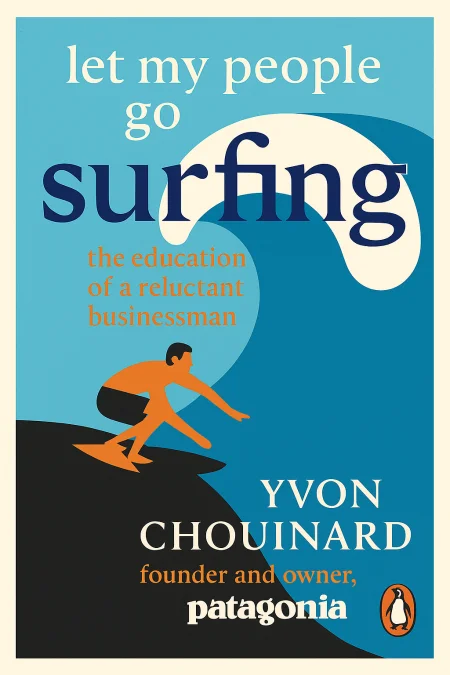
Let My People Go Surfing
The Education of a Reluctant Businessman
Book Edition Details
Summary
From the rugged peaks of his youth to the boardrooms of corporate America, Yvon Chouinard has never followed the beaten path. In "Let My People Go Surfing," the visionary founder of Patagonia, Inc. invites readers into a world where business meets bold exploration. Chouinard's narrative is not merely a chronicle of entrepreneurial triumph but a manifesto on infusing ethical responsibility into every venture. This compelling tale captures the spirit of adventure and the relentless pursuit of innovation, drawing from daring climbs and crafting gear that revolutionized the sport. A testament to how passion and purpose can redefine success, this book is a must-read for those who dream of leaving a mark on both industry and earth.
Introduction
In the pantheon of American business leaders, few figures embody such a profound contradiction as Yvon Chouinard. Here was a man who spent decades claiming he never wanted to be a businessman, yet built one of the most influential outdoor clothing companies in the world. A blacksmith turned entrepreneur who measured success not by quarterly profits but by the number of old-growth forests saved from clear-cutting. A corporate leader who encouraged employees to abandon their desks when perfect waves beckoned, yet maintained exacting standards for product quality that set industry benchmarks. Chouinard's story unfolds against the backdrop of America's environmental awakening, from the countercultural movements of the 1960s to the corporate responsibility revolution of the modern era. His journey from a teenage falconer sleeping in Yosemite's shadows to the founder of Patagonia reveals a man who refused to accept the traditional boundaries between profit and purpose, between business success and environmental stewardship. Through his unconventional path, readers will discover how authentic leadership emerges from staying true to core values, how a company can thrive by prioritizing quality over quantity, and how business can become a powerful force for positive change when guided by conscience rather than convention alone.
From Blacksmith to Business Owner: The Making of Patagonia
Yvon Chouinard's transformation from wandering climber to reluctant businessman began with a simple necessity: the need for better climbing equipment. In 1957, working from a coal-fired forge purchased at a junkyard, the eighteen-year-old taught himself blacksmithing to create pitons that could withstand the demanding granite walls of Yosemite. While European imports were designed for single use, Chouinard's chrome-molybdenum steel pitons could be placed and removed repeatedly, making them essential for the big-wall climbing revolution happening in America's national parks. What started as crafting gear for personal use evolved into a business almost by accident. Chouinard would load his anvil into his car and travel the California coast, forging pitons on beaches between surfing sessions and selling them from his trunk for $1.50 each. The young entrepreneur embodied the climbing community's ethos of living on the margins, supporting himself on fifty cents to a dollar a day, sleeping in his army surplus bag under boulders rather than in tents, and viewing his business merely as a means to fund his next climbing adventure. The company's evolution reflected Chouinard's deepening understanding of both craftsmanship and environmental responsibility. When he and partner Tom Frost realized their hard steel pitons were scarring Yosemite's rock faces, they made a revolutionary decision that would define their approach to business: they abandoned their most profitable product line and championed "clean climbing" using removable aluminum chocks instead. This willingness to sacrifice immediate profit for long-term values became a cornerstone of what would eventually become Patagonia. The transition from hardware to clothing began with Chouinard's eye for functional design. A rugby shirt spotted in Scotland, corduroy knickers from an English mill, and polyester pile fabric originally intended for toilet seat covers all became the building blocks of a clothing line that prioritized performance over fashion. By the time they needed a name for their soft goods division, Patagonia was chosen for its evocation of wild, distant places and the spirit of adventure that drove both the company's founder and its customers.
Building a Different Kind of Company: Values and Philosophy
As Patagonia grew from a blacksmith shop into a major apparel company, Chouinard faced the challenge of scaling his personal values across a complex organization. The crisis of 1991, when rapid expansion nearly destroyed the company, forced a fundamental reckoning with what kind of business they wanted to be. Rather than simply cutting costs and streamlining operations, Chouinard took his management team to Argentina's windswept mountains to examine their core purpose and articulate the principles that would guide every business decision. This introspection gave birth to Patagonia's comprehensive philosophy system, covering everything from product design to human resources. The design philosophy mandated that every product must be functional, multifunctional, durable, and as simple as possible. The company rejected the fashion industry's approach of designing from fabric samples upward, instead beginning with genuine functional needs and allowing form to follow purpose. This principle led to innovations like layering systems that revolutionized outdoor clothing, but also to the discipline of refusing to chase trends or proliferate unnecessary product variations. The workplace culture Chouinard fostered reflected his belief that work should be indistinguishable from play when you're passionate about what you're doing. The famous "Let My People Go Surfing" flextime policy allowed employees to chase perfect waves or powder snow, trusting that engaged, fulfilled workers would more than compensate for rigid schedule adherence through their creativity and commitment. The company's on-site childcare center, healthy cafeteria, and open office architecture all reinforced the vision of business as an extension of community rather than a separate sphere of existence. Perhaps most significantly, Patagonia embraced what Chouinard called "natural growth" rather than the exponential expansion that Wall Street demanded. By growing only as fast as their core customers' genuine needs required, they maintained the intimacy and authenticity that made their products special. This philosophy meant passing up opportunities that might have made them vastly wealthier but would have compromised the values that gave their work meaning. The decision to remain privately held ensured they could prioritize long-term sustainability over quarterly earnings, establishing a business model built to last a century rather than maximize short-term returns.
Environmental Responsibility and Corporate Activism
Chouinard's environmental awakening transformed Patagonia from a company that happened to care about nature into one whose primary mission became using business as a force for environmental solutions. This evolution began with personal observations during his global climbing and fishing expeditions, where he witnessed firsthand the accelerating destruction of wild places he had known in their pristine state. The realization that his own company contributed to environmental harm, despite its outdoor industry credentials, sparked a comprehensive examination of every aspect of their operations. The decision to switch entirely from conventional to organic cotton exemplified Patagonia's willingness to sacrifice profits for principles. Despite organic cotton costing three times more and requiring them to master an entirely new supply chain, the company made the transition by 1996 after learning that conventional cotton production consumed 25 percent of the world's insecticides and 10 percent of its pesticides. This decision, which could have bankrupted a more traditionally run company, instead strengthened Patagonia by forcing them to understand their products more deeply and communicate their values more clearly to customers. Patagonia's "earth tax" of donating one percent of sales to environmental organizations represented Chouinard's belief that companies must pay the true cost of their resource consumption rather than externalizing environmental damage onto society. Over two decades, this commitment channeled over twenty-two million dollars to grassroots activists working to protect endangered ecosystems, remove obsolete dams, and fight corporate environmental crimes. The company's support went beyond money to include tools, training, and legitimacy for environmental warriors often dismissed as fringe radicals. The creation of 1% for the Planet Alliance demonstrated Chouinard's understanding that individual companies, no matter how well-intentioned, couldn't solve global environmental problems alone. By creating a simple certification system that allowed consumers to identify businesses committed to environmental giving, he provided a mechanism for scaling values-based commerce across entire industries. This approach reflected his deeper philosophy that lasting change requires systemic transformation rather than isolated good intentions, and that business leaders must think beyond their own companies to consider their role in reshaping capitalism itself.
Summary
Yvon Chouinard's journey from reluctant businessman to environmental leader offers a powerful blueprint for integrating personal values with commercial success, proving that companies can thrive by prioritizing purpose alongside profit. His experience demonstrates that authentic leadership emerges not from following conventional wisdom but from the courage to remain true to core principles even when they conflict with short-term financial interests. The Patagonia story suggests that the most sustainable businesses are those built around genuine human needs rather than manufactured desires, and that long-term success requires viewing the company as a steward of resources and relationships rather than merely a profit-generating machine. For anyone seeking to create meaningful work or build organizations that contribute positively to the world, Chouinard's approach offers two essential insights: first, that excellence and environmental responsibility are not competing priorities but mutually reinforcing values that attract both the best employees and most loyal customers; and second, that business can serve as a powerful platform for activism and social change when leaders are willing to use their economic influence to support causes larger than themselves. His story ultimately reveals that the most fulfilling path lies not in choosing between personal passion and professional success, but in creating enterprises that make both possible through unwavering commitment to what matters most.
Related Books
Download PDF & EPUB
To save this Black List summary for later, download the free PDF and EPUB. You can print it out, or read offline at your convenience.
By Yvon Chouinard
