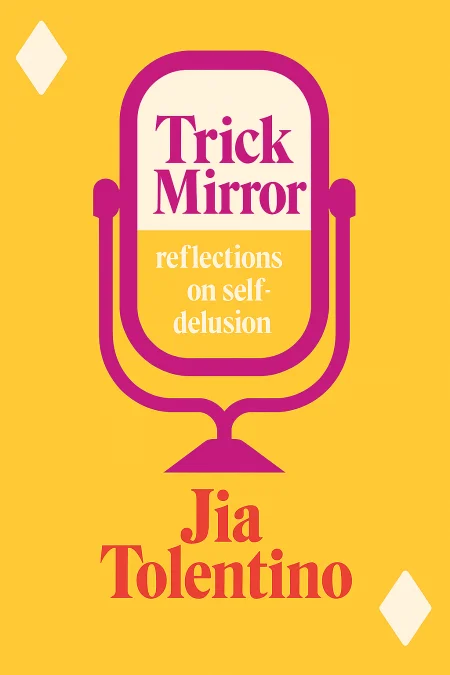
Trick Mirror
Reflections on Self-Delusion
Book Edition Details
Summary
In the kaleidoscopic realm of Trick Mirror, Jia Tolentino crafts an incisive tapestry of essays that pierce through the shimmering facade of modern self-perception. This debut collection is a sharp and dazzling exploration of the illusions we inhabit and the cultural mazes that shape our identities. Tolentino wields her pen like a scalpel, dissecting the rise of the social internet's pervasive grip, the idolization of con artists, and the relentless pursuit of unattainable beauty standards. With a voice that echoes the sharp wit of Joan Didion and the penetrating insight of Susan Sontag, Tolentino deftly intertwines personal reflection with societal critique. Here lies a work that challenges readers to question the narratives they've internalized and to seek clarity in a world awash with distortion.
Introduction
Contemporary American culture operates through a series of distorting mirrors that promise clarity while delivering confusion. These mirrors reflect not reality but carefully constructed illusions that shape how we understand ourselves, our relationships, and our place in society. The digital age has amplified these distortions, creating feedback loops where performance becomes indistinguishable from authenticity, where optimization masquerades as self-improvement, and where individual success is marketed as collective progress. The analysis reveals how cultural mechanisms operate not as isolated phenomena but as interconnected systems that reinforce each other, creating a comprehensive apparatus of self-deception that feels both inescapable and oddly comforting. Digital platforms exploit our deepest human needs for recognition and belonging, transforming them into mechanisms of control and commodification while maintaining the illusion of empowerment and choice. Through examination of internet culture, wellness obsessions, economic structures, and institutional traditions, a pattern emerges showing how modern life systematically undermines genuine self-knowledge while promoting its counterfeit alternatives. This investigation employs personal narrative alongside cultural criticism, revealing how individual experiences reflect broader social dynamics and exposing the ways digital culture creates false dichotomies between authenticity and performance, individual agency and structural constraint.
The Internet's Architecture of Performative Identity
The internet fundamentally restructures human identity by eliminating natural boundaries between public and private self-presentation. Unlike offline social interactions occurring in discrete contexts with specific audiences, online platforms collapse all potential audiences into a single, perpetual performance space. This architectural design creates unprecedented psychological pressure, as individuals must simultaneously appeal to family members, professional contacts, romantic interests, and strangers while maintaining a coherent public persona. Social media platforms exploit this vulnerability through reward systems that encourage constant self-surveillance and optimization. The metrics of likes, shares, and comments create quantified feedback loops that transform social validation into data-driven enterprises. Users learn to calibrate their self-presentation based on algorithmic responses, gradually internalizing platform values as their own. This process feels voluntary and empowering while systematically eroding capacity for genuine self-reflection. The attention economy underlying these platforms requires constant engagement, most effectively generated through emotional extremes. Platforms amplify outrage, envy, and anxiety while presenting these heightened emotional states as normal social interaction. Users become trapped in cycles of performative activism, competitive lifestyle display, and manufactured controversy, mistaking artificial intensity for meaningful engagement with the world. Rather than expanding understanding of others, algorithmic curation ensures users primarily encounter information confirming existing beliefs and preferences. This creates the illusion of being well-informed while actually narrowing perspective, making individuals more confident in opinions even as knowledge becomes increasingly limited and distorted. The internet's promise of connection and democratized information has instead produced unprecedented isolation and epistemic fragmentation.
Optimization Culture as Systemic Social Control
Modern wellness culture transforms ancient human desires for self-improvement into market-driven enterprises that commodify every aspect of personal development. The optimization mindset reframes human flourishing as technical problems requiring the right combination of products, services, and lifestyle adjustments. This approach systematically obscures social and political dimensions of well-being, redirecting attention from collective solutions toward individual consumption. The fitness industry exemplifies this commodification through practices like barre classes, which package discipline and physical transformation as luxury experiences. These activities promise not just improved health but access to idealized versions of femininity that appear effortless yet require constant maintenance. The contradiction is intentional: the more effort required to achieve the effortless ideal, the more valuable the services promising to deliver it. Athleisure represents the logical endpoint of optimization culture, creating clothing that signals commitment to self-improvement during non-exercise activities. This fashion category transforms bodies into billboards advertising their owners' dedication to optimization, making physical discipline visible and socially legible. The clothing becomes soft surveillance, reminding wearers of optimization commitments while signaling participation in the wellness economy. The optimization mindset extends beyond physical wellness to encompass productivity, relationships, and spiritual development. Apps track meditation minutes, sleep cycles, and emotional states, transforming intimate human experiences into data points for analysis and improvement. This quantified approach creates illusions of scientific precision while reducing complex human experiences to crude metrics manipulated for profit, resulting in self-alienation disguised as self-knowledge.
Feminist Narratives and the Co-optation of Progressive Discourse
Popular culture's treatment of female celebrities reveals complex dynamics of contemporary feminism, particularly how feminist discourse can be co-opted to serve existing power structures while appearing to challenge them. The rehabilitation of previously maligned women through feminist analysis represents genuine progress in understanding how misogyny shapes public narratives, yet this analytical framework can be weaponized to defend problematic figures simply because they face gendered criticism. The difficult woman archetype has become a dominant framework for understanding female public figures, celebrating women who refuse to conform to traditional expectations of feminine behavior. While representing important shifts away from demanding female perfection, it creates new forms of essentialism that reduce complex individuals to their relationships with patriarchal expectations. This framework can obscure actual political and ethical differences between women by focusing primarily on shared experiences of gendered criticism. Celebrity feminism demonstrates how progressive language can be stripped of political content and repackaged as individual empowerment. The transformation of feminist concepts into marketing slogans and lifestyle brands represents profound depoliticization of ideas that originally challenged fundamental power structures. This process allows corporations and institutions to appear progressive while maintaining economic and social systems that feminism originally sought to transform. Focus on individual female success stories, while important for representation, can inadvertently reinforce meritocracy myths by suggesting systemic barriers can be overcome through individual excellence. This narrative places enormous pressure on women to succeed within existing systems rather than working to change those systems, ultimately legitimizing inequality by highlighting exceptional cases rather than addressing structural problems.
Traditional Institutions Adapting to Preserve Power Structures
Traditional institutions like marriage and higher education maintain cultural authority by adapting surface presentations while preserving underlying power dynamics. The wedding industry exemplifies this process, transforming historically simple legal and social ceremonies into elaborate consumer spectacles that reinforce gender inequality through languages of choice and tradition. Modern weddings present themselves as celebrations of individual love and personal expression, but their actual structures reproduce historical patterns of female subordination. Brides remain central figures in performances that ultimately celebrate their transitions from independence to roles defined primarily through relationships to others. The enormous financial and emotional investments required for contemporary weddings intensify commitment to institutions that statistically benefit men more than women. Higher education operates through similar mechanisms, promising social mobility and intellectual development while actually functioning as systems of class reproduction and debt creation. The student debt crisis represents social control that forces young people into economic relationships constraining life choices for decades. The promise of education as liberation becomes a mechanism for ensuring compliance with existing economic structures. These institutions maintain legitimacy by constantly updating rhetoric to match contemporary values while preserving essential functions. Marriage incorporates feminist language about partnership and equality while maintaining legal and social structures that disadvantage women. Universities promote diversity and critical thinking while operating as businesses prioritizing profit over educational mission. This adaptability allows traditional power structures to survive social change by appearing to embrace it.
Summary
The digital transformation of contemporary life has created unprecedented opportunities for both liberation and control, with the balance tilting decisively toward the latter as technology companies and existing power structures learn to exploit human psychology for profit and compliance. The promise of digital democracy and individual empowerment has given way to new forms of surveillance and manipulation that operate through languages of choice and self-expression while actually constraining both. Understanding these dynamics requires moving beyond individual solutions toward collective recognition of how systemic forces shape personal experience, creating space for authentic resistance to emerge from genuine community rather than algorithmic connection. The path toward authentic selfhood necessarily involves understanding how these systems operate and finding ways to resist their logic without completely withdrawing from social participation.
Related Books
Download PDF & EPUB
To save this Black List summary for later, download the free PDF and EPUB. You can print it out, or read offline at your convenience.
By Jia Tolentino
