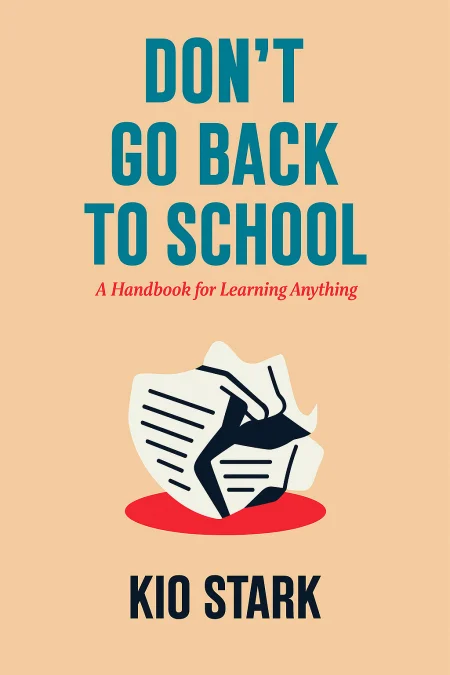
Don’t Go Back to School
A Handbook for Learning Anything
Book Edition Details
Summary
In a world where diplomas no longer dictate destiny, "Don’t Go Back to School" emerges as a beacon for the bold and the curious. Kio Stark weaves together a tapestry of tales from over a hundred trailblazing individuals who dared to learn outside the confines of traditional classrooms. This book is more than a guide; it's a manifesto for self-directed education, filled with proven strategies and practical resources that empower you to chart your own course. For those at the crossroads of conventional education and independent exploration, Stark presents a compelling argument: success is not measured by degrees but by the depth of your knowledge and the courage to forge your own path. Engage with this transformative narrative that not only questions the status quo but also equips you to thrive beyond it.
Introduction
The traditional path of formal education is crumbling before our eyes, yet millions continue to follow it blindly, accumulating crushing debt while watching their dreams slip away. Student loans now exceed mortgage payments, graduation rates plummet, and countless graduates find themselves overqualified for jobs that don't exist and underqualified for the careers they actually want. Meanwhile, a quiet revolution is taking place in coffee shops, home studios, online communities, and collaborative workspaces around the world. Passionate individuals are discovering they can learn anything they need without stepping foot in a classroom, without accumulating debt, and without waiting for someone else's permission to begin their education. This revolution isn't about rejecting knowledge or taking shortcuts. It's about reclaiming the fundamental human capacity to learn, grow, and master new skills on your own terms. It's about recognizing that the most successful people throughout history have always been self-directed learners who refused to let institutions define the limits of their potential. The tools, communities, and opportunities for independent learning have never been more accessible, and the results speak for themselves. From technology innovators to acclaimed artists, from successful entrepreneurs to respected journalists, independent learners are reshaping every industry and proving that curiosity, determination, and strategic self-education can accomplish what years of formal schooling often cannot.
Building Your Learning Community
The greatest myth about independent learning is that it happens in isolation. Nothing could be further from the truth. The most successful self-taught individuals understand that learning is fundamentally a social act, requiring connection, collaboration, and community to reach its full potential. Quinn Norton, a respected technology journalist, discovered this truth when she realized she needed to "take the auto out of autodidact." Her breakthrough came not from studying alone, but from joining mailing lists where experts freely shared their knowledge with curious newcomers. Norton's experience illustrates the open secret of independent learning. When she became interested in marine science, she didn't enroll in university courses or hire expensive tutors. Instead, she joined the marine mammal research mailing list and discovered something remarkable: experts love talking about their work. "Experts are experts because they like their topics," she explains. "They like talking about them. If you want to talk about them, great." Within months, she had built relationships with leading researchers who became informal mentors, freely sharing insights that would have taken years to acquire through traditional academic channels. The transformation in Norton's learning accelerated when she began reciprocating. Rather than approaching experts as a passive student seeking wisdom, she came prepared to contribute something valuable in return. "I approach every interview or interaction like this: I'm going to bring you a present, then I'm going to ask you for a present as well." This philosophy of generous exchange became her gateway into any field she wished to explore, from technology to journalism to neuroscience. Building your own learning community starts with identifying where passionate people gather around your interests. Online forums, local meetups, professional associations, and collaborative workspaces all offer entry points. Begin by lurking and learning the culture, then contribute something genuinely helpful before asking for assistance. Offer to document processes, share resources, or teach others what you already know. Remember that the most powerful learning communities operate on principles of mutual aid and reciprocity, where everyone both teaches and learns.
Finding Your Own Learning Method
Most people never discover how they learn best because formal education forces everyone through identical processes regardless of individual differences. Independent learners have the freedom to experiment, fail, and discover their optimal learning strategies, leading to deeper understanding and greater retention. The key lies in recognizing whether you thrive with structured, linear approaches or prefer the organic exploration of associative learning paths. Christopher Bathgate's journey from frustrated art student to acclaimed sculptor demonstrates how finding your natural learning style can unlock extraordinary potential. Disillusioned with art school's emphasis on theory over practical skills, Bathgate dropped out and established a backyard studio where he could learn metalworking through direct experimentation. Instead of following predetermined curricula, he designed sculptures around specific techniques he wanted to master, learning welding by creating pieces that required welding, mastering sphere-turning by designing spherical sculptures. Bathgate's methodical, project-based approach proved far more effective than classroom instruction. "Rather than doing practice exercises, I preferred learning while making my sculptures," he reflects. "I designed the pieces around what I was trying to learn." When he encountered obstacles, like a computer controller that wouldn't function properly, he spent days analyzing the problem from every angle until breakthrough moments arrived. "Getting stuck for me has been one of my best teachers. It has taught me the huge difference between just knowing the answer, and knowing how to find the answer." This discovery process revealed Bathgate's learning preferences: hands-on experimentation, problem-solving under real constraints, and progressive skill-building through meaningful projects. His sculptures now appear in galleries nationwide, and he makes his living as a full-time artist, proving that understanding your learning style can transform both the process and outcomes of education. To identify your optimal learning methods, reflect on your most successful learning experiences. Do you retain information better through reading, listening, or doing? Do you prefer structured sequences or exploratory tangents? Do you learn best alone or in groups? Design small experiments to test different approaches, then adapt your strategies based on what produces the deepest understanding and strongest motivation.
Getting Real-World Experience and Jobs
The greatest fear surrounding independent learning concerns employment prospects, yet the stories of successful self-taught professionals reveal that skills, portfolio work, and demonstrable competence often matter more than credentials. The key lies in understanding how to present your abilities, gain experience, and navigate hiring processes without traditional qualifications. David Mason's career trajectory illustrates the power of confident self-advocacy combined with genuine learning ability. When Red Hat's founder asked if he knew XML during a casual interview, Mason knew only the related SGML language. "I told him, 'Yes, sure I do,' because I knew that I could find out whatever I needed to know. I knew I could learn it." This strategic optimism, backed by proven learning skills, launched Mason's technology career and taught him valuable lessons about hiring practices. Years later, as a manager himself, Mason discovered that formal credentials often poorly predict job performance. "Some of the people who have worked with me and for me who don't have degrees are actually better than the ones who do have degrees," he observes. His hiring criteria shifted toward identifying candidates confident in their ability to acquire new knowledge quickly. "I don't care if they actually know things or not when I hire them. The best programmers don't know everything, but they know how to quickly pick up whatever it is they need to do." Mason's experience reveals the hiring secret that independent learners can exploit: many employers care more about learning ability than existing knowledge. The challenge lies in demonstrating this capacity without traditional credentials. Build a portfolio showcasing projects that required you to master new skills quickly. Document your learning process, highlighting how you overcame obstacles and acquired knowledge independently. Seek opportunities to work on real projects with consequences, whether through internships, freelance work, or collaborating with established professionals. Start with smaller organizations where individual contributions are more visible and hiring processes less bureaucratic. Network within your learning community, as personal recommendations often bypass credential requirements. Most importantly, approach job searches with Mason's mindset: view each position as an opportunity to continue learning while contributing value, rather than simply exchanging existing knowledge for payment.
Summary
The path of independent learning represents far more than an alternative to formal education. It embodies a fundamental shift toward taking personal responsibility for your intellectual and professional development, recognizing that the most profound learning occurs when you direct your own curiosity toward meaningful goals. As Quinn Norton discovered, "You don't need school for that," and the evidence overwhelmingly supports this conclusion. The individuals featured throughout this exploration share common characteristics that transcend their diverse fields and backgrounds. They approached learning as an active, social process, building communities of mentors, peers, and fellow learners who supported their growth. They experimented until they discovered their optimal learning methods, then structured their education around projects and goals that provided immediate feedback and real-world application. Most importantly, they refused to let the absence of formal credentials prevent them from pursuing their interests or advancing their careers. Your journey as an independent learner begins with a single action: identify one skill or area of knowledge you've always wanted to develop, then reach out to someone in your network who shares that interest or knows someone who does. Propose meeting for coffee to discuss their experience and ask for reading recommendations or community suggestions. This small step initiates the process of community-building and demonstrates your commitment to learning beyond traditional boundaries. Remember that every expert was once a beginner, and most are surprisingly generous with their knowledge when approached by genuinely curious learners. The education you design for yourself will be more personally relevant, immediately applicable, and ultimately more satisfying than any curriculum created by someone else.
Related Books
Download PDF & EPUB
To save this Black List summary for later, download the free PDF and EPUB. You can print it out, or read offline at your convenience.
By Kio Stark
