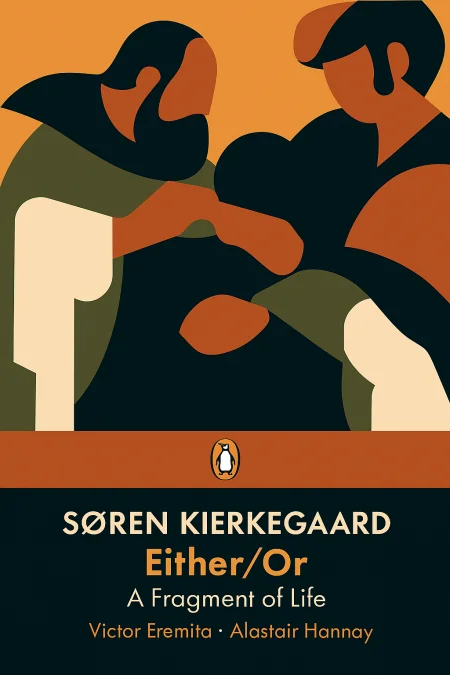
Either/Or
A Fragment of Life
bySøren Kierkegaard, Victor Eremita, Alastair Hannay
Book Edition Details
Summary
In a dance between desire and duty, Søren Kierkegaard's "Either/Or" invites readers into a profound exploration of life’s dualities. Through the eyes of two contrasting voices—the hedonistic youth simply known as 'A' and the morally resolute Judge Vilhelm—this philosophical narrative examines the delicate balance between aesthetic indulgence and ethical responsibility. As they grapple with themes of existential angst, love, and the pursuit of meaning, Kierkegaard's ingenious use of pseudonymous authorship breathes life into a discourse that remains fiercely relevant. Here lies a tapestry of irony, wit, and wisdom, where laughter might mask tears, and the quest for truth becomes a journey of self-discovery.
Introduction
Human existence confronts us with fundamental choices that determine not merely what we do, but who we become. The tension between living for immediate pleasure and embracing moral responsibility represents one of philosophy's most enduring and personally urgent dilemmas. This exploration examines two radically different approaches to life: the aesthetic existence that pursues beauty, novelty, and sensual experience, and the ethical existence grounded in commitment, duty, and moral choice. Rather than offering simple prescriptions, this investigation reveals how each mode of being contains its own internal logic, satisfactions, and ultimate limitations. The aesthetic life, while rich in possibility and freedom, eventually leads to despair through its very refusal to choose definitively. The ethical life, though offering stability and meaning through commitment, demands a leap that cannot be rationally justified. Through detailed psychological portraits and philosophical analysis, we encounter the paradox that neither pure aestheticism nor pure moralism can fully satisfy human nature. The investigation proceeds through concrete examples rather than abstract theorizing, showing how these life-views manifest in actual experience, relationships, and the inevitable crises that force us to confront the inadequacy of any single approach to existence.
The Aesthetic Life-View: Immediacy, Pleasure, and the Inevitability of Despair
The aesthetic approach to existence finds its purest expression in the pursuit of immediate experience and sensual pleasure. This life-view operates on the principle of spontaneity, seeking always the novel, the beautiful, and the emotionally stirring. Rather than committing to any particular path or relationship, the aesthetic individual maintains a stance of ironic detachment, sampling life's offerings without allowing any single experience to claim ultimate authority over the self. Music serves as the ideal medium for understanding aesthetic existence because it captures pure immediacy without the mediation of concepts or moral categories. The aesthetic person lives like music itself—in the moment, flowing from one experience to another without the burden of memory or the anxiety of future commitment. This mode of being celebrates possibility over actuality, preferring the richness of potential experiences to the limitations imposed by definitive choices. The aesthetic life-view manifests most clearly in the realm of erotic love, where desire operates as a natural force seeking satisfaction without the complications of ethical obligation. The seducer represents the aesthetic principle in its most developed form—not through calculated manipulation, but through the spontaneous expression of sensual energy that draws others into its orbit. Yet this very commitment to non-commitment contains the seeds of its own dissolution. The aesthetic individual, in refusing to choose definitively, eventually discovers that this refusal is itself a choice—one that leads inevitably toward emptiness and despair. The constant pursuit of novelty becomes repetitive, the cultivation of possibility becomes an avoidance of actuality, and the freedom from commitment becomes a prison of indecision. The principle of "crop rotation" illustrates how aesthetic consciousness attempts to manage boredom through systematic variation of experience, yet these very strategies perpetuate the underlying condition they claim to address. The analysis demonstrates how this approach to existence, while appearing to offer freedom and sophistication, actually represents a form of spiritual imprisonment. The aesthetic individual becomes trapped in an endless cycle of seeking novelty and avoiding repetition, yet finds that each new experience quickly loses its capacity to provide satisfaction. This dynamic reveals the inherent contradiction within aesthetic existence: the very strategies employed to overcome boredom serve to reinforce the conditions that generate it, ultimately exposing the aesthetic approach as a sophisticated form of despair that refuses to acknowledge itself as such.
The Ethical Life-View: Choice, Commitment, and Universal Moral Responsibility
The ethical existence emerges as a response to the ultimate inadequacy of aesthetic living. Where the aesthetic individual seeks to avoid definitive choice, the ethical person embraces choice as the fundamental expression of human freedom and responsibility. This transition requires what can only be described as a leap—a decisive act of will that cannot be rationally justified but nevertheless establishes the foundation for meaningful existence. Marriage serves as the paradigmatic expression of ethical commitment because it represents the choice to bind oneself to another person through time, accepting both the limitations and the deeper satisfactions that come with sustained relationship. Unlike the aesthetic pursuit of romantic novelty, marriage embodies the ethical principle that meaning emerges through fidelity, through the willingness to work within constraints rather than constantly seeking escape from them. The ethical life-view transforms the individual's relationship to time itself. Where the aesthetic person lives in an eternal present, the ethical person accepts historical continuity, taking responsibility not only for present choices but for past actions and future consequences. This temporal commitment creates the possibility of genuine development, of becoming someone rather than merely experiencing various states of being. Professional duty, social obligation, and moral responsibility provide the concrete content of ethical existence. The ethical individual finds meaning not in the pursuit of pleasure or the cultivation of interesting experiences, but in the fulfillment of obligations that connect the self to larger purposes. This mode of being offers stability, social recognition, and the satisfaction of contributing to something beyond immediate self-interest. The ethical perspective emphasizes the universal dimension of human experience, focusing on what all human beings share in common rather than celebrating individual uniqueness or exceptional circumstances. However, the ethical stage also reveals its own limitations when examined closely. While it provides stability and meaning, ethical existence can become rigid and abstract when it loses touch with the concrete realities of individual life. The emphasis on universal principles sometimes conflicts with the particular circumstances and unique qualities that make each person distinct. Moreover, the ethical individual may discover situations where different duties conflict, or where following moral principles leads to outcomes that seem to contradict the very values those principles were meant to serve.
The Dialectical Tension: Why Neither Approach Achieves Ultimate Resolution
Neither the aesthetic nor the ethical life-view can claim final victory in the struggle for human allegiance. Each contains partial truths that the other lacks, and each generates problems that only the other can address. The aesthetic celebration of immediacy and possibility serves as a necessary corrective to ethical rigidity, while ethical commitment provides the stability and meaning that pure aestheticism cannot sustain. The dialectical relationship between these approaches reveals itself most clearly in moments of crisis, when the limitations of each become apparent. The aesthetic individual eventually confronts the emptiness of a life lived without definitive commitment, while the ethical person may discover that duty alone cannot satisfy the human need for transcendence and meaning. These crises force a recognition that neither approach, taken in isolation, can encompass the full complexity of human existence. The tension manifests particularly in the realm of choice itself. The aesthetic person's refusal to choose definitively is revealed as a choice for indefiniteness, while the ethical person's embrace of commitment requires a leap beyond rational justification. This paradox suggests that human existence operates according to a logic that transcends both immediate experience and moral reasoning, pointing toward dimensions of existence that neither aesthetic nor ethical categories can fully capture. The relationship between these life-views is not one of simple opposition but of mutual dependence. The aesthetic provides the raw material of experience that gives content to ethical choice, while the ethical provides the framework of commitment that prevents aesthetic experience from dissolving into meaninglessness. The fundamental paradox emerges in the recognition that the choice between aesthetic and ethical existence cannot itself be made on either aesthetic or ethical grounds. The aesthetic person cannot choose the ethical life for aesthetic reasons without contradicting the nature of ethical commitment, while the ethical person cannot justify the ethical choice through ethical reasoning without circular argument. This paradox points toward the necessity of a leap that transcends both approaches, suggesting the need for a third possibility that can encompass and transcend their partial truths.
Beyond Either/Or: The Religious Leap and Authentic Human Existence
The ultimate resolution of the tension between aesthetic and ethical existence requires moving beyond both toward what can only be called the religious dimension of human experience. This stage does not emerge through logical progression from the ethical, but through a leap of faith that acknowledges the fundamental limitations of all purely human approaches to existence. The religious individual maintains ethical commitments while recognizing that these commitments themselves depend on a relationship with something beyond human understanding or control. The religious perspective transforms both aesthetic and ethical elements rather than simply rejecting them. The capacity for immediate experience and appreciation of beauty, which characterizes aesthetic existence, finds its proper place within a larger framework of meaning. Similarly, ethical commitment and moral responsibility remain essential, but they are now grounded in something more solid than human reason or social convention. The religious individual can embrace both immediate experience and universal obligation because both are understood as aspects of a relationship with the absolute. The religious stage represents not an escape from the human condition but its deepest fulfillment. By acknowledging the limitations of purely human approaches to existence, the religious individual paradoxically discovers the possibility of authentic human life. This requires what can only be called faith—not mere intellectual belief, but a passionate commitment that engages the whole person. Such faith cannot be achieved through argument or demonstration, but only through the kind of decisive choice that transforms one's entire existence. The resolution, if it can be called that, lies not in choosing one approach over the other, but in recognizing the necessity of living the tension between them. Human existence requires both the aesthetic appreciation of life's immediate richness and the ethical commitment to sustained responsibility. The mature individual learns to inhabit this tension without seeking premature resolution, accepting the anxiety and uncertainty that come with refusing to absolutize either approach. This recognition points toward a religious dimension of existence that neither aesthetic nor ethical categories can adequately describe, representing a transformation of perspective that allows both aesthetic and ethical concerns to find their proper place within a larger understanding of human purpose and meaning.
Summary
The exploration of aesthetic and ethical existence reveals that human life cannot be reduced to either the pursuit of immediate pleasure or the fulfillment of moral duty, but requires a dynamic engagement with both dimensions that ultimately points beyond them toward religious transformation. The aesthetic life-view, with its celebration of possibility and immediate experience, provides necessary correctives to ethical rigidity but ultimately leads to despair through its refusal of definitive commitment. The ethical life-view offers stability and meaning through the embrace of responsibility and sustained relationship, but cannot justify its own foundation or satisfy the human longing for transcendence. The dialectical tension between these approaches generates the fundamental anxiety of human existence while also creating the conditions for authentic spiritual development. This investigation serves readers who seek to understand the deeper structures of human choice and commitment, offering not easy answers but a more sophisticated appreciation of the complexity and ultimate mystery of human existence, challenging us to move beyond comfortable compromises toward the kind of passionate engagement with existence that alone can satisfy the deepest human needs.
Related Books
Download PDF & EPUB
To save this Black List summary for later, download the free PDF and EPUB. You can print it out, or read offline at your convenience.
By Søren Kierkegaard
