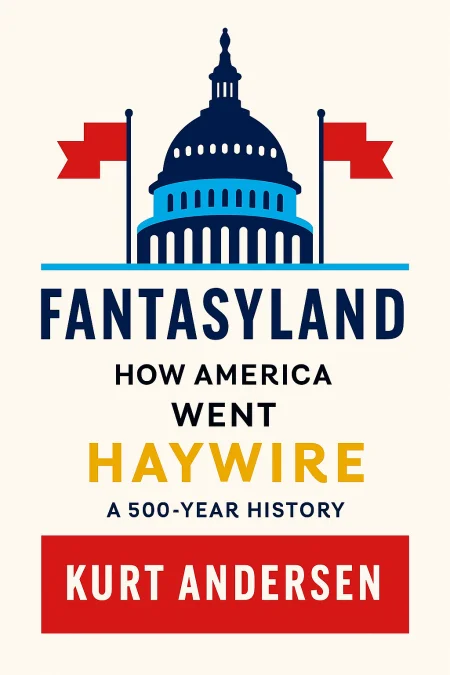
Fantasyland
How America Went Haywire
Book Edition Details
Summary
Have you ever wondered if America’s fascination with fantasy is more than just a passing phase? In "Fantasyland," Kurt Andersen pulls back the curtain on 500 years of American history, revealing a nation fueled by dreams and delusions. From the witch trials of Salem to the glittering allure of Hollywood, Andersen deftly navigates a landscape where illusion often trumps reality. This is a story of a country founded on the belief that anything is possible, a place where the fantastical becomes the fabric of national identity. Andersen's narrative is as exhilarating as it is unsettling, challenging readers to reconsider what makes America truly exceptional.
Introduction
Picture this: it's 1692 in Salem, Massachusetts, and respected citizens are pointing fingers at their neighbors, convinced they've witnessed supernatural witchcraft. Fast-forward to 1969, and millions of Americans believe the moon landing was staged in a Hollywood studio. Jump to today, and we find ourselves in a nation where conspiracy theories spread faster than wildfire, where alternative facts compete with actual facts, and where believing something passionately seems to make it true. How did we get here? The answer lies not in recent political upheavals or social media algorithms, but in the very DNA of America itself. From the moment European settlers first set foot on this continent, driven by dreams of gold and religious utopias, Americans have possessed an extraordinary capacity for wishful thinking. We've always been a nation of dreamers, believers, and reinventors of reality. This historical journey reveals three crucial insights that explain our present moment. First, America's founding wasn't just about political freedom, but about the freedom to believe anything you wanted, no matter how fantastical. Second, our greatest strengths as a nation—our optimism and individualism—contain the seeds of our greatest vulnerabilities to delusion. Third, what we're experiencing today isn't an aberration, it's the culmination of four centuries of American exceptionalism in the realm of magical thinking. This exploration is essential for anyone seeking to understand not just how we arrived at our current moment of fractured reality, but why America has always been uniquely susceptible to the allure of beautiful lies over uncomfortable truths.
Colonial Foundations: Religious Extremism and Early Fantasy Culture (1600s-1800s)
America began as a fever dream, a collection of impossible fantasies that somehow became real. In the early 1600s, two very different groups of English settlers crossed the Atlantic, each chasing their own version of the impossible. In Virginia, fortune-seekers arrived convinced they would stumble upon gold lying on the ground, just as the Spanish had found in Mexico and Peru. They spent decades digging for treasure that didn't exist, dying in droves while clinging to their golden delusions. Meanwhile, in Massachusetts, religious extremists established what they believed would be God's kingdom on Earth. These Puritans weren't just seeking religious freedom—they were convinced they were the chosen people destined to build the New Jerusalem. They saw Satan's hand in every setback, from Indian attacks to failed crops, and they expected Jesus Christ to return any day to establish His earthly reign. When Anne Hutchinson claimed direct divine revelation, challenging even their rigid orthodoxy, she embodied a distinctly American principle: every individual has the right to determine truth for themselves, regardless of what experts or authorities say. Both groups shared a crucial characteristic that would define American culture for centuries to come. They were willing to abandon everything they knew, risk death and disaster, all for the sake of beliefs that seemed preposterous to reasonable people back in England. The gold-seekers' fantasy was eventually abandoned when tobacco proved more profitable than fool's gold. But the religious fantasists' legacy proved more enduring. These founding settlements established America's template: a place where the impossible seemed possible, where individual conviction trumped collective wisdom, and where the line between faith and delusion was deliberately blurred. The New World became a laboratory for testing the limits of human credulity, and the results would echo through the centuries.
The Great Transformation: From Reason to Magic Thinking (1960s-1990s)
The 1960s shattered America's epistemological foundations in ways that reverberate today. What began as legitimate challenges to authority—questioning the Vietnam War, demanding civil rights, exposing government lies—evolved into a wholesale rejection of the concept of objective truth itself. The counterculture's motto "question everything" morphed into "believe anything," as millions of Americans decided that reality was whatever they wanted it to be. The decade's most influential figures weren't just political radicals but reality rebels. Timothy Leary urged people to "turn on, tune in, drop out," while the Esalen Institute promoted the idea that mystical feelings should override scientific understanding. Academic intellectuals joined the assault on reason, arguing that science was just another form of oppression and that all beliefs deserved equal respect. The boundaries between sanity and madness, truth and fiction, began dissolving. This wasn't just a left-wing phenomenon. Conservative Christians experienced their own reality revolution, embracing speaking in tongues, faith healing, and end-times prophecies with unprecedented fervor. The Jesus Movement attracted hippies seeking spiritual highs, while televangelists learned to package supernatural beliefs for mass consumption. Both secular and religious Americans were united in their rejection of mainstream rationality. The period's lasting legacy wasn't any particular belief system but rather the principle that everyone was entitled to their own truth. "Do your own thing" became the national creed, whether that meant dropping acid, speaking in tongues, or believing in UFOs. By the mid-1970s, America had become a nation where anything was possible because nothing was definitively real. The cultural DNA was permanently altered, creating conditions for the fantasy explosion that would follow.
Full Fantasyland: Digital Age and Political Unreality (2000s-Present)
The Internet didn't create American fantasyland—it supercharged it. Suddenly, every conspiracy theory, every fringe belief, every magical cure could find its audience and build its community. The democratization of information became the democratization of misinformation, where a blogger in his basement could command the same attention as a tenured professor or experienced journalist. This digital revolution coincided with the rise of reality television, creating a culture where performance and authenticity became indistinguishable. Politicians learned to govern like reality show hosts, while actual reality show hosts discovered they could become politicians. The fantasy-industrial complex reached its apotheosis when a casino owner and television personality, armed with Twitter and a genius for spectacle, captured the presidency by promising to make America great again through sheer force of will. The political implications were staggering. Climate science became a matter of opinion. Vaccination became controversial. Basic facts about crowd sizes, election results, and pandemic responses became partisan battlegrounds. The same country that had put humans on the moon was now debating whether the moon landing had been faked. Expertise wasn't just questioned—it was actively despised as elitist manipulation. Social media algorithms, designed to maximize engagement, discovered that outrage and fantasy were far more compelling than nuance and fact. The result was a feedback loop that rewarded the most extreme voices and punished moderation. In this environment, traditional gatekeepers—editors, fact-checkers, academic peer reviewers—found themselves overwhelmed by the sheer volume of fantasy masquerading as news, analysis, and scholarship.
Consequences and Future: When Fantasy Breaks Reality's Boundaries
The transformation from a nation that balanced fantasy with reality to one where fantasy often dominates has profound consequences that extend far beyond politics. When significant portions of the population reject scientific consensus on vaccines, climate change, and basic public health measures, the results aren't just philosophical—they're literally matters of life and death. The COVID-19 pandemic offered a stark demonstration of how fantasy-based thinking could turn a public health crisis into a political battleground, with devastating consequences for communities across the nation. The economic implications are equally serious. When financial markets become detached from underlying reality—as they did in the lead-up to 2008—the fantasy of endless growth and risk-free returns eventually collides with mathematical certainty. Similarly, when political movements promise impossible solutions to complex problems, the inevitable disappointment fuels even more extreme fantasies and deeper cynicism about democratic institutions. Yet this historical analysis also reveals reasons for hope. America has faced reality crises before and found ways to restore balance. The same cultural DNA that produces dangerous fantasies also generates remarkable innovation, creativity, and resilience. The challenge isn't to eliminate fantasy entirely—that would be both impossible and undesirable—but to restore the boundaries that once kept magical thinking from overwhelming practical governance and social cooperation. The path forward requires recognizing that this isn't simply a political problem requiring political solutions, but a cultural challenge that demands cultural responses. It means rebuilding institutions that can distinguish between legitimate skepticism and destructive cynicism, between healthy imagination and dangerous delusion. Most importantly, it means remembering that reality, however inconvenient, remains the foundation upon which any sustainable society must be built.
Summary
The American journey from colonial settlement to digital-age fantasyland reveals a consistent tension between two fundamental aspects of the national character: the capacity for both extraordinary innovation and dangerous self-deception. This isn't a story of recent decline, but of long-standing cultural tendencies that have finally reached a tipping point where fantasy threatens to overwhelm reality entirely. The historical pattern is clear: the same forces that produced religious freedom, entrepreneurial dynamism, and technological breakthroughs also created fertile ground for conspiracy theories, magical thinking, and the rejection of expertise. America's strength—its willingness to challenge authority and embrace the impossible—became its weakness when those tendencies lost their grounding in shared standards of evidence and truth. The stakes of this transformation extend far beyond academic debate. When fantasy-based thinking drives public policy on issues like climate change, public health, and economic regulation, the consequences affect everyone. The challenge isn't to eliminate American optimism and imagination, but to restore the reality-testing mechanisms that once kept these powerful forces in productive balance. This requires rebuilding trust in institutions that can distinguish between legitimate innovation and dangerous delusion, while fostering a culture that values both creativity and critical thinking. The future depends on whether Americans can rediscover the wisdom to dream big while keeping their feet firmly planted on the ground.
Related Books
Download PDF & EPUB
To save this Black List summary for later, download the free PDF and EPUB. You can print it out, or read offline at your convenience.
By Kurt Andersen
