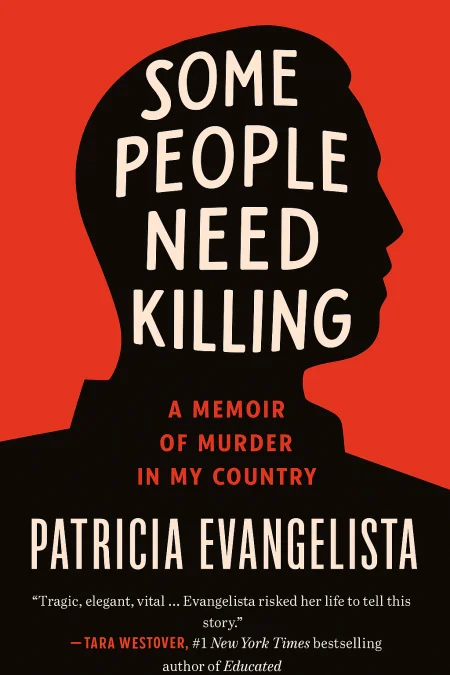
Some People Need Killing
A Memoir of Murder in My Country
Book Edition Details
Summary
In the shadows of Manila's bustling streets, journalist Patricia Evangelista confronts the chilling aftermath of a government's brutal crusade. Some People Need Killing plunges readers into the heart of the Philippines' drug war, where the line between justice and terror blurs beyond recognition. Evangelista, armed with a pen and unyielding courage, delves deep into the harrowing tales of lives shattered by a regime that deems some lives expendable. This gripping narrative captures the haunting reality of a nation gripped by fear, where the echo of a gunshot is both a sentence and a silence. With unflinching prose, Evangelista exposes the raw truth of a society struggling under the weight of autocracy, offering a poignant reflection on humanity's darkest impulses and its indomitable will to resist.
Introduction
In the sweltering heat of Manila's poorest neighborhoods, a new kind of war began in 2016. It wasn't fought between armies or nations, but waged by a government against its own people in the narrow alleys and cramped homes of the urban poor. President Rodrigo Duterte's war on drugs would claim tens of thousands of lives and transform the Philippines from a vibrant democracy into a killing field where suspected addicts and dealers were hunted down like animals. This extraordinary transformation reveals how democracies die not through dramatic military coups, but through the gradual normalization of state violence and the systematic erosion of human rights. Through meticulous documentation of individual tragedies and institutional failures, we witness how a charismatic leader convinced an entire nation that some people simply needed killing, and how ordinary citizens became complicit in extraordinary evil. The story exposes the fragility of democratic institutions when confronted by popular authoritarianism and the seductive promise of order through violence. This account serves as both historical record and urgent warning for citizens, journalists, and leaders worldwide who must understand how quickly civilized societies can descend into barbarism when fear overwhelms compassion and security is prioritized over liberty.
From Davao Laboratory to Presidential Power (1988-2016)
Long before Rodrigo Duterte became president, he perfected his methods of governance through violence as mayor of Davao City. From 1988 to 2016, this southern Philippine city served as his personal laboratory for extrajudicial killing, where the Davao Death Squad operated with complete impunity under his direct command. What began as a response to Communist insurgency evolved into systematic elimination of anyone the mayor deemed undesirable, from street children to petty criminals to suspected drug users. The death squad's operations followed a chillingly efficient pattern. Targets were identified through police intelligence, abducted by plainclothes officers, and executed without trial. Bodies were dumped in quarries or fed to crocodiles while official reports claimed victims had resisted arrest or been killed by vigilantes. Witnesses described a mayor who personally issued kill orders, provided weapons, and celebrated each death as a victory for law and order. Duterte openly boasted about the killings, telling audiences that criminals were legitimate targets of assassination and that Davao was a place where you could die any time. This local reign of terror became Duterte's political calling card, transforming him from provincial strongman into national hero. Millions of Filipinos, exhausted by crime and corruption, saw in his brutality a refreshing honesty about the nature of power. They believed his violence would never touch them, only the criminals and addicts they feared and despised. The Davao model revealed a crucial truth about democratic backsliding: voters will often choose security over liberty when presented with a leader who promises to eliminate their fears through violence. When Duterte finally announced his presidential candidacy in 2015, he carried this bloody legacy as a badge of honor, promising to replicate his success nationwide within six months. The electorate, seduced by the promise of order through brutality, gave him the mandate to transform his local experiment into national policy.
Operation Double Barrel: State Terror Unleashed (2016-2017)
Within hours of Duterte's inauguration, the killing machine roared to life across the archipelago. Operation Double Barrel launched with the euphemistically named Tokhang campaign, supposedly offering drug users a chance to surrender and seek rehabilitation. In practice, it became a death warrant system where police compiled lists of suspected users and dealers, then systematically eliminated them in staged encounters that invariably ended with suspects shot dead for allegedly fighting back. The president's rhetoric provided both moral cover and explicit encouragement for the slaughter. He declared drug addicts were not human beings who had forfeited their right to live, claiming without evidence that they had killed 77,000 Filipinos and posed an existential threat to society. These fabricated statistics created a framework that justified mass murder as public health policy, while his increasingly unhinged speeches promised to slaughter idiots and fill Manila Bay with corpses. Police operations followed a deadly script with mathematical precision. Suspects would allegedly sense the presence of lawmen and draw weapons, forcing officers to kill in self-defense. The phrase nanlaban became synonymous with extrajudicial execution, as 97 percent of drug operations resulted in dead suspects and zero police casualties. Bodies accumulated so rapidly that morgues overflowed and funeral parlors reported record profits, while the president celebrated each death toll as beautiful progress toward national salvation. The language of extermination permeated every level of government discourse. Suspects were neutralized rather than killed, operations resulted in encounters rather than executions, and victims were consistently described as having fought back against overwhelming police firepower. This bureaucratic euphemism masked the reality of systematic murder while providing legal protection for perpetrators who understood their president's true message: kill them all, and I will protect you.
Systematic Killing and the Collapse of Justice (2017-2020)
By 2017, extrajudicial killing had become so routine that it barely registered in public consciousness, transforming from shocking aberration into mundane administrative procedure. The presumption of regularity doctrine protected police from prosecution, creating a legal framework where any killing by law enforcement was presumed justified unless proven otherwise. This burden of proof proved impossible to meet when witnesses were intimidated, evidence was fabricated, and investigators were complicit in covering up state-sponsored murder. The mechanics of murder became standardized across the archipelago. Buy-bust operations invariably ended with suspects producing weapons and engaging in firefights they never survived, while crime scene photos showed bodies with guns placed in their hands, often still warm from police holsters. Vigilante groups like the Confederate Sentinels Group operated as force multipliers, carrying out assassinations on police orders while maintaining plausible deniability for official forces. These civilian killers received target lists from station commanders, collected bounties for successful hits, and coordinated their operations with uniformed officers who provided intelligence and protection. The case of Efren Morillo exposed the murderous reality behind official narratives. Police executed four men in his presence, shooting them at close range after binding their hands with electrical wire. When Morillo survived to testify about the massacre, authorities charged him with assault while his attackers received commendations for heroic service. His testimony, corroborated by forensic evidence, was dismissed as unreliable because he was a subject of the very police operation that preceded the killings. The collapse of due process extended beyond individual cases to complete institutional capture. Courts accepted police testimony without scrutiny, prosecutors declined to file charges against officers, and oversight bodies dismissed complaints as politically motivated. The entire justice system became complicit in covering up mass murder, transforming the rule of law into the rule of violence while society learned to look away from atrocities committed in their name.
International Reckoning and Democratic Decay (2020-2022)
As Duterte's presidency entered its final phase, the true scope of the carnage became undeniable even to his most ardent supporters. Conservative estimates placed the death toll at over 30,000, though the actual number may never be known due to systematic destruction of evidence and intimidation of witnesses. The International Criminal Court authorized an investigation into crimes against humanity, finding reasonable basis to believe that mass murder had been committed as deliberate state policy rather than isolated police misconduct. The drug war's legacy extended far beyond its immediate victims to encompass the complete degradation of democratic institutions and social norms. It normalized violence as a solution to complex social problems, created a generation of Filipinos who viewed extrajudicial killing as acceptable governance, and demonstrated that electoral legitimacy could be used to justify the abandonment of constitutional constraints. Public opinion polls showed majority support for the campaign even as bodies piled up in morgues and families mourned their dead, revealing how thoroughly the nation had internalized authoritarian values. Perhaps most tragically, the war failed even by its own metrics. Drug use remained widespread, criminal syndicates adapted to the new environment, and violence became endemic rather than targeted. The promise of safety through brutality proved hollow, leaving behind only trauma, institutional decay, and a society conditioned to accept state terror as normal governance. International sanctions and diplomatic pressure proved ineffective against a leader who wore global condemnation as a badge of honor while maintaining overwhelming domestic support. The 2022 elections delivered the final verdict on this dark chapter, as voters rewarded Duterte's chosen successor and the son of former dictator Ferdinand Marcos with overwhelming victories. The electorate's embrace of authoritarian continuity demonstrated that the drug war had achieved its ultimate goal: not the elimination of drugs, but the transformation of Filipino political culture from democratic to authoritarian, from rights-based to violence-based, from human to inhuman.
Summary
The Duterte drug war represents a definitive case study in how twenty-first-century democracies die not through dramatic military coups but through the systematic normalization of state violence and the gradual erosion of human rights. The central tragedy lies in the fundamental contradiction that drove this transformation: the belief that democracy could be preserved by abandoning its core principles, that human rights could be protected by denying the humanity of the vulnerable, and that the rule of law could be strengthened by embracing systematic lawlessness. This historical moment offers three crucial lessons for contemporary democracies facing similar authoritarian pressures. First, electoral legitimacy cannot justify the abandonment of constitutional constraints, as popular support for violence does not legitimize mass murder or transform it into acceptable governance. Second, the language of dehumanization inevitably leads to actual dehumanization, as bureaucratic euphemisms provide moral cover for unspeakable atrocities while conditioning society to accept the unacceptable. Third, institutional capture happens gradually through the corruption of individual actors rather than dramatic confrontations, making democratic backsliding harder to recognize and resist until the transformation becomes irreversible. The ultimate teaching of this dark chapter is that democracy requires constant vigilance and active defense from citizens willing to reject simple solutions to complex problems, demand transparency from security forces, and insist that human rights apply to all people regardless of their alleged crimes. The alternative, as the Philippines discovered, is not order but chaos, not safety but terror, not justice but the rule of the gun.
Related Books
Download PDF & EPUB
To save this Black List summary for later, download the free PDF and EPUB. You can print it out, or read offline at your convenience.
By Patricia Evangelista
