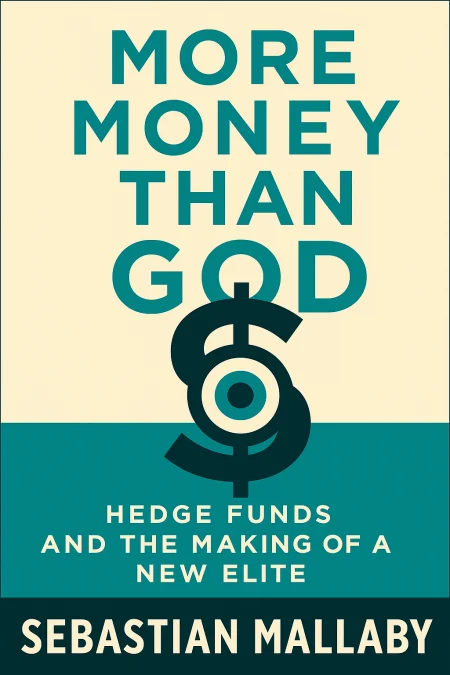
More Money Than God
Hedge Funds and the Making of a New Elite
Book Edition Details
Summary
In the high-stakes arena of finance, where fortunes are made and lost in the blink of an eye, hedge funds stand as enigmatic titans. "More Money Than God" offers an electrifying exposé of this shadowy financial world, peeling back the layers to reveal the audacity and genius of its key players. From the audacious Ken Griffin's dorm room gambles to the relentless ambition of Paul Tudor Jones, these financial wizards defy the odds, challenging the very notion of market predictability. Sebastian Mallaby, armed with unprecedented insider access, crafts a narrative that is as thrilling as it is informative, tracing the evolution of hedge funds from their inception to their formidable influence today. As banks falter and economic storms rage, these survivors endure, hinting at a future where their unconventional strategies might just hold the key to financial stability. Whether you're a finance aficionado or a curious observer, this gripping chronicle promises to reshape your understanding of capitalism's daring frontier.
Introduction
In 1949, a former journalist named Alfred Winslow Jones made a modest investment that would fundamentally reshape global finance. With just $100,000, he launched what would become the world's first hedge fund, introducing a revolutionary concept that combined buying undervalued stocks with selling overvalued ones short. This seemingly simple innovation would eventually spawn an industry managing trillions of dollars and wielding unprecedented influence over world markets, capable of toppling governments and moving currencies with the stroke of a pen. The rise of hedge funds reveals three profound transformations in modern capitalism. First, it demonstrates how financial innovation consistently outpaces regulation, creating both extraordinary opportunities and systemic risks that policymakers struggle to understand. Second, it shows how a small group of brilliant contrarians evolved from Wall Street outsiders into the most powerful force in global finance, challenging traditional banking and investment paradigms. Third, it illustrates the ongoing tension between market efficiency and financial stability, as these sophisticated investors serve as both capitalism's early warning system and its most dangerous destabilizing force. This story speaks directly to investors seeking to understand alternative strategies, policymakers grappling with financial regulation, and anyone curious about how modern markets really operate. The hedge fund revolution offers essential insights into the forces driving today's interconnected global economy, revealing how intellect, technology, and enormous leverage combine to shape our financial future.
Early Pioneers and Market Innovation (1949-1980s)
The hedge fund industry emerged from the intellectual ferment of post-war America, when traditional investment wisdom seemed inadequate for a rapidly changing world. Alfred Winslow Jones, drawing on his eclectic background as a sociologist and journalist, recognized that most investors were trapped in a false choice between being bullish or bearish on the entire market. His breakthrough insight was elegantly simple: separate stock selection skill from market timing by maintaining both long and short positions simultaneously, creating a "hedged" portfolio that could profit regardless of overall market direction. Jones's early success attracted a small circle of disciples who refined and expanded his techniques throughout the 1960s and 1970s. Michael Steinhardt pioneered aggressive block trading strategies, exploiting the information advantages that came from handling large institutional transactions during an era when such data moved slowly through markets. Meanwhile, George Soros began developing his theory of reflexivity, arguing that markets were not self-correcting mechanisms but unstable systems where investor perceptions could become self-fulfilling prophecies, creating boom-bust cycles ripe for exploitation. The intellectual foundation of hedge fund investing rested on a profound insight about market inefficiency that contradicted prevailing academic theory. While economists preached that markets were perfectly efficient, these early practitioners observed daily evidence to the contrary. They discovered that forced sellers created opportunities for patient buyers, that information traveled unevenly through markets, and that human psychology created predictable patterns in price movements that could be systematically exploited. By the 1980s, these pioneering experiments had established hedge funds as a distinct asset class, characterized by absolute return targets, performance-based compensation structures, and freedom from the regulatory constraints that limited traditional money managers. The stage was set for the industry's explosive growth as global markets became increasingly interconnected and volatile, creating vast new opportunities for skilled speculators willing to challenge conventional wisdom.
Global Disruption and Currency Wars (1990s)
The 1990s marked hedge funds' emergence as genuine forces in global finance, capable of challenging governments and central banks with devastating effectiveness. George Soros led this transformation through spectacular currency trades that demonstrated how sophisticated investors could exploit the fundamental contradictions in government policies. His philosophy of reflexivity proved devastatingly effective when applied to foreign exchange markets, where central bank commitments to defend artificial exchange rate pegs created enormous one-way betting opportunities for those brave enough to take them. The decade's defining moment arrived in September 1992, when Soros orchestrated a massive assault on the British pound's membership in the European Exchange Rate Mechanism. Working closely with lieutenant Stanley Druckenmiller, Soros built a ten-billion-dollar short position against sterling, correctly calculating that the Bank of England could not indefinitely defend an overvalued currency given Britain's economic fundamentals and political constraints. When Britain was forced to withdraw from the ERM after spending billions in futile defense, Soros earned over a billion dollars in profits while earning the title "the man who broke the Bank of England." This period also witnessed the rise of Julian Robertson's Tiger Management, which demonstrated that traditional stock-picking skills could generate extraordinary returns when combined with global reach and rigorous fundamental analysis. Robertson's approach differed markedly from macro traders like Soros, focusing instead on identifying exceptional companies trading at reasonable prices across international markets. His success spawned an entire generation of "Tiger Cubs" who would carry his value-oriented methods into the next century, proving that hedge fund advantages extended far beyond currency speculation. The currency wars of the 1990s established hedge funds as a new force in international relations, capable of disciplining governments and forcing policy changes through market pressure. Their willingness to take large, concentrated positions based on deep analytical conviction created a dynamic where small groups of highly skilled investors could wield influence far beyond their nominal capital base, fundamentally altering the balance of power between private markets and sovereign states.
Dot-Com Bubble and Institutional Growth (2000s)
The new millennium brought unprecedented growth to the hedge fund industry, but also revealed the dangers of fighting obvious bubbles and the limits of rational analysis in irrational markets. The dot-com mania created a painful divide between value-oriented managers like Julian Robertson, who refused to participate in obvious speculation, and momentum-driven investors who rode technology stocks to extraordinary heights. Robertson's principled stance against the bubble proved financially disastrous as his assets under management plummeted from $21 billion to under $10 billion, ultimately forcing him to close Tiger Management in March 2000, just days before the bubble began to burst. Long-Term Capital Management's spectacular failure in 1998 had already demonstrated how mathematical sophistication could fail catastrophically when market conditions exceeded historical norms. Despite employing Nobel Prize-winning economists and state-of-the-art risk management systems, LTCM's highly leveraged arbitrage strategies collapsed when Russia's default triggered a global flight to quality that broke correlations across seemingly unrelated markets. The fund's near-collapse required Federal Reserve intervention to prevent systemic financial damage, highlighting the interconnected nature of modern markets and the potential for hedge fund failures to threaten broader stability. Paradoxically, these high-profile failures coincided with massive institutional adoption of hedge fund strategies. University endowments led by David Swensen at Yale pioneered the "endowment model" that treated hedge funds as essential portfolio diversifiers rather than speculative vehicles. This institutional embrace provided hedge funds with more stable, long-term capital while legitimizing the industry in ways that wealthy individual investors never could, transforming hedge funds from boutique partnerships into large-scale institutional platforms. The period's most dramatic success story belonged to John Paulson, whose methodical analysis of the subprime mortgage market led to the greatest trade in hedge fund history. While banks and rating agencies convinced themselves that housing prices could never fall nationwide, Paulson recognized that the mortgage securitization machine had created a massive bubble built on fraudulent lending practices. His patient accumulation of credit default swaps on mortgage securities generated over fifteen billion dollars in profits when the housing market collapsed, demonstrating that careful research and contrarian thinking could still triumph over institutional groupthink.
Financial Crisis and Systemic Impact (2007-2008)
The financial crisis of 2007-2008 represented both hedge funds' finest analytical hour and their greatest operational trial, revealing fundamental differences between their risk management capabilities and those of traditional financial institutions. While major banks loaded up on toxic mortgage securities, constrained by regulatory capital requirements and conflicted by fee-generating businesses, many hedge funds recognized the subprime bubble early and positioned themselves accordingly. Their intellectual freedom, combined with performance-based compensation structures that aligned incentives, generally produced superior investment decisions and risk management practices. However, the post-Lehman Brothers chaos exposed hedge funds' own vulnerabilities to systemic market breakdowns. The collapse of the investment banking model triggered massive deleveraging across the financial system, forcing hedge funds to liquidate positions regardless of fundamental value as prime brokers demanded additional collateral and reduced credit lines. Even sophisticated quantitative strategies found their mathematical models failing as correlations spiked to unprecedented levels, demonstrating that diversification benefits could disappear precisely when they were most needed. The crisis accelerated a fundamental transformation in hedge fund structure and strategy, favoring large, diversified platforms over boutique specialists. Massive multistrategy funds like Citadel proved capable of surviving extreme market conditions through superior risk management systems and diversified funding sources, while many smaller, specialized funds were forced to close despite sound investment processes. This evolution toward institutional scale and complexity began to blur the traditional distinctions between hedge funds and other financial institutions. Unlike banks, investment banks, and insurance companies, hedge funds required no taxpayer bailouts despite suffering significant losses during the crisis. This fundamental difference reflected their partnership structures, where managers typically invested substantial personal wealth alongside client capital, creating powerful incentives for prudent risk management. The industry's resilience during the crisis, combined with its analytical successes in identifying the mortgage bubble, enhanced its reputation and attracted even more institutional capital in the recovery period.
Summary
The hedge fund revolution represents a fundamental shift in how global financial markets operate, transforming capitalism from a world dominated by traditional banks and mutual funds into one where sophisticated alternative investment strategies play an increasingly central role. This evolution reflects the broader development of modern finance toward greater complexity, interconnectedness, and reliance on mathematical models and technological innovation to identify and exploit market inefficiencies. The industry's six-decade history demonstrates that financial markets are far from the efficient, self-regulating systems described in academic textbooks, but rather complex adaptive systems where skilled participants can profit by identifying persistent inefficiencies created by regulatory constraints, institutional limitations, and human psychology. The most successful hedge fund managers combined intellectual rigor with practical market experience, developing intuitive understanding of how political pressures and bureaucratic incentives create systematic mispricing across global markets. For investors, policymakers, and citizens navigating today's financial landscape, the hedge fund story offers three essential lessons. First, maintain healthy skepticism toward conventional wisdom and regulatory promises of safety, as the greatest opportunities and dangers often arise from contrarian analysis of widely accepted assumptions. Second, recognize that superior risk management trumps return generation in determining long-term success, since survival is the prerequisite for compounding wealth over time. Finally, understand that financial innovation will continue creating new opportunities and systemic risks, requiring constant adaptation and learning from both spectacular successes and devastating failures in an ever-evolving global marketplace.
Related Books
Download PDF & EPUB
To save this Black List summary for later, download the free PDF and EPUB. You can print it out, or read offline at your convenience.
By Sebastian Mallaby
