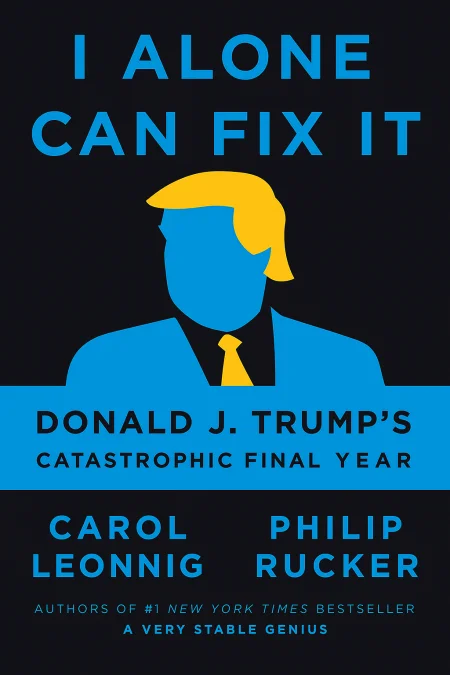
I Alone Can Fix It
Donald J. Trump's Catastrophic Final Year
byPhilip Rucker, Carol Leonnig
Book Edition Details
Summary
Power, chaos, and a nation on the edge collide in this gripping exposé of Donald Trump’s tumultuous final year in office. Pulitzer Prize-winning journalists Phil Rucker and Carol Leonnig unravel the tangled web of a presidency marked by unprecedented challenges and controversial decisions. As the pandemic wreaks havoc and societal unrest simmers, we witness Trump’s desperate maneuvers to maintain control amidst a crumbling administration. With unparalleled access to insiders and eyewitnesses, this book paints a vivid picture of the intricate power struggles and explosive moments that defined 2020. Unmasking the inner workings of a White House in turmoil, it reveals the shocking truths behind decisions that altered the course of American history, culminating in the unforgettable events of January 6. Prepare to be captivated by a narrative that is both a historical document and a thrilling tale of political drama.
Introduction
The year 2020 stands as a watershed moment in American history, when multiple crises converged to test the very foundations of democratic governance. As a deadly pandemic swept across the nation, claiming hundreds of thousands of lives, and protests for racial justice erupted in cities nationwide, the United States found itself confronting challenges that would reveal the true character of its institutions and leaders. At the center of this maelstrom sat a president whose response to crisis would ultimately threaten the peaceful transfer of power that had defined American democracy for over two centuries. This extraordinary period illuminates three fundamental questions that continue to resonate today: How do personal ambitions and political calculations influence crisis management at the highest levels of government? What happens when democratic institutions face sustained pressure from within their own ranks? And perhaps most critically, how do the actions of a single leader ripple through the complex machinery of federal governance to affect millions of lives? The answers to these questions prove invaluable for anyone seeking to understand the delicate balance between executive power and democratic accountability, the role of expertise in policymaking, and the importance of institutional resilience in times of national crisis. For students of history, political leaders, and engaged citizens alike, this account offers essential insights into how democracies survive existential challenges and what lessons we must learn to prevent such crises from recurring.
Pandemic Denial and Institutional Breakdown (January-June 2020)
The opening months of 2020 found President Trump riding high on his Senate impeachment acquittal and strong economic indicators, seemingly positioned for reelection success. Yet even as he celebrated at Mar-a-Lago on New Year's Eve, a mysterious respiratory illness was already spreading in Wuhan, China. The administration's early response to the coronavirus pandemic revealed a fundamental tension between Trump's political instincts and public health imperatives, as career officials like CDC Director Robert Redfield and Dr. Anthony Fauci grew increasingly alarmed while the president remained focused on protecting his trade deal with China and maintaining economic confidence. The period established a dangerous pattern that would define the entire pandemic response: the subordination of scientific expertise to political messaging. When Health Secretary Alex Azar first briefed Trump about the coronavirus on January 18, the president's immediate concerns centered on electoral implications rather than potential human costs. His repeated public assurances that the virus was "totally under control" contradicted the growing alarm among his own health advisers, creating a schism between scientific reality and political narrative that would prove catastrophic. By spring, Trump's frustration with the crisis manifested in increasingly erratic behavior and open hostility toward scientific experts whose credibility often overshadowed his own. The president's obsession with unproven treatments like hydroxychloroquine and his suggestion that Americans might inject disinfectants epitomized the dangerous consequences of rejecting expert guidance. Behind the scenes, a shadow war erupted between political appointees and career scientists over data, messaging, and policy recommendations, as the White House communications team worked to limit media appearances by health officials and ensure their statements aligned with Trump's political narrative. This systematic undermining of scientific expertise reflected a broader authoritarian tendency to subordinate truth to power, treating objective reality as merely another political battlefield. The consequences extended far beyond policy disagreements, fundamentally damaging public trust in scientific institutions and expert knowledge. Trump's rebellion against his own experts not only hampered the pandemic response but established a template for rejecting inconvenient truths that would later manifest in his election denial, setting the stage for even greater challenges to democratic governance.
From Civil Unrest to Electoral Defiance (July-November 2020)
The killing of George Floyd on May 25, 2020, ignited nationwide protests that presented Trump with both a moral leadership test and a political opportunity he would catastrophically mishandle. Rather than seeking to heal racial wounds or address systemic injustices, Trump saw the unrest primarily through the lens of political advantage and personal image management. His demand to deploy active-duty military forces against American citizens met fierce resistance from Defense Secretary Mark Esper and Joint Chiefs Chairman Mark Milley, who understood the profound constitutional implications of such an action and chose institutional integrity over presidential pressure. The clearing of Lafayette Square for Trump's Bible photo opportunity became a defining image of his presidency, encapsulating his tendency to prioritize political theater over genuine leadership. The use of force against peaceful protesters to stage a campaign-style event shocked even some of his own advisers and marked a new low in presidential conduct. This episode exposed the fragility of democratic norms when confronted by a president willing to exploit national trauma for personal gain, while the resistance he encountered from military leaders proved crucial in preventing even greater damage to democratic institutions. As the 2020 election approached, Trump's campaign became a study in dysfunction and desperation. His relentless assault on mail-in voting effectively suppressed turnout among his own supporters, while his debate performances and COVID-19 diagnosis reinforced perceptions of reckless leadership. The campaign's financial mismanagement left Trump's operation nearly broke by late summer, forcing dramatic budget cuts just when resources were most needed. His attacks on popular figures like Anthony Fauci in the final weeks baffled even his most loyal supporters. The final months before the election witnessed an acceleration of the authoritarian tendencies that had characterized Trump's entire presidency. His suggestion that the 2020 election should be delayed, his refusal to commit to accepting the results, and his systematic efforts to undermine confidence in the electoral process represented unprecedented attacks on democratic processes by a sitting president. These actions went far beyond normal political rhetoric, constituting a direct assault on the foundations of American democracy and setting the stage for the constitutional crisis that would follow his electoral defeat.
The Big Lie and Insurrection (December 2020-January 2021)
Following his electoral defeat, Trump's response revealed the dangerous intersection of personal psychology and institutional power as he transformed disappointment into a systematic assault on electoral integrity. Rather than accepting the verdict of voters, the president doubled down on fraud allegations, creating what would become known as the "Big Lie" about a stolen election. This period demonstrated how quickly democratic norms can erode when a leader prioritizes personal grievance over constitutional duty, as Trump's legal team pursued increasingly desperate strategies to overturn legitimate election results. The president's pressure campaign extended beyond the courts to direct intimidation of state officials, most notably his call to Georgia Secretary of State Brad Raffensperger demanding he "find" enough votes to change the outcome. This represented a fundamental violation of democratic principles, as Trump attempted to use his office to coerce state officials into falsifying election results. Attorney General Bill Barr's eventual break with Trump over election fraud claims illustrated the critical role of institutional independence in preserving democracy, as his public statement that the Justice Department had found no evidence of widespread fraud came at significant personal and political cost. January 6, 2021, represented the culmination of Trump's assault on democratic norms, as his refusal to accept electoral defeat transformed into violent insurrection. The events began with Trump's rally near the White House, where he repeated false claims about election fraud and directed supporters to march on the Capitol with words that served as direct incitement: "if you don't fight like hell, you're not going to have a country anymore." The subsequent breach of the Capitol building shocked the world and forced a reckoning with American democracy's vulnerabilities. Vice President Mike Pence emerged as an unlikely defender of constitutional order, refusing Trump's pressure to overturn election results despite personal danger and political cost. His decision to remain in the Capitol and complete the certification process demonstrated how individual conscience can serve as democracy's last line of defense. The successful completion of the peaceful transfer of power on January 20, 2021, marked both an end and a beginning, as American democracy had survived its greatest test since the Civil War while exposing vulnerabilities that would require ongoing vigilance to address.
Summary
Trump's final year in office revealed a fundamental truth about democratic governance: institutions are only as strong as the people who lead them and the norms that constrain their behavior. Throughout 2020, America witnessed what happens when a president prioritizes personal interests over national welfare, treats expertise as a threat rather than a resource, and views democratic processes as obstacles to be overcome rather than principles to be upheld. The convergence of pandemic, economic crisis, racial unrest, and electoral challenges created the perfect storm for testing American democratic resilience, ultimately demonstrating both the system's vulnerabilities and its capacity for survival. The year's events offer crucial lessons for preserving democratic institutions in an era of rising authoritarianism worldwide. The importance of maintaining independent expertise within government cannot be overstated, as Trump's marginalization of scientists and career professionals directly contributed to policy failures that cost lives. The courage of individual officials who chose institutional integrity over personal loyalty proved essential in preventing even greater damage to democratic norms, from military leaders resisting unconstitutional orders to election officials upholding their duties under extreme pressure. Most critically, the episode demonstrates that democratic backsliding often occurs gradually through the accumulation of norm violations rather than dramatic coups, making vigilance and early resistance all the more essential. For citizens and leaders today, Trump's final year serves as both warning and instruction manual for protecting democracy. It shows how quickly authoritarian tactics can take root in established democracies, how personal character in leadership positions affects entire nations, and why the defense of democratic institutions requires active participation from both officials and ordinary citizens. The ultimate lesson may be that democracy's survival depends not on perfect leaders or flawless institutions, but on enough people choosing principle over convenience when the stakes are highest, and on maintaining the sacred understanding that power derives from the consent of the governed, not the will of the powerful.
Related Books
Download PDF & EPUB
To save this Black List summary for later, download the free PDF and EPUB. You can print it out, or read offline at your convenience.
By Philip Rucker
