
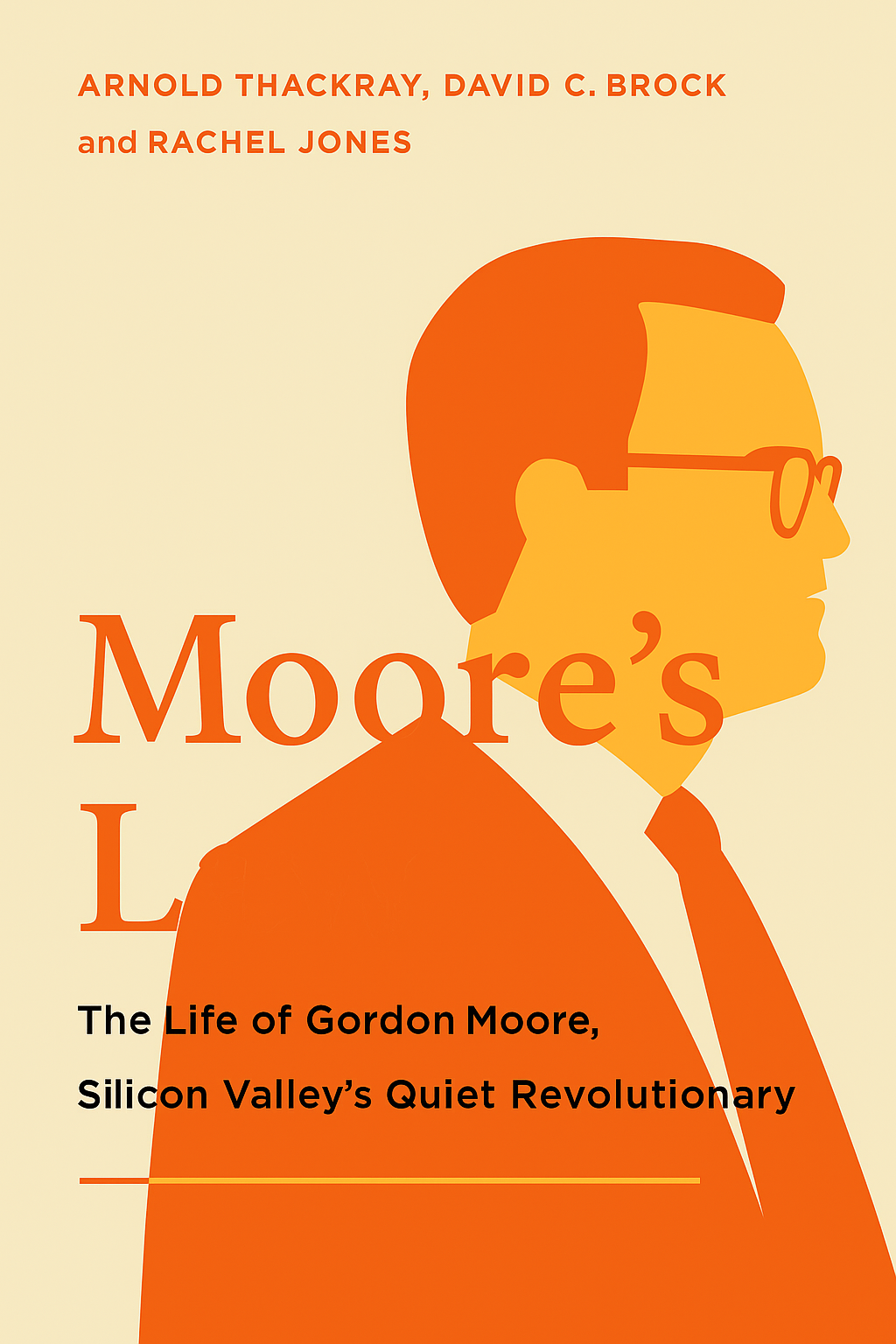
Moore’s Law
The Life of Gordon Moore, Silicon Valley’s Quiet Revolutionary
byArnold Thackray, David C. Brock, Rachel Jones
Book Edition Details
Summary
In the quiet corners of innovation, one man dared to redefine reality. Gordon Moore, a visionary chemist turned trailblazer, foresaw a world revolutionized by silicon transistors—tiny marvels that would transform cumbersome machines into sleek, omnipresent powerhouses. "Moore's Law" chronicles the rise of this humble genius, whose insights into doubling microchip power ignited a technological renaissance. From the bustling labs of Fairchild Semiconductor to the pioneering corridors of Intel, Moore's relentless pursuit of progress sculpted the modern digital landscape, touching everything from the depths of cyberspace to the reaches of outer space. With unparalleled access to Moore and his legacy, this compelling narrative captures the essence of a revolution that reshaped not just industries, but human destiny itself.
Introduction
On a cold February evening in 1956, a phone call would change the world. Gordon Moore, a young chemist working at a government lab in Maryland, answered to hear the confident voice of William Shockley, the Nobel Prize-winning inventor of the transistor. That call would set in motion a chain of events that would transform a sleepy agricultural valley in California into Silicon Valley, the epicenter of the digital revolution. Moore's journey from a small coastal town to becoming one of the most influential figures in modern technology reveals the power of quiet determination, scientific curiosity, and visionary thinking. Moore's story illuminates three profound aspects of innovation and leadership. First, his relentless pursuit of scientific understanding, beginning with childhood experiments with explosives and culminating in groundbreaking work with semiconductors, demonstrates how deep technical expertise becomes the foundation for revolutionary change. Second, his ability to see patterns and predict the future of technology, crystallized in the famous Moore's Law, shows how careful observation and analysis can guide entire industries. Finally, his approach to building companies and fostering innovation reveals how quiet, methodical leadership can be more powerful than charismatic showmanship in creating lasting change.
From Chemistry Set to Silicon Valley Pioneer
Gordon Moore's path to technological greatness began in the fog-shrouded coastal town of Pescadero, California, where he was born in 1929 to a family of practical pioneers. His great-great-grandfather had crossed the American continent by wagon train in 1847, embodying the restless spirit that would later drive Gordon to explore new frontiers in technology. Growing up in a family where his father served as the local sheriff and his grandfather ran the town's general store, Gordon learned early the values of hard work, integrity, and community service that would guide him throughout his career. The spark that ignited Moore's lifelong passion came at age eleven when his neighbor received a chemistry set for Christmas. Unlike other children who might have quickly lost interest, Gordon was captivated by the dramatic transformations he could create through careful experimentation. He built his own laboratory in the family garage, complete with a concrete floor he poured himself, and began purchasing increasingly sophisticated chemicals and equipment with money earned from summer jobs. His experiments with explosives and pyrotechnics were so impressive that his father, despite being a law enforcement officer, allowed him to continue, recognizing his son's genuine scientific curiosity. This early immersion in hands-on experimentation taught Moore crucial lessons about the relationship between theory and practice. He learned that real understanding came not from reading about chemical reactions but from carefully controlling conditions, measuring results, and analyzing outcomes. These skills would prove invaluable when he later tackled the complex chemistry of semiconductor manufacturing. His methodical approach to problem-solving, combined with an intuitive understanding of how to make things work in the real world, set him apart from purely theoretical scientists. The transition from small-town experimenter to world-class scientist required Moore to venture far beyond his comfortable origins. His journey through San Jose State College, UC Berkeley, and finally Caltech for his PhD in chemistry represented a steady progression toward the frontiers of scientific knowledge. At each institution, he sought out the most challenging courses and most demanding professors, driven by an inner conviction that excellence required pushing beyond comfortable boundaries. This willingness to embrace difficulty and uncertainty would become a defining characteristic of his approach to both science and business.
The Birth of Moore's Law and Intel's Rise
Moore's entry into the semiconductor industry came through that fateful phone call from William Shockley, who was assembling a team of brilliant young scientists to commercialize the silicon transistor. Despite having no background in semiconductors, Moore recognized the opportunity to apply his chemical expertise to a technology that could transform electronics. His decision to join Shockley's startup in Mountain View, California, represented a leap of faith that would reshape his career and, ultimately, the world. Working at Shockley Semiconductor Laboratory, Moore quickly mastered the complex chemistry of silicon processing, building the furnaces and gas-handling systems needed to create transistors through chemical diffusion. However, Shockley's erratic management style and increasingly paranoid behavior created an untenable working environment. When eight of the company's key scientists, including Moore, decided to leave and start their own company, they were branded the "Traitorous Eight" by their former boss. This act of rebellion, led partly by Moore's quiet determination, established the template for Silicon Valley's culture of entrepreneurial risk-taking and talent mobility. The founding of Fairchild Semiconductor in 1957 marked Moore's transformation from scientist to entrepreneur. As the company's research director, he oversaw the development of the planar process, a revolutionary manufacturing technique that made it possible to produce transistors reliably and economically. More importantly, Moore began to see patterns in the rapid improvement of semiconductor technology that others missed. He noticed that the number of transistors that could be placed on a computer chip was doubling approximately every year, while the cost of computing power was falling at an equally dramatic rate. In 1965, Moore published his observations in an article for Electronics magazine, predicting that this trend would continue for at least ten years. This prediction, which became known as Moore's Law, was far more than a technical forecast. It was a roadmap for the entire semiconductor industry, providing a target for engineers and a promise to customers about the future capabilities of electronic devices. Moore's Law became a self-fulfilling prophecy, driving innovation and investment decisions across the technology sector and enabling the digital revolution that would transform every aspect of human life.
Building the Digital Revolution Through Transistors
Moore's vision of the future extended far beyond the technical specifications of semiconductor devices to encompass a fundamental transformation of human society. In 1968, he co-founded Intel Corporation with Robert Noyce, creating a company specifically designed to push the boundaries of semiconductor technology and explore its applications. As Intel's longest-serving CEO, Moore guided the company through the development of memory chips, microprocessors, and the personal computer revolution, always keeping his eye on the long-term trajectory of technological progress. The development of the microprocessor at Intel in the early 1970s represented the culmination of Moore's vision of putting ever more computing power into smaller and smaller packages. These "computers on a chip" made possible everything from personal computers to smartphones to the internet, fundamentally changing how humans work, communicate, and understand the world. Moore recognized that the microprocessor was not just a more efficient way to build computers but a completely new category of technology that would enable applications no one had yet imagined. Throughout this period, Moore continued to refine and update his famous law, adjusting the timeline from annual doubling to doubling every eighteen months as the challenges of semiconductor manufacturing became more complex. His ability to maintain this prediction over decades required not just technical insight but also the management skills to coordinate the efforts of thousands of engineers and billions of dollars in research and development spending. Moore's Law became the organizing principle for an entire industry, driving the coordinated development of materials science, manufacturing equipment, and design tools. Moore's approach to innovation emphasized the importance of sustained, methodical progress over dramatic breakthroughs. He understood that the digital revolution would be built not through a single genius insight but through the accumulated efforts of many talented people working together over many years. His leadership style, characterized by quiet competence rather than charismatic vision, proved ideally suited to managing the complex, long-term projects required to advance semiconductor technology. By focusing on measurable progress and practical results, Moore created a culture of innovation that could sustain itself across multiple generations of technology.
Legacy of the Semiconductor Industry's Architect
As Moore transitioned from active leadership of Intel to the role of industry elder statesman, his influence on the technology sector continued to grow. Moore's Law had become more than a technical prediction; it was a fundamental assumption underlying the entire digital economy. Every technology company, from software developers to telecommunications providers, built their business plans around the expectation that computing power would continue to become faster, smaller, and cheaper at a predictable rate. Moore's later years were marked by his recognition that Moore's Law could not continue forever. As transistors approached the size of individual atoms, the physical limits of silicon-based technology became apparent. However, rather than viewing this as a failure, Moore saw it as a natural transition to new forms of innovation. His willingness to acknowledge the eventual end of his own law demonstrated the intellectual honesty and scientific rigor that had characterized his entire career. Beyond his technical contributions, Moore's approach to philanthropy reflected the same methodical, results-oriented thinking that had made him successful in business. Through the Gordon and Betty Moore Foundation, he applied rigorous analysis to identify the most effective ways to support scientific research, environmental conservation, and patient care. His insistence on measurable outcomes and evidence-based giving helped establish new standards for philanthropic effectiveness. Moore's legacy extends far beyond the specific technologies he helped create to encompass a way of thinking about innovation and progress. His career demonstrated that the most profound changes often come not from dramatic disruptions but from the patient, sustained effort to make things work better. His combination of technical expertise, business acumen, and ethical leadership provided a model for how scientists and engineers could take responsibility for the broader implications of their work.
Summary
Gordon Moore's life exemplifies how quiet determination and methodical thinking can reshape the world more profoundly than dramatic gestures or charismatic leadership. His journey from a small-town chemistry enthusiast to the architect of the digital age demonstrates that true innovation requires not just brilliant insights but also the patience and persistence to turn those insights into practical reality. Moore's Law became one of the most important organizing principles of the modern economy precisely because it was grounded in careful observation, rigorous analysis, and a deep understanding of both the possibilities and limitations of technology. The lessons from Moore's career remain relevant for anyone seeking to create lasting change in any field. His emphasis on measurable progress, his willingness to take calculated risks, and his ability to maintain focus on long-term goals while adapting to changing circumstances provide a blueprint for effective leadership in an uncertain world. For students of technology, business leaders, and anyone interested in how innovation actually happens, Moore's story offers invaluable insights into the patient work of building the future.
Related Books
Download PDF & EPUB
To save this Black List summary for later, download the free PDF and EPUB. You can print it out, or read offline at your convenience.
By Arnold Thackray
