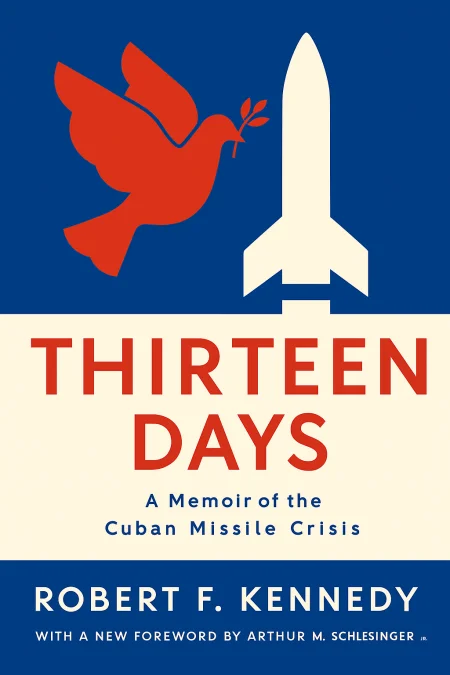
Thirteen Days
A Memoir Of The Cuban Missile Crisis
byRobert F. Kennedy, Arthur M. Schlesinger Jr.
Book Edition Details
Summary
In October 1962, the world stood teetering on the edge of nuclear devastation, a perilous dance of diplomacy and power captured vividly in Robert F. Kennedy's compelling narrative. "Thirteen Days" immerses readers in the Cuban Missile Crisis, unraveling the intricate web of tense negotiations and strategic gambits that defined this critical moment in history. Through the eyes of Kennedy himself, the drama unfolds with an intimacy and urgency rarely afforded to such epochal events. This insider’s account grants unprecedented access to the machinations of political titans, with particular focus on President John F. Kennedy's pivotal role. Enhanced by Arthur Schlesinger, Jr.'s insightful foreword, this book not only chronicles those fateful days but also sheds light on newly revealed Soviet perspectives, ensuring its place as an enduring testament to the fragility and resilience of global peace.
Introduction
In October 1962, the world teetered on the precipice of nuclear annihilation. For thirteen extraordinary days, the fate of humanity rested in the hands of a small group of men gathered in the White House Cabinet Room, making decisions that would determine whether civilization would survive or perish in atomic fire. This crisis represents the closest mankind has ever come to destroying itself, when two superpowers armed with weapons of unprecedented destructive power engaged in a deadly game of nuclear chess. The events of those thirteen days reveal profound truths about leadership under unimaginable pressure, the razor-thin line between prudent restraint and dangerous weakness, and the terrifying reality that rational human beings could find themselves contemplating the destruction of millions of lives. Through the intimate perspective of someone who sat at the very heart of these deliberations, we witness how great decisions are truly made when the stakes could not be higher. This account offers invaluable insights for anyone seeking to understand how power operates at its highest levels, how crises unfold in the nuclear age, and what qualities of leadership and judgment become essential when facing the ultimate test of human survival.
Discovery and Initial Response (October 16-22, 1962)
On the morning of October 16, 1962, President Kennedy learned that Soviet offensive missiles had been secretly deployed in Cuba. The discovery shattered a carefully constructed web of diplomatic assurances and thrust the world toward nuclear confrontation. For Kennedy, this represented not merely a strategic challenge but a profound personal betrayal. Khrushchev had given explicit guarantees that no offensive weapons would be placed in Cuba, even as Soviet ships were already delivering the very missiles he had promised would never arrive. The initial shock gave way to intense deliberation as Kennedy assembled what would become known as the Executive Committee of the National Security Council. These men, representing the highest levels of American government, faced a choice that would define the nuclear age. The military leadership advocated for immediate surgical air strikes, arguing that delay would only allow the missiles to become operational. Others pushed for invasion, viewing this as an opportunity to eliminate the Communist presence in Cuba entirely. Yet Kennedy and his closest advisors recognized that the obvious military solutions carried catastrophic risks. "I now know how Tojo felt when he was planning Pearl Harbor," Robert Kennedy scribbled in a note during those first meetings. The parallel was deeply troubling, the idea that America might launch a surprise attack that would forever change how the world viewed the United States. The week-long secret deliberations that followed represented democracy at its most intense and consequential. Unlike the hasty decision-making that had characterized the Bay of Pigs disaster, Kennedy insisted on exhaustive analysis of every option. The discussions revealed the fundamental dilemma of nuclear statecraft: how to respond with enough force to be credible, yet with enough restraint to avoid triggering the very catastrophe one seeks to prevent.
Confrontation and Naval Quarantine (October 23-26)
Kennedy's announcement of the naval quarantine on October 22 marked the public beginning of the most dangerous crisis in human history. Rather than launching immediate military strikes, the President chose a middle path that would apply pressure while leaving room for diplomatic resolution. The quarantine represented a deliberate escalation that stopped short of direct military action, giving Khrushchev time to consider his response while demonstrating American resolve. The next four days tested the nerves of both superpowers as Soviet ships approached the quarantine line. In the Caribbean, American naval forces took positions to intercept Soviet vessels, while strategic nuclear forces on both sides went to maximum alert status. The world watched anxiously as two nuclear giants engaged in their deadly chess match, each move carrying the potential to trigger global destruction. The tension reached its peak on October 24 when reports indicated that Soviet ships were continuing toward Cuba, potentially forcing a direct confrontation at sea. Then came the moment that defined the crisis: Soviet ships stopped dead in the water just short of the quarantine line. As Secretary of State Dean Rusk would later observe, "We're eyeball to eyeball, and I think the other fellow just blinked." The immediate danger of naval confrontation had passed, but the missiles already in Cuba continued their rapid assembly. These critical days demonstrated both the possibilities and limitations of graduated pressure in nuclear confrontation. While the quarantine successfully prevented additional weapons from reaching Cuba, it did nothing to address the missiles already operational on the island. Kennedy found himself caught between domestic political pressure demanding stronger action and the terrifying knowledge that each escalatory step brought the world closer to nuclear war.
Nuclear Brinkmanship and Diplomatic Resolution (October 27-28)
The final weekend of the crisis brought humanity to the very edge of nuclear war. On Saturday, October 27, Major Rudolf Anderson's U-2 spy plane was shot down over Cuba, killing the pilot and creating intense pressure for military retaliation. The Joint Chiefs of Staff unanimously recommended immediate air strikes, arguing that American pilots could no longer be sent over Cuba without eliminating the Soviet surface-to-air missile sites. The complexity of the crisis deepened with Khrushchev's contradictory communications. His emotional Friday evening letter suggested a possible resolution based on non-invasion pledges, but his formal Saturday message demanded a missile trade between Cuba and Turkey. Kennedy faced the agonizing choice between accepting terms that might appear as weakness or risking nuclear war over obsolete missiles that he had already wanted removed. The resolution came through a masterful combination of public diplomacy and private negotiation. Kennedy publicly accepted Khrushchev's initial proposal while privately assuring the Soviets that Turkish missiles would be removed after the crisis ended. This dual-track approach allowed both leaders to claim success while avoiding the humiliation that might have made compromise impossible. Sunday morning brought Khrushchev's announcement that Soviet missiles would be withdrawn from Cuba, ending the immediate crisis. The relief was palpable, but it came with the sobering recognition of how close civilization had come to destruction. Both leaders had demonstrated that even in the nuclear age, rational statecraft could prevail over the momentum toward war, but only through extraordinary courage, restraint, and wisdom.
Lessons in Crisis Management and Presidential Decision-Making
The Cuban Missile Crisis established enduring principles for leadership in the nuclear age. Kennedy's management of the crisis revealed the critical importance of maintaining multiple options while resisting pressure for premature action. The President consistently rejected advice to eliminate diplomatic alternatives through military action, understanding that preserving flexibility was essential when dealing with an opponent who possessed the power to destroy American civilization. The crisis demonstrated the vital role of perspective and empathy in nuclear diplomacy. Throughout the thirteen days, Kennedy repeatedly asked his advisors to consider how their actions would appear to Khrushchev and the Soviet leadership. This wasn't weakness but wisdom, recognizing that successful crisis resolution required giving one's opponent a face-saving way to retreat from dangerous positions. Perhaps most importantly, the crisis revealed the awesome responsibility that rests with leaders in the nuclear age. As Robert Kennedy later reflected, the weight of potentially condemning millions of innocent people to death for decisions they had no part in making posed profound moral questions about the exercise of power. The young people of both nations, who had no voice in the confrontation but whose lives hung in the balance, represented the ultimate stakes of nuclear brinkmanship. The successful resolution established what would become known as the "rules of the nuclear game," informal understandings about crisis behavior that helped both superpowers avoid direct confrontation for the remainder of the Cold War. These lessons about restraint, communication, and the careful management of escalation remain relevant wherever nuclear weapons cast their shadow over international relations.
Summary
The Cuban Missile Crisis stands as history's ultimate test of human wisdom in the face of unprecedented destructive power. The central tension that defined those thirteen days was the collision between traditional concepts of national security and the revolutionary implications of nuclear weapons, where victory and defeat had lost their meaning in the face of mutual annihilation. The crisis offers three enduring lessons for our time. First, the importance of principled restraint in the exercise of power, recognizing that true strength sometimes requires rejecting options that might appear decisive but carry catastrophic risks. Second, the vital role of empathy and perspective-taking in resolving conflicts, understanding that successful diplomacy requires seeing through an opponent's eyes without abandoning one's own interests. Finally, the crisis reveals how individual character and judgment become magnified in moments of ultimate crisis, when the normal constraints and processes of government collapse under the weight of unprecedented decisions. These insights remain painfully relevant in an era when nuclear weapons continue to proliferate and new forms of catastrophic risk emerge from technology and climate change. The Cuban Missile Crisis reminds us that human survival ultimately depends not on perfect systems or foolproof strategies, but on the wisdom, courage, and moral imagination of fallible human beings facing choices that could determine the fate of civilization itself.
Related Books
Download PDF & EPUB
To save this Black List summary for later, download the free PDF and EPUB. You can print it out, or read offline at your convenience.
By Robert F. Kennedy
